Reptiles transformed by life at sea
Prehistoric marine reptiles were air-breathing vertebrates that entered the oceans and evolved bodies suited to swimming, feeding, and reproducing in water. They were not one family, and most were not dinosaurs. Ichthyosaurs had streamlined profiles and powerful tails; plesiosaurs propelled themselves with four flippers; mosasaurs were giant marine lizards; specialized crocodile relatives hunted offshore; and sea turtles carried a familiar shell plan into ancient seas. These animals appeared in different branches of the reptile family tree and at different moments in the Mesozoic Era. A beginner can understand them by asking three questions: how did each group move, how did it breathe and reproduce, and which features reveal its ancestry despite an ocean-shaped body?
A: No. They surfaced and filled lungs with air.
A: The classic ichthyosaurs, plesiosaurs, and mosasaurs were not dinosaurs.
A: Later ichthyosaurs independently evolved the closest overall outline.
A: Their four flippers acted as coordinated underwater wings.
A: Mosasaurs belong within squamates, the lizard-and-snake branch.
A: No. Evidence varies by lineage, and turtles remained egg layers.
A: Large eyes improved light gathering in dim water or at depth.
A: They required physiological salt balance, probably including specialized glands in some groups.
A: Some overlapped, but their ranges differed greatly through the Mesozoic.
A: The end-Cretaceous impact crisis eliminated mosasaurs and plesiosaurs.
Marine reptile is an ecological description
The phrase marine reptile describes habitat, not a single taxonomic group. It gathers unrelated reptiles that spent much or nearly all of their lives in salt water. Some lineages became fully pelagic and could not walk on land. Others foraged at sea but retained the ability to crawl ashore, nest, or rest. Their shared features arose through convergent evolution: similar environmental demands repeatedly favored flippers, streamlined outlines, salt management, and changes to breathing.
That distinction prevents a common mistake. A mosasaur, an ichthyosaur, and a plesiosaur did not form a natural trio in the way cats, dogs, and bears all belong within Carnivora. Their last common ancestor lacked their specialized marine bodies. Each lineage carried a different inherited skeleton into the ocean, so similar-looking solutions were assembled from different starting parts.
Why they were not sea dinosaurs
Dinosaurs belong to a particular land-vertebrate branch defined by skeletal relationships, especially features of the hips, limbs, and ankles. Plesiosaurs and ichthyosaurs lie outside Dinosauria, while mosasaurs belong among squamate reptiles, the broader group containing lizards and snakes. Calling every large Mesozoic reptile a dinosaur erases those relationships. It also hides one of evolution’s most interesting patterns: several reptile groups invaded the sea independently while true dinosaurs remained overwhelmingly terrestrial. Birds are living dinosaurs, and some extinct birds became capable marine swimmers. Penguins and hesperornithiform birds therefore represent marine dinosaurs in a strict evolutionary sense. They are still not what paleontologists usually mean by the classic Mesozoic marine reptiles. Context determines whether a display is discussing habitat broadly or the famous non-dinosaur groups.
Ichthyosaurs resembled fast-swimming fish
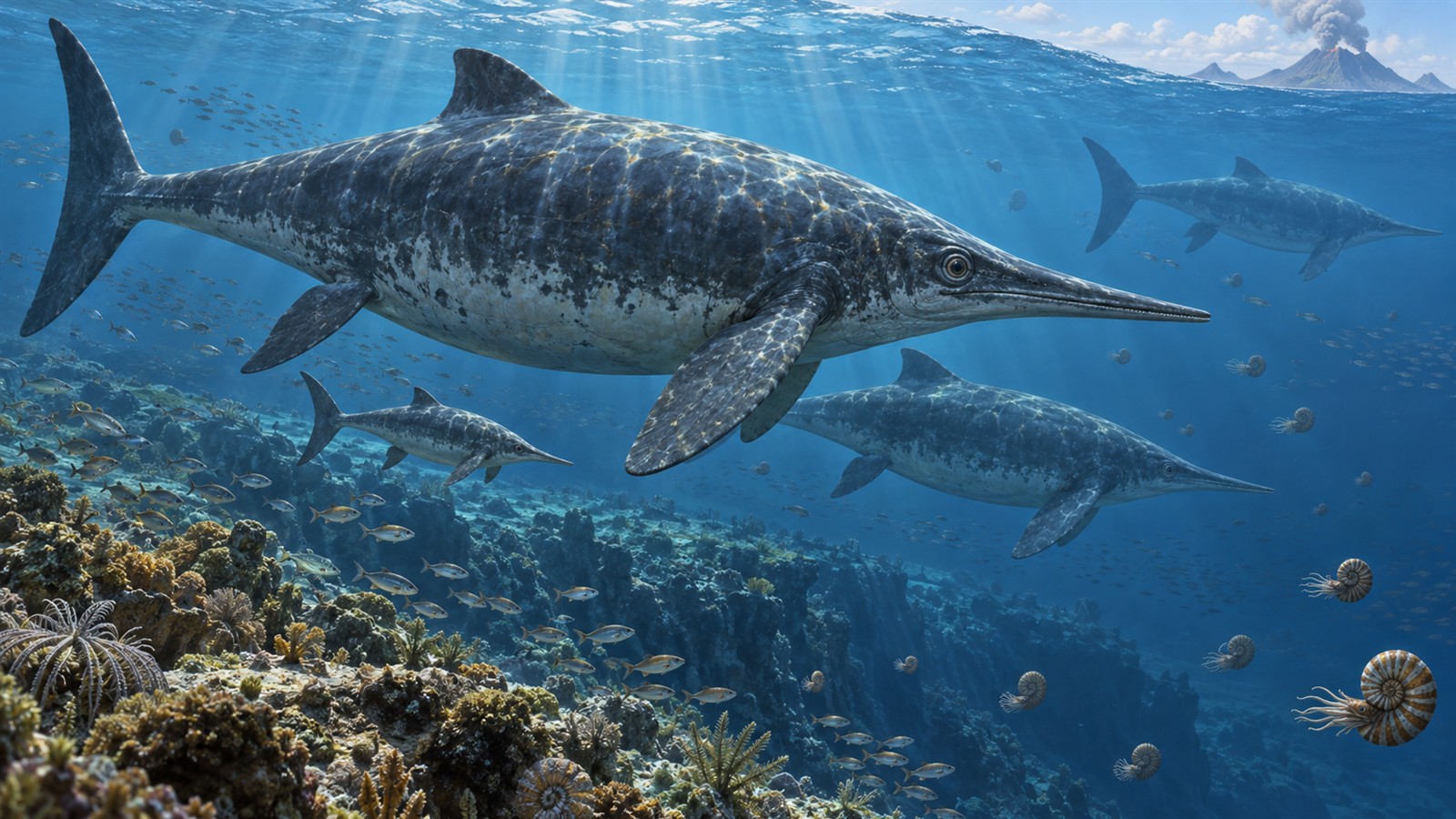
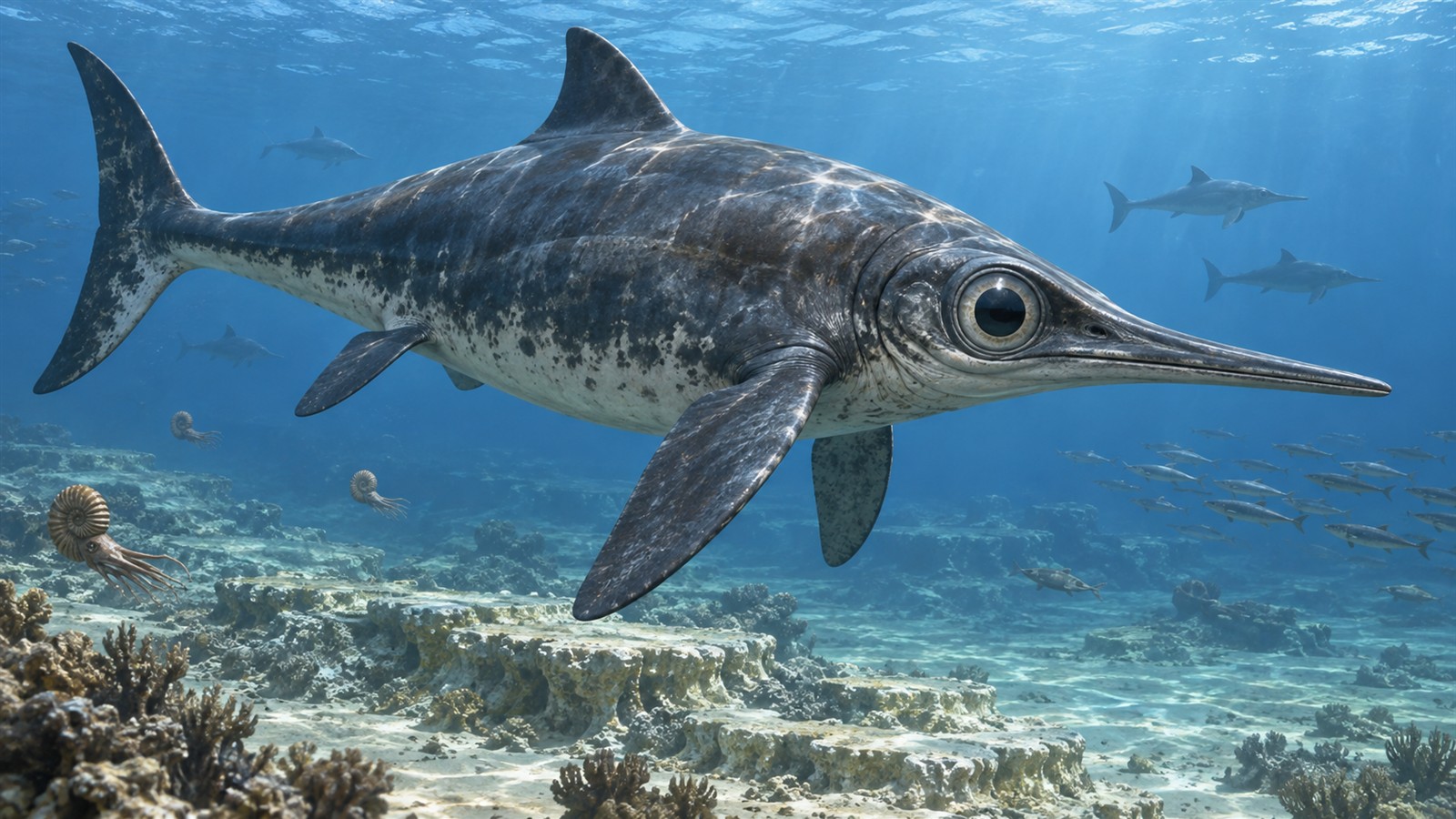
Ichthyosaurs first appeared early in the Triassic and diversified into forms ranging from eel-like coastal swimmers to deep-bodied open-ocean cruisers. Later species developed a fish-shaped profile with a pointed snout, dorsal fin, paired flippers, and a vertical crescent tail. The resemblance to tuna and dolphins is convergence, not close kinship. A downward bend in the vertebral column supported the lower part of the tail fin, an arrangement revealed by rare body outlines.
Many ichthyosaurs had enormous eyes reinforced by rings of small bones called sclerotic ossicles. Large eyes could improve vision in dim water, during deep dives, or at low-light hours. Conical teeth suited grasping slippery prey, although tooth shape and jaw build varied. Some giant Triassic species probably pursued larger prey or used different feeding strategies than the compact Jurassic animals commonly illustrated.
Fossils of pregnant individuals show that ichthyosaurs gave birth to live young. They did not need to haul onto a beach to lay eggs, and their paddle-like limbs would have made land travel extremely difficult. Embryos preserved inside the body provide direct evidence that their reproductive cycle had become fully marine.
Plesiosaurs flew underwater with four flippers
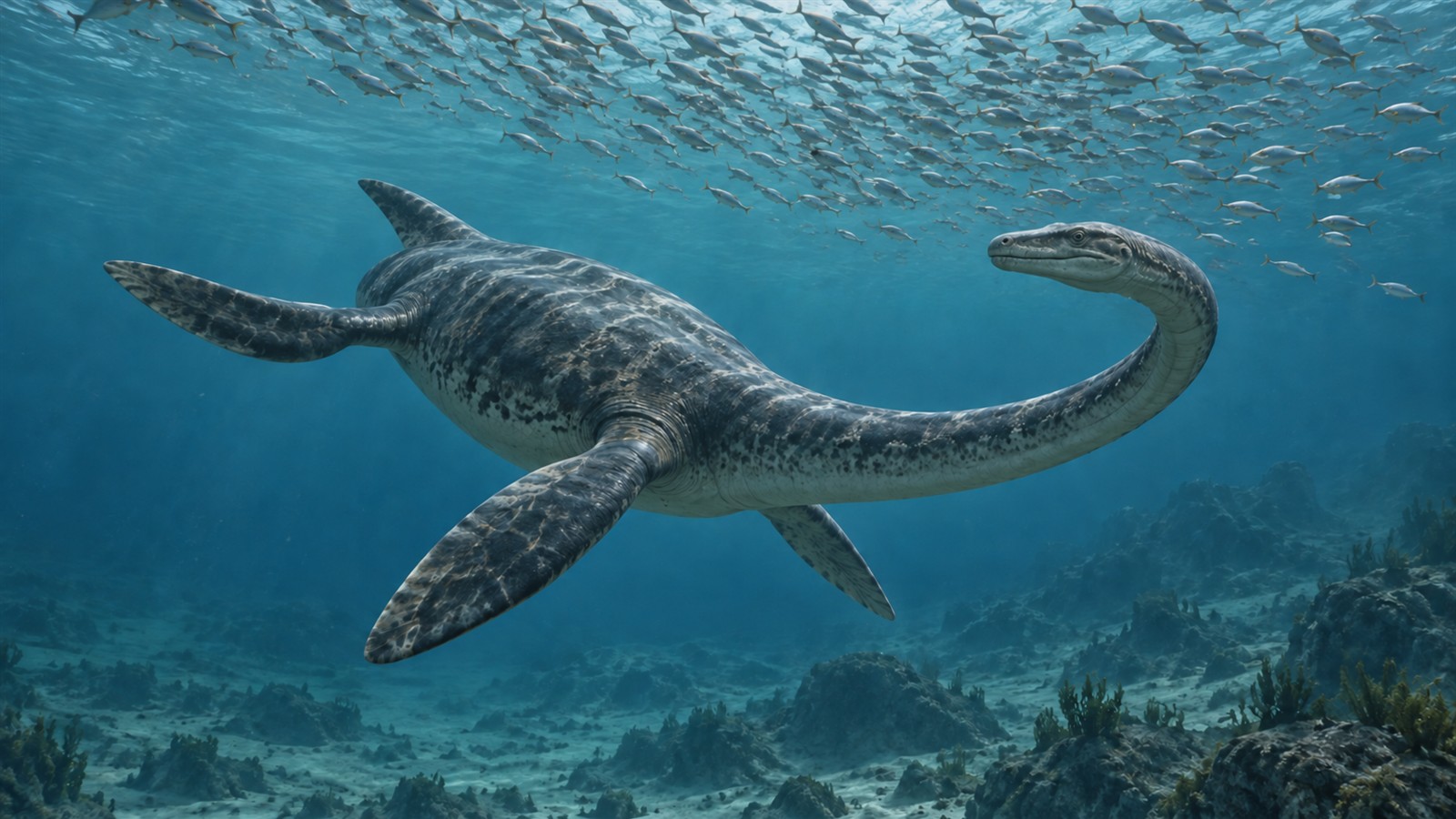
Plesiosaurs had broad trunks, short tails, and two pairs of large hydrofoil-shaped limbs. Computer models, joint anatomy, and comparison with living swimmers indicate that both front and rear flippers contributed to propulsion. Their motion is often compared with underwater flight, although no living animal uses the same four-flipper system in exactly the same way. Coordinating the limbs could supply thrust while preserving control during turns and changes in depth.
Two familiar body plans developed within Plesiosauria. Long-necked plesiosauroids often had relatively small heads, while many pliosaurids carried huge skulls on short, powerful necks. This contrast is useful for beginners but not an absolute rule for every species. Neck length, tooth form, jaw strength, and body size varied across more than one hundred million years of evolution.
A long neck was not a flexible fishing pole
Long-necked plesiosaurs possessed many cervical vertebrae, yet their necks were not endlessly flexible. Joint surfaces, ribs, and surrounding muscles limited sharp bends. The neck likely helped position the head away from the turbulence and bulk of the torso, perhaps during quiet approaches to fish or bottom-associated prey. Different species may have used different depth zones and feeding movements. Gastroliths, or swallowed stones, occur with some plesiosaur skeletons. They may have aided digestion, ballast, or both, but a pile of stones does not prove one universal function. Stomach contents and tooth wear provide firmer clues to diet. Fossils include fish remains, cephalopod hooks, and other prey traces, demonstrating that the group was ecologically varied.
Mosasaurs were ocean-going lizards
Mosasaurs rose during the Late Cretaceous, after ichthyosaurs had disappeared and while plesiosaurs still occupied the seas. Their closest relationships lie within squamates. Early members retained more land-capable proportions, while later forms developed flipper-like limbs, deep tails, streamlined bodies, and skulls built to seize marine prey. Preserved skin outlines support a two-lobed tail fin in advanced mosasaurs rather than the old image of a simple sea-snake tail.
Flexible skull joints helped mosasaurs handle prey, but popular claims that they unhinged their jaws like a mechanical trap are misleading. Their jaws remained connected by ligaments and muscles. Tooth marks, stomach contents, and damaged shells show diets that could include fish, ammonites, turtles, birds, sharks, and other marine reptiles. Species differed in tooth shape, so a blunt crushing set suggests a different menu from narrow piercing teeth.
Mosasaur fossils containing embryos and very young individuals support live birth at sea. Their rapid diversification produced predators from a few meters long to some of the largest hunters in Cretaceous oceans. Size estimates remain sensitive to how complete the vertebral column is and which relative supplies missing proportions.
Other reptiles also crossed the shoreline
Thalattosaurs, pachypleurosaurs, nothosaurs, placodonts, and tanystropheids occupied Triassic coasts and seas. Placodonts included broad, armored shell crushers with flattened teeth, while nothosaurs combined webbed or paddle-like limbs with bodies still capable of coming ashore. These animals document experimentation early in the Mesozoic recovery after the end-Permian mass extinction. They also show that fully open-ocean life was only one possible marine adaptation.
Marine crocodylomorphs entered the water in several forms. Jurassic and Early Cretaceous metriorhynchids transformed most dramatically, losing heavy back armor, developing flippers, and growing tail fins. Their skulls and teeth range from narrow fish-catching designs to robust arrangements suited to larger prey. Because they descended from crocodile-line archosaurs, their route into the sea differed from every group above.
Sea turtles followed a durable plan
Turtles were present in Mesozoic oceans, and giant Late Cretaceous forms such as Archelon demonstrate that the lineage could reach enormous sizes. Marine turtles retained a shell, beak, and a body plan linked to living sea turtles, but extinct species were not simply oversized versions of modern ones. Shell construction, limb proportions, and feeding anatomy varied. Unlike fully pelagic ichthyosaurs, living sea turtles must return to land to lay eggs, and fossil evidence does not justify assuming live birth for their extinct marine relatives.
Air breathing shaped every dive
No classic marine reptile had gills. Each surfaced to inhale with lungs and stored oxygen in blood, muscles, and respiratory spaces. Streamlining reduced the cost of travel between breaths. Large body size may have increased oxygen capacity and slowed heat loss, while circulation and metabolism determined practical dive duration. Scientists estimate diving ability from anatomy and living analogues, but a precise stopwatch value cannot be read from bone.
Breathing also affected birth. Live-bearing groups could remain offshore throughout reproduction, whereas egg layers needed land or a very different reproductive solution. Fossils of embryos are therefore unusually important. They reveal not only family life but the degree to which a lineage had severed its physical dependence on shore.
Temperature and salt created hidden challenges
Seawater draws water from tissues and adds excess salt through swallowed prey and water. Marine reptiles needed physiological methods to maintain balance. Living sea turtles and marine iguanas use specialized salt glands, and grooves or spaces in fossil skulls may suggest comparable structures. Soft glands rarely fossilize, so their exact placement and efficiency can remain uncertain. Body temperature is equally difficult to reconstruct. Isotopes in teeth and bone, growth rates, body size, and geographic range can indicate that some marine reptiles maintained temperatures above surrounding water. That does not make them mammals. Several combinations of metabolism, insulation, activity, and heat retention can produce elevated temperatures, and different lineages need not have used the same strategy.
Fossils record food webs and injuries
Stomach contents provide a direct but narrow snapshot of a final meal. Coprolites can retain scales, bone fragments, or cephalopod hard parts. Bite marks identify interactions only when tooth spacing and healing support the match. A healed wound records survival, while an unhealed mark may reflect predation, scavenging, or damage around death. Several clues together build a stronger ecological case than one dramatic puncture.
Marine sediments can preserve articulated skeletons when a carcass sinks into low-oxygen water and escapes scavengers. Currents may scatter a body, and pressure flattens three-dimensional bones. Geological context tells whether the animal lived in a shallow shelf, inland seaway, coastal lagoon, or deep basin. The same species may enter several deposits through travel or carcass drift, so burial place and daily habitat are related but not identical.
Mass extinctions repeatedly reset the seas
The end-Triassic extinction removed some early marine reptile lineages while plesiosaurs and ichthyosaurs continued into the Jurassic. Ichthyosaurs vanished during the early Late Cretaceous for reasons still investigated through climate, prey change, sea-level shifts, and diversity patterns. At the end of the Cretaceous, the asteroid impact and its environmental aftermath eliminated mosasaurs and plesiosaurs along with non-avian dinosaurs. Sea turtles survived through the boundary, though their communities changed. These turnovers warn against picturing one timeless prehistoric ocean. A Triassic coast with nothosaurs and placodonts belonged to a different world from a Jurassic sea patrolled by pliosaurs or a Cretaceous seaway dominated by mosasaurs. Rock age is therefore as important as body shape when identifying an animal’s possible neighbors.
How to read a marine reptile reconstruction
Start with the skeleton. A vertical tail fluke, four nearly equal propulsion flippers, or a shell should correspond to preserved anatomy and close relatives. Next inspect the setting: animals from different periods should not be mixed without explanation. Finally separate direct evidence from informed restoration. Skin texture, color, fat contours, and behavior are often plausible choices rather than fossil facts. A responsible image can still be vivid while leaving uncertain details modest.
The most useful beginner’s habit is to name the group before guessing the species. A fish-shaped ichthyosaur, four-flippered plesiosaur, lizard-bodied mosasaur, shell-bearing turtle, and marine crocodile relative each carries a recognizable structural signature. Once that foundation is secure, skull form, tooth type, age, and locality can narrow the identification. Marine reptiles become easier to understand when the ocean is treated not as their family tree, but as the demanding environment that repeatedly reshaped many branches of reptile life.