Parallel footprints raise a problem of timing
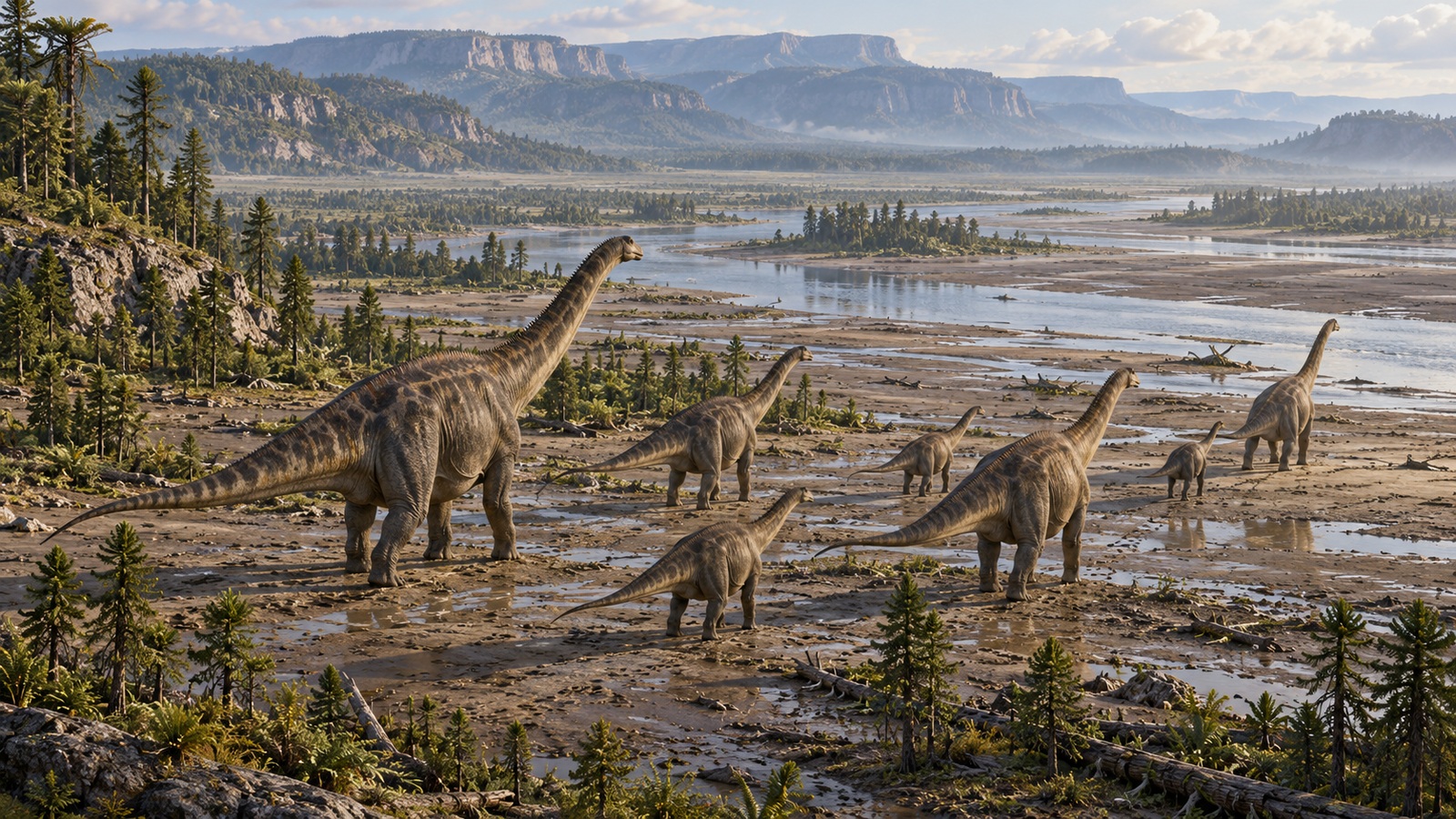
Across an ancient mud surface, several dinosaur trackways point in roughly the same direction. It is easy to picture a herd walking together, but the rock does not come with a timestamp for every footprint. The animals might have crossed within minutes, or they might have followed the same convenient route on different days. Paleontologists investigate herd living by testing that difference, combining track geometry with sediment, preservation, and evidence from bodies and breeding grounds. Some dinosaur sites support genuine group association, including cases with organization by age. Others remain compatible with independent animals concentrated by water, food, or geological processes. The answer to whether dinosaurs lived in herds is therefore yes for some populations, with important limits on how much any individual discovery reveals about group size, duration, membership, and behavior.
A: They are suggestive, but timing, spacing, and geographical constraints must also be assessed.
A: Yes. Counts of skeletal elements must be converted carefully into minimum individual estimates.
A: Comparable footprint dimensions suggest size classes, while skeletal growth evidence can test developmental age more directly.
A: No. Evidence of association occurs in several lineages, including smaller early dinosaurs.
A: Their relative positions do not directly establish family relationships.
A: Some sites support that possibility, but each requires its own timing and identification evidence.
A: The trails may have formed separately, so proximity does not establish a chase.
A: Transport or repeated mortality can combine individuals from separate events.
A: The reconstructed arrangement also needs room for trunks, limbs, and tails; centerline spacing is not the entire moving-body envelope.
A: Migration involves recurrent movement between areas, usually seasonal, beyond one travel episode.
A herd is a living association, not simply a large fossil count
In ordinary language, a herd means animals traveling or living together, usually with some continued tendency to associate. A fossil site can establish part of that pattern without revealing its entire duration. Animals crossing a surface together demonstrate a more immediate association than bones found together after death. Neither observation automatically proves a lifelong group.
Keeping that definition explicit avoids inflated conclusions. Hundreds of bones need not represent hundreds of complete individuals, and hundreds of individuals need not all have belonged to one herd. Counts, timing, and behavior are separate measurements. Researchers first establish the physical population represented and then investigate what produced its concentration.
A trackway records a moving animal in its environment
Each sequence of footprints preserves repeated contacts between feet and a deformable surface. Stride, track width, direction, and footprint size provide information about the animal and its movement. Several sequences allow comparisons among individuals. This makes tracksites especially valuable because the evidence was generated during life rather than assembled from dead bodies. Nevertheless, the track surface itself must be understood before social claims are made. Multiple layers can become exposed together, and transmitted impressions beneath the original walking surface can complicate which tracks belong to the same episode. A clean-looking display is not necessarily a single moment preserved intact.
Direction is useful only when other evidence agrees
Parallel routes are consistent with group travel, especially when individuals maintained plausible spacing and comparable directions through a broad area. Yet geography can impose alignment independently. A narrow shore, channel margin, or opening between obstacles may direct many separate travelers along one corridor. The environment supplies an alternative explanation that must be tested.
Researchers compare track depth, sharpness, deformation, and relationships where trails cross. Similar preservation may support a limited formation interval, but it is not a perfect clock. Weather and substrate conditions can remain suitable for some time. Evidence becomes stronger when several independent observations constrain both the route and the interval in which it was used.
Changes in direction can add useful context. A set of trails turning together across an unconstrained surface is harder to explain by a simple straight corridor than parallel lines along a bank. Even that pattern requires careful mapping and geological interpretation. The goal is to understand the least complicated explanation for the whole surface, not select the most dramatic few tracks.
Footprint size can suggest group composition without giving exact ages
A set of similarly sized footprints may indicate animals of broadly comparable body dimensions. Mixed sizes could represent a more varied group, but foot size does not translate directly into a precise birthday. Different species, substrate effects, and preservation can alter apparent dimensions. Identifying the track makers is itself often more uncertain than identifying a skeleton. Scientists therefore describe size classes before making stronger claims about adults and juveniles. A very small trail among larger ones might support the presence of young animals if the track anatomy and context fit. It does not establish that the larger individual immediately beside it was its parent. Family relationships require evidence beyond neighboring footprints.
Bonebeds need their own investigation of assembly
A dense concentration of skeletons can preserve a group killed by a shared event, but flowing water can also bring unrelated remains together. Repeated deaths at a water source may accumulate over years. Researchers examine abrasion, articulation, skeletal parts, preferred orientation, and surrounding sediments to distinguish these processes. The discipline studying what happens between death and fossil discovery is called taphonomy. Its purpose here is practical: determine whether the site reflects an original living association or an assemblage constructed afterward.
A convincing herd interpretation should account for the whole deposit, including missing bones and signs of disturbance, rather than relying only on the number of animals represented. Comparing multiple nearby exposures can help reveal whether a concentration extends beyond the visible excavation. If bones follow a channel deposit, transport deserves particular scrutiny. If skeletons remain associated on a restricted surface, a shared mortality event may fit better. Neither observation alone decides the case, but each adds a constraint that the proposed herd history must satisfy.
Age structure can strengthen a case for organized groups
Skeletons offer advantages that footprints cannot always provide. Microscopic growth features can help estimate relative ages, while anatomy identifies the animals more precisely. If similar-age individuals occur in coherent clusters, that pattern can inform how the population was organized. Geological explanations still have to be considered before social organization is accepted.
The Mussaurus study from an Early Jurassic breeding area reported eggs and individuals from several growth stages, with particular clusters interpreted as age-segregated associations. This is significant because it goes beyond finding many animals in one place. The proposed structure connects life stage with grouping. It does not reveal a fixed leadership system or prove that every related dinosaur formed the same sort of herd.
Age segregation is biologically plausible when body size changes dramatically through development. Young animals may feed at different heights, use different shelter, or move differently from adults. Such differences could make companions of similar size more compatible. The fossils can support the grouping pattern more directly than any single explanation for its evolutionary advantage.
Early dinosaur groups broaden the evidence beyond giants
Herd discussions often focus on sauropods and large duck-billed dinosaurs, but smaller early dinosaurs also provide relevant evidence. A Lesothosaurus bonebed investigated with growth and burial evidence supports social aggregation in an early ornithischian. Such finds show why giant body size is not a prerequisite for association. The ecological reasons for gathering may differ across lineages.
Evidence distributed across the dinosaur family suggests repeated opportunities for group living rather than one uniform herd inherited unchanged by all descendants. Different sites preserve different behaviors and degrees of certainty. A broad evolutionary pattern should therefore be built from clearly identified cases. It should not erase differences between a breeding aggregation, an age-based group, and animals apparently traveling together.
Mixed species introduce an additional layer of uncertainty
Modern herbivores sometimes associate with other species, making mixed dinosaur groups plausible. A shared track surface can test that possibility, but only if the tracks were sufficiently close in time. The Natural History Museum’s account of Canadian ceratopsian and ankylosaur tracks discusses potential mixed-species herding while emphasizing uncertainty over the surface’s exposure interval.
The reported surface is in Dinosaur Provincial Park, Alberta, and dates to about seventy-six million years ago. Thirteen ceratopsian footprints were interpreted as representing at least five animals, with an ankylosaurid trail among them. The trail types supply broader identities than complete skeletons could provide.
This gives the proposed mixed gathering a physical scale and recognizable membership without requiring exact species identifications. The important comparison is between different kinds of feet moving through one setting, rather than a collection of famous names assembled for a scene. Their shared direction is the observation; mixed-species membership is the behavioral interpretation.
The discovery illustrates the difference between an exciting interpretation and a fully resolved event. Predator tracks nearby need their own timing assessment as well. Without it, a proposed mixed herd pursued by hunters may combine several separate visits into one invented chase.
Nesting grounds can preserve repeated association without year-round herding
A suitable nesting area may concentrate adults and eggs seasonally. Repeated clutches on distinct surfaces can show that an area remained useful over multiple breeding episodes. That makes the site important evidence for reproductive aggregation. It does not establish how far the animals traveled together before arriving or whether they dispersed immediately afterward.
The same distinction applies to hatchling concentrations. Young animals might remain near a common hatching area or form groups after adults departed. Alternatively, burial could combine separate clutches. Nest boundaries, developmental stages, and sedimentary relationships help distinguish the options. A nursery interpretation should be tied to those observations rather than the emotional appeal of a family gathering.
Herd structure may have varied during the year. Animals could converge to breed, separate while feeding, and form other associations during movement between habitats. Fossils usually sample one part of that cycle. A comprehensive reconstruction should preserve the possibility of changing group membership rather than treating one event as an unchanging social arrangement.
Benefits of grouping explain plausibility, not the fossil itself
Potential advantages include improved predator detection and lower individual risk within a gathering. Neighbors may also help reveal usable routes or resources through their own movements. These possibilities make herding understandable in ecological terms. They cannot replace physical evidence that a particular dinosaur population actually associated.
Group living also imposes costs. Many large herbivores can consume vegetation rapidly, compete for access to water, and attract predators through their visibility. The balance changes with habitat and season. Explaining why herding might help is a second task after establishing the association, not a shortcut to proving it from the animal’s size or diet.
A traveling group does not establish long-distance migration
Migration involves repeated movement between areas, usually with a seasonal component, and requires more evidence than a set of aligned tracks. A herd could travel locally between feeding places without undertaking a continental journey. Even a very long trackway preserves only the exposed part of a route. Investigations of migration may draw on environmental context, geographic distribution, and chemical records, with their own uncertainties. Assigning migration from group movement alone adds a conclusion the tracks cannot supply. The same caution applies to exact travel schedules or claims that a particular route was taught across generations.
The most persuasive cases combine evidence that fails differently
Tracks document movement but may struggle with precise identity and timing. Skeletons can offer identity and age but require careful reconstruction of accumulation after death. Nests reveal breeding activity while often leaving the rest of the year unknown. Because these records have different weaknesses, agreement among them can provide a stronger behavioral case.
That agreement must concern compatible animals and settings. A tracksite from one species cannot supply missing details for an unrelated bonebed simply because both suggest groups. Researchers compare patterns across sites while keeping the original observations separate. This builds a range of supported possibilities rather than a composite herd assembled from every favorable discovery.
Some dinosaurs lived or traveled in groups, sometimes with organization by age. The useful distinction to remember is between a route and an association: several animals can use the same path without using it together. Tracks narrow the movement story, while skeletons and nests can add ages and breeding context. A modest group supported by those connections can tell us more about herding than a spectacular pile of remains accumulated over centuries.