A gathering and a society leave different problems to solve
A prehistoric waterhole crowded with dinosaurs would be a spectacular sight, but the crowd alone would not reveal how the animals related to one another. Some might have arrived independently for a drink. Others could have traveled together for weeks, recognized familiar companions, or gathered only during breeding. All of these possibilities involve proximity, yet they represent different kinds of social life. Fossils support group association in several dinosaur lineages, including some with evidence for structured gatherings rather than accidental crowds. They do not establish that every dinosaur formed a herd, cared for unrelated young, or hunted cooperatively. Understanding dinosaur social behavior means moving carefully from the physical traces to the particular interaction they can support. The answer becomes richer when we ask how, when, and why a species associated instead of assigning the entire dinosaur family one personality.
A: Yes. Mating, territorial encounters, and competition are social interactions.
A: A temporary gathering and a persistent group are different interpretations.
A: Predators could associate too, although cooperation requires separate evidence.
A: Their age-related organization contributes evidence beyond a simple concentration of individuals.
A: The nests alone rarely identify ranks or individual roles.
A: A local association documents particular circumstances; broader claims require geographically and environmentally varied evidence.
A: Social association need not depend on conspicuous skeletal ornaments.
A: They document associations rather than direct evidence of emotions.
A: Changing size, food needs, and vulnerability make that biologically plausible.
A: Brief interactions usually neither create durable traces nor end with the participants buried together.
Social behavior includes brief encounters and enduring relationships
Animals can interact socially while spending much of their lives apart. Courtship, territorial disputes, mating, and competition at food all involve responses to other individuals. A permanent group is only one possible arrangement. This broad definition prevents a false choice between completely solitary animals and highly organized herds. It also prevents a single discovery from being used to assign a permanent temperament to a species. An animal could tolerate neighbors while feeding but behave competitively around a mate or nest. Social behavior describes responses in particular circumstances, so the setting of an interaction is part of the biological explanation.
Scientists use more specific terms when the evidence permits. An aggregation describes animals occurring together, while gregariousness implies a tendency to associate. Cooperation requires an additional claim about coordinated action or mutual benefit. These terms can overlap, but they should not be treated as interchangeable conclusions drawn from the same pile of bones.
The dinosaur family was too diverse for one social system
Nonavian dinosaurs occupied many environments and varied enormously in size, diet, growth, and reproductive biology. Those differences would have shaped the costs and opportunities of interacting with neighbors. A small juvenile browsing near cover did not face precisely the same circumstances as a giant adult feeding across open ground. Social tendencies could also change through life or between seasons. Evidence of association in one population therefore cannot define an entire lineage unchanged across millions of years. The useful unit of analysis is a particular species, age group, locality, or behavior, supported by evidence that matches the scale of the claim.
Bones together establish an association that still needs explaining
A bonebed containing many individuals of one species can support the possibility of social gathering. Its value depends on how the animals reached the site. Bodies may have accumulated through a shared catastrophe, repeated deaths near a resource, or transport by water. The final arrangement can represent living behavior, geological sorting, or a combination. Researchers examine articulation, abrasion, skeletal completeness, orientation, and sedimentary structures to test those alternatives. Connected skeletons in a restricted event deposit tell a different story from scattered, worn bones collected over a long interval. Age distribution provides another independent clue. No single feature supplies a universal threshold for declaring a fossil society.
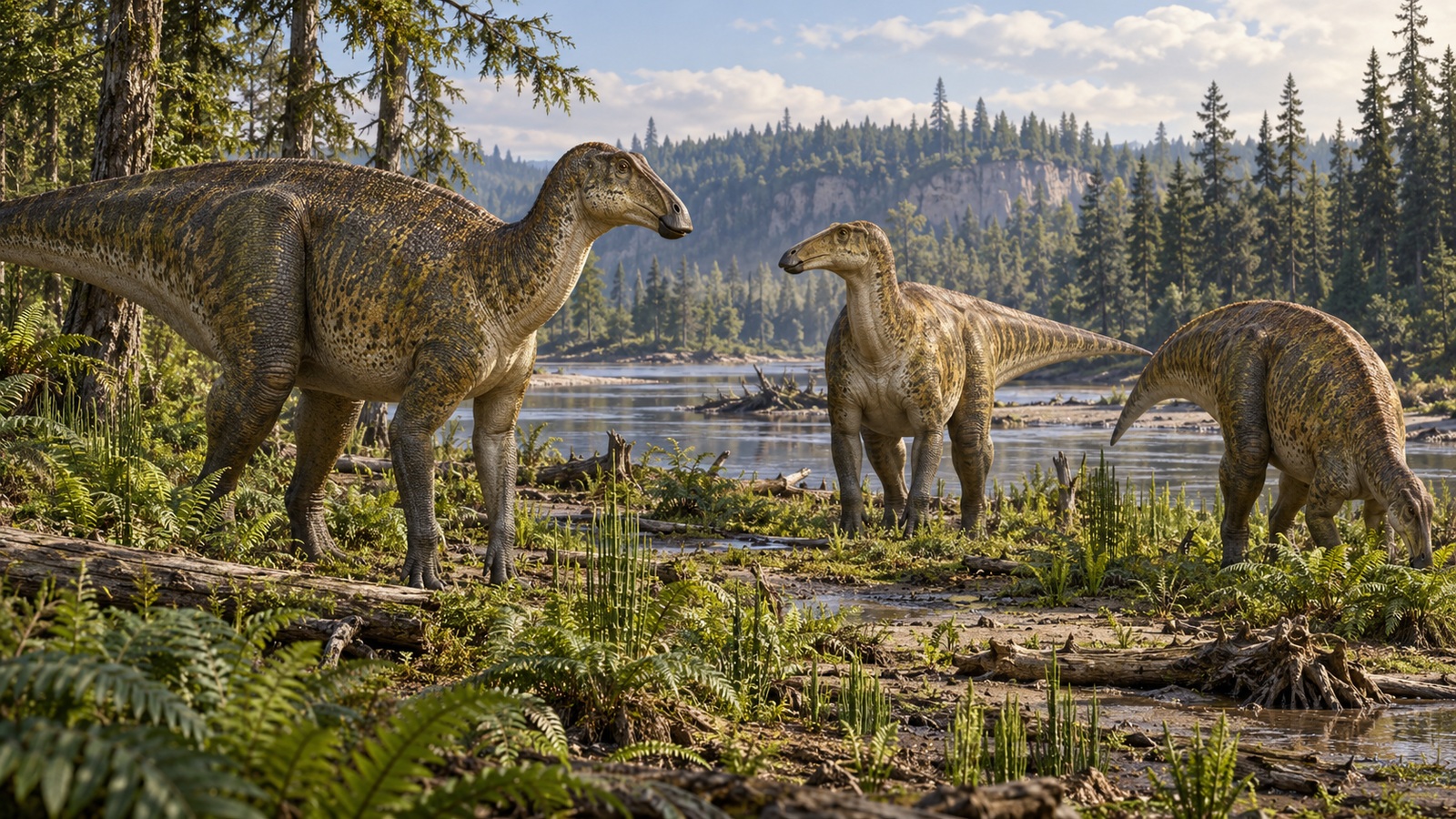
A South African Lesothosaurus bonebed contains numerous skeletons packed and jumbled together. Research described by the Natural History Museum in 2022 interpreted their burial as a shared event, strengthening the case that the small Early Jurassic dinosaurs had gathered while alive. Microscopic growth evidence helped describe the individuals rather than simply counting loose bones. This social association predates the enormous horns and frills familiar from later ornithischians. A dinosaur did not need a conspicuous bony ornament to live among others.
Tracks capture movement rather than the final place of death
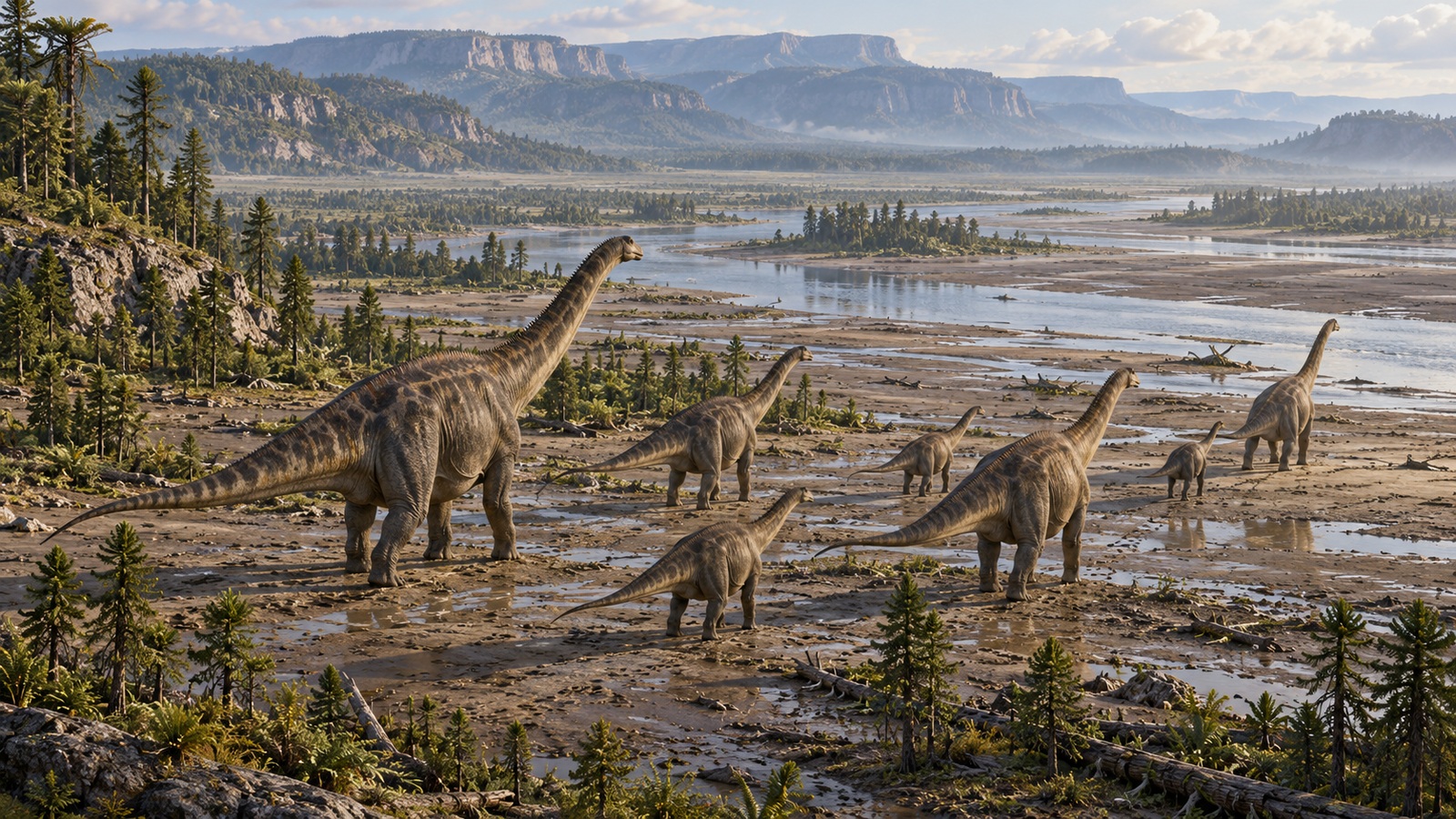
Multiple trackways can show animals moving across the same surface. Similar directions, appropriate spacing, comparable preservation, and evidence for a short formation interval can strengthen an interpretation of group travel. Tracks therefore complement bonebeds by recording an activity performed while alive.
Even so, a common route can bring unrelated travelers into alignment.
A river margin or narrow passage may repeatedly channel animals along the same path. Researchers must ask whether the tracks were genuinely contemporaneous rather than merely preserved on one exposed layer. A convincing group movement interpretation remains narrower than a complete social history. It can show association during travel without demonstrating lifelong membership or a hierarchy.
Age clusters can reveal structure within a gathering
The Mussaurus site in Patagonia preserves more than a hundred eggs and remains representing eighty individuals, from embryos to adults. Within that wider breeding area, Pol and colleagues described distinct age-related clusters, including an aggregation of at least eleven juveniles with articulated or partly connected skeletons, some overlapping. Other finds included hatchlings and associated adults. The pattern was therefore not simply a random mixture of big and small bones: particular developmental stages occurred together within a much broader population record. Burial analysis argued against water gathering those juveniles from separate places. This supported age-segregated association, although it could not reveal whether any two individuals recognized one another or belonged to the same family.
Nesting colonies do not require permanent family units
Suitable breeding ground can attract many animals to a small area. Multiple nests may therefore indicate colonial nesting, repeated use, or a combination of separate seasons. Geological separation among nesting surfaces helps establish the sequence. A cluster of eggs is a starting point for investigating a breeding community, not proof that all adults lived together throughout the year.
Living animals show why the distinction matters. Species may tolerate close neighbors at a nesting site while competing intensely for space or returning to solitary lives afterward. Such comparisons provide plausible alternatives rather than a direct description of a dinosaur colony. They help explain why temporary association and lasting group cohesion must be tested separately. Parent-offspring relationships add another level of complexity. A brooding adult supports attendance at a particular clutch, but that does not establish communal feeding or care of unrelated offspring. Likewise, young dinosaurs found together might represent a juvenile group rather than a single family. Social interpretation becomes clearer when nesting, care, and later group membership are treated as distinct behaviors.
Conspicuous anatomy could help animals respond to one another
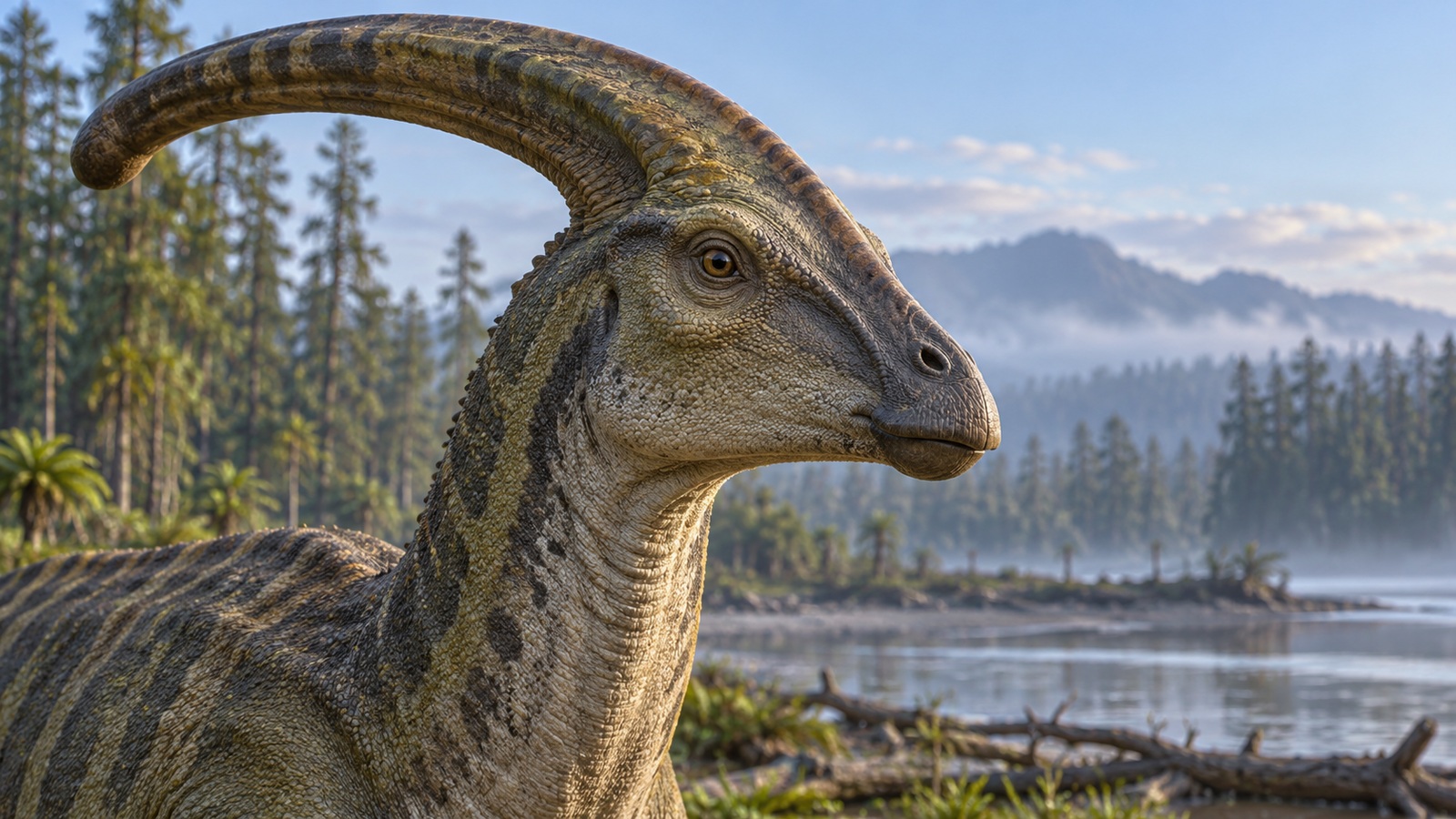
Horns, frills, crests, and elaborate feathers would have affected an animal’s visible outline. Some probably played roles in recognition, display, or competition, although the exact messages remain difficult to recover.
A structure could communicate effectively without a bright color pattern preserved in the fossil. Shape, size, movement, and contrast can all influence visibility.
Testing a social function requires more than noticing that an ornament looks impressive. Researchers compare variation through growth, differences among related species, and whether the structure could withstand proposed physical uses. Several functions may operate together. A horn used in competition might also serve as a signal that sometimes prevents a contest from becoming physical.
Predatory association is separate from coordinated pack hunting
Several carnivores at a carcass could have tolerated one another temporarily, competed aggressively, or arrived at different times. None of those arrangements automatically entails a jointly planned attack. A fossil association can support proximity while leaving the relationship among the predators unresolved. Coordinated hunting makes a stronger behavioral claim and demands correspondingly stronger evidence. Even animals capable of complex social behavior need not hunt cooperatively on every occasion. Popular comparisons with wolves can be useful imaginative starting points, but they become misleading when a modern species supplies the missing strategy instead of fossils testing it.
Grouping could reduce some risks while creating others
Potential benefits include more opportunities to detect predators and a lower chance that any one individual becomes the target. Group members might also encounter useful feeding or nesting areas through the movements of neighbors. These are biologically plausible advantages, not events directly demonstrated by every herd fossil. Their importance depends on the animals’ environment and behavior.
Costs include competition for food, increased visibility, and the possibility that disease or parasites spread more easily among close neighbors. A large group can exhaust nearby vegetation or crowd suitable nesting ground. Social living is therefore a balance of pressures rather than an automatic improvement over solitude. An environment that favors grouping in one season could favor dispersal in another.
Individual age can change that balance. Juveniles may need different food, travel at different sustainable speeds, or seek shelter unavailable to adults. Separate age groups could reduce competition or improve compatibility without requiring adult abandonment as a universal explanation. Fossils can reveal the pattern more readily than the exact advantage that caused it to evolve. A useful comparison is to ask what different proposed advantages would predict. If compatible feeding needs were important, age and body size might correlate within groups. If a temporary resource drove the gathering, geological evidence for that resource could become relevant. These predictions help turn an attractive adaptive story into hypotheses that can compete with alternatives.
Communication need not resemble human conversation
A shift in posture, the presentation of an ornament, or a call could alter another dinosaur’s behavior. Signals might regulate spacing, attract partners, or help individuals remain in contact. The existence of a communication channel does not tell us the meaning of every signal. A spectacular crest cannot be translated into a specific greeting or command.
Modern birds and crocodilians show that archosaurs can communicate through several sensory channels. Their behavior guides hypotheses for extinct relatives while demonstrating considerable variation. A crocodilian display or bird call should not simply be assigned to a dinosaur because it makes a vivid reconstruction. Anatomy and ecological context must constrain the comparison.
Complex minds are difficult to reconstruct from group fossils
A group can stay together through responses to its neighbors without every movement requiring a shared plan. Following direction changes or maintaining a comfortable distance could generate organized movement. A fossil cluster cannot show which rules the animals used, but this distinction helps explain why association does not measure intelligence directly. Mussaurus’s age organization is interesting in its own right, even without attaching human-like relationships to its members.
Evaluate social reconstructions by the alternatives they survive
A useful reconstruction begins with the observation and then asks what else could have produced it. For a bonebed, that means geological accumulation; for tracks, repeated independent travel; for nests, repeated use of favorable ground. Strong interpretations explain why those alternatives are less consistent with the combined evidence. Uncertainty becomes part of the test rather than an afterthought.
This approach also makes discoveries comparable. One site may provide strong evidence of a group but little detail about its duration. Another might preserve age organization or repeated nesting. Combining them can reveal a wider range of social possibilities, provided the animals and time periods remain clearly distinguished. Several separate discoveries should not be assembled into one fictional species with every impressive behavior.
Some dinosaurs were social in meaningful, demonstrable ways, and their associations were probably as varied as other aspects of their biology. The surviving evidence supports a world of encounters, gatherings, breeding communities, and at least some structured groups. It does not support one universal dinosaur society. Seeing these animals as responsive to one another, while keeping the claims tied to the fossils, gives a more convincing picture of prehistoric life than either constant solitude or automatic cooperation.