A clutch is the surviving pattern of many separate actions
A cluster of fossil eggs can look like a single object, but each egg arrived through a biological sequence. An egg developed inside a female, acquired its protective coverings, passed out of the body, and joined a clutch in a particular position. The animal also had to place that clutch where embryos could obtain suitable warmth, moisture, and oxygen. Dinosaurs accomplished these tasks in different ways, so there is no universal nest plan that fits every species. Scientists reconstruct egg laying from shell structure, embryos, arrangements within nests, and a few extraordinary associations with adult skeletons. These clues reveal more than the simple fact that dinosaurs laid eggs. They show how anatomy and nesting behavior interacted, while also explaining why a fossil clutch cannot preserve every movement the female made.
A: Repeated arrangements indicate sequential deposition in some groups; one universal schedule is unsupported.
A: They contribute to evidence for paired reproductive pathways in some theropods.
A: The space could accommodate an attending adult while reducing weight on the eggs.
A: Usually an embryo or another strong association is needed for a confident match.
A: Egg dimensions did not scale directly with adult size; gas exchange and structure imposed limits.
A: Imaging techniques can sometimes reveal internal remains through the surrounding material.
A: No. Later storms and sedimentation can also cover a nest.
A: Some contain evidence compatible with hatching, while others preserve unhatched embryos.
A: A single specimen may be incomplete or atypical, so multiple nests are preferable.
A: Their positions and sediment relationships preserve behavioral information that collection can destroy.
The egg was assembled within the reproductive tract
An egg began as an ovum containing the material that would support a developing embryo. Following fertilization, additional coverings formed around it as it passed through the reproductive system. Comparison with living archosaurs supplies the broad anatomical framework. Most extinct dinosaurs do not preserve the organs themselves, so their exact arrangement must be inferred rather than described as directly observed. The mineralized shell formed before the egg was laid. Shell glands deposited material in a patterned structure that can survive fossilization as microscopic layers and crystal units. Those features help distinguish biological shell from a rounded stone or mineral coating. They also allow researchers to compare eggs whose producers remain unidentified.
Shell thickness solved several problems at once
A shell needed enough strength to maintain the egg’s integrity, yet the embryo still required gas exchange and eventual escape. Water loss also had to remain within tolerable limits during development. A growing embryo consumed oxygen and released carbon dioxide through the shell’s pore system. Wet ground could reduce the air available around those openings, while very dry conditions could draw too much water out of the egg. Successful incubation required a workable balance rather than the thickest possible covering.
Thickness therefore cannot be interpreted simply as armor against predators. Pores, membranes, size, and surrounding humidity all affected how the egg functioned. A thick shell under one set of conditions might have very different consequences in another. Fossil measurements become biologically useful when scientists consider these interacting properties rather than treating a single number as a complete description of reproductive strategy. Surface texture is another feature that needs context. Ridges and bumps can help identify an egg type, yet their presence does not translate directly into a single environmental function. Similar-looking textures can arise within different shell architectures. Measuring the preserved surface and examining its microscopic organization provides a firmer basis for interpretation than assigning every visible bump a protective or camouflaging purpose.
The word shell covers a wider range than a breakfast egg suggests
For a long time, heavily mineralized eggs provided the most obvious dinosaur evidence because durable fragments are comparatively easy to preserve and recognize. Delicate eggs can leave much subtler traces. That uneven record makes it risky to assume that familiar hard shells were universal. Chemical and structural observations have expanded the range of egg types considered plausible.
Research proposing soft ancestral dinosaur eggs drew attention to fossils of Protoceratops and Mussaurus. The evolutionary implications depend on how shell characteristics are identified and distributed across the family tree. New discoveries can change that reconstruction. The key practical point is that the absence of thick shell does not eliminate the possibility of egg laying.
Soft or weakly mineralized eggs also change expectations about nesting. A flexible package interacts with surrounding sediment differently from a rigid one and may be especially sensitive to water balance. That provides hypotheses for testing, rather than a complete nest reconstruction by itself. Embryos, surrounding rock, and shell preservation need to be assessed together.
Some clutches preserve evidence of a paired laying pattern
Several theropod clutches contain elongated eggs arranged in pairs. Together with rare fossils preserving shelled eggs within an adult and comparison with relatives, these patterns support the interpretation that some dinosaurs produced eggs through two functional reproductive pathways rather than the single functional ovary typical of most living birds. The visible arrangement is evidence, while the soft internal anatomy remains largely reconstructed. Pairs do not tell us the precise interval between successive laying events. Nor should the pattern be extended automatically to unrelated dinosaurs with differently organized clutches.
A circular nest may have accumulated through repeated deposition rather than one simultaneous release. Reconstructing the sequence requires close attention to which eggs lie together, which overlap, and whether burial disturbed their original positions.
Arrangement can make space for an attending adult
Oviraptorosaur nests are particularly informative because some preserve rings of eggs around a central area. This geometry has been investigated as a way for an adult to attend a clutch without placing its entire body weight directly on fragile eggs. Nest size and egg distribution varied with the animal. An open center could therefore be mechanically important without implying that every egg received identical contact or heat. The arrangement provides constraints for physical models, including how an adult might sit, how its forelimbs reached, and how energy moved through the nest. It does not turn the clutch into a perfectly preserved film of construction.
The ground held information that the eggs alone cannot provide
Field documentation begins before a clutch is removed from the rock. Researchers record the position, inclination, spacing, and burial relationships of individual eggs. Sediment layers may show whether a depression existed or whether eggs lay within a larger nesting surface. These observations can be lost if a specimen is collected without its context.
A clutch partly buried by the parent is different from a clutch covered suddenly by a storm. Both can end up beneath sediment, but they imply different nesting conditions. Geological structures and the orientation of the eggs help distinguish possibilities. The final fossil position must always be compared with processes that could have moved, compressed, or rotated the material after laying.
Natural exposure may reveal only the top of a nest, hiding lower eggs and the order in which they accumulated. A ring visible in a photograph might therefore be one level of a more complicated arrangement. Preserved inclination and overlap help reconstruct how successive eggs fitted into that space. The result explains a laying pattern rather than merely increasing the final count.
Buried incubation depended on a suitable local environment
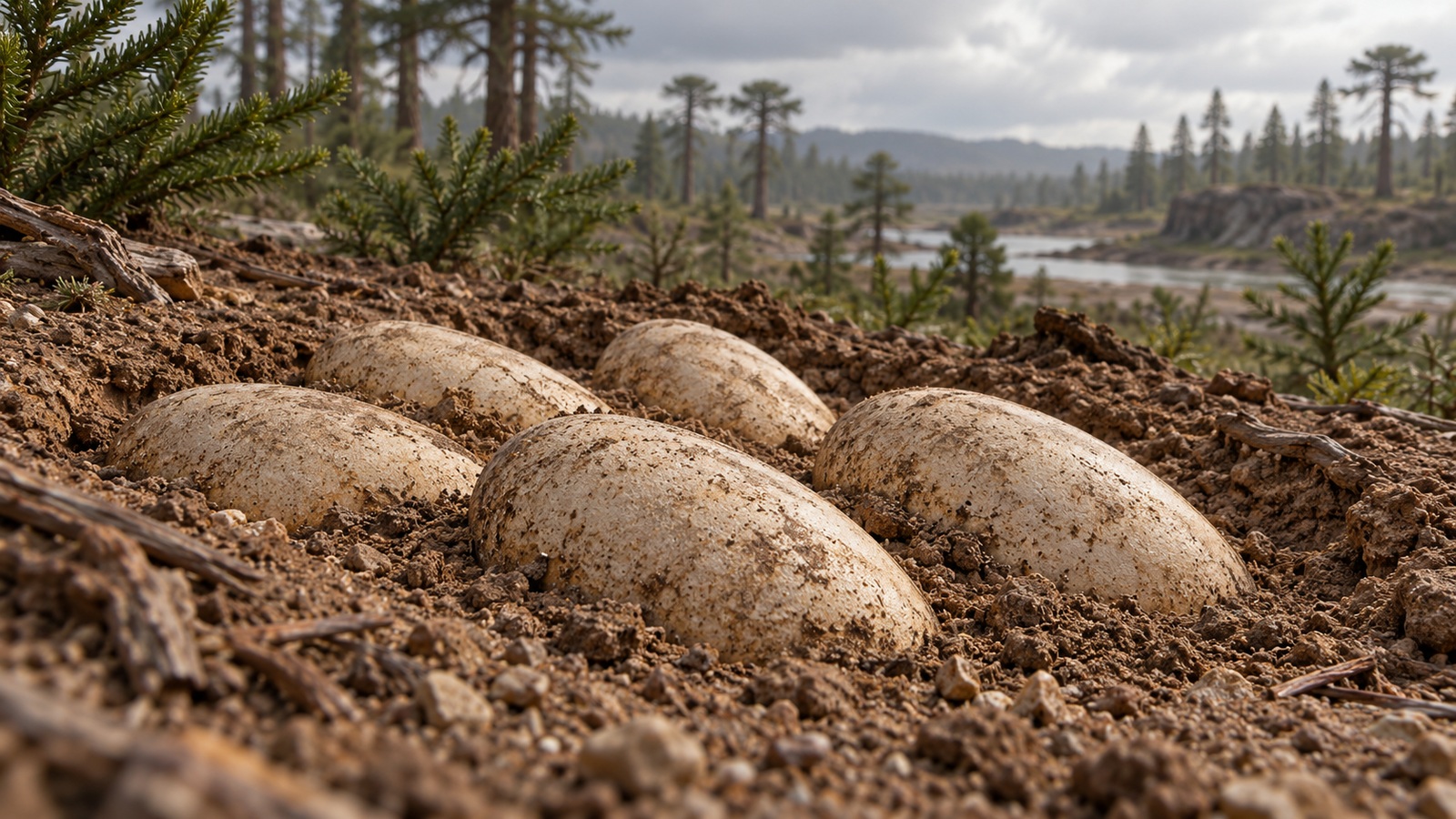
Eggs incubated within a substrate needed access to enough oxygen while retaining appropriate moisture. Soil texture, burial depth, and the properties of the shell all influenced those conditions. Environmental warmth could contribute substantially without an adult covering the clutch. Such a system required a favorable setting rather than a completely self-sufficient egg.
Scientists investigate burial using nest geometry, surrounding sediments, and shell features such as porosity. None of these observations should be interpreted in isolation because preservation can alter original properties. A confident reconstruction emerges when independent lines of evidence point toward the same arrangement. Burial remains a strategy to test for particular dinosaurs, not a rule that all large species followed identically.
Exposed eggs created different opportunities for attendance
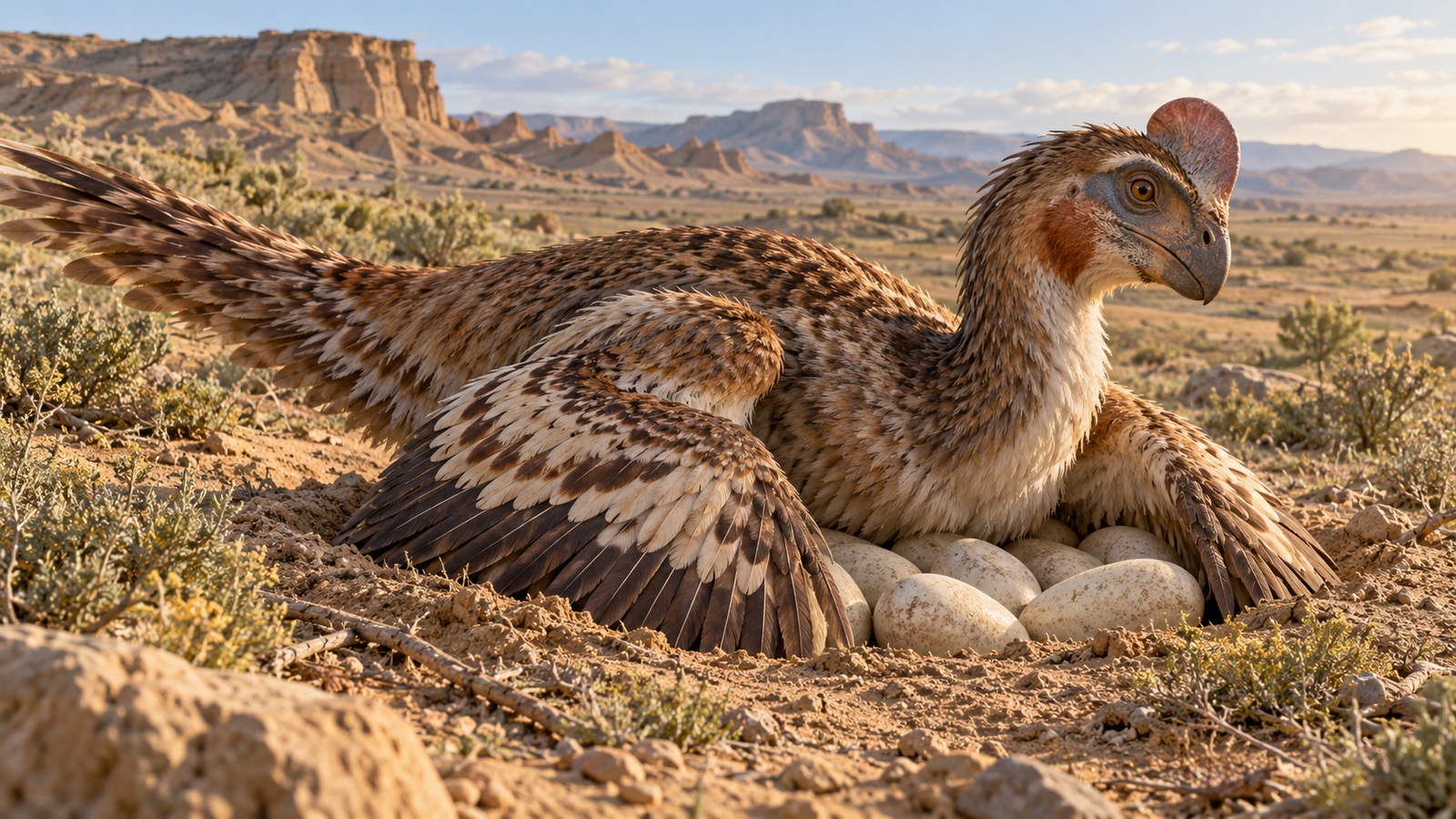
An egg projecting above the substrate could interact directly with an adult’s body or feather covering. A fossil nicknamed Big Mamma makes that relationship visible. Discovered at Ukhaa Tolgod in Mongolia in 1993, it preserves an adult oviraptorid with its arms around the perimeter of a nest containing more than twenty eggs. The American Museum of Natural History’s preparation account describes how excavation revealed the eggs beneath the squatting skeleton. This is a physical arrangement of adult and clutch, rather than a brooding pose borrowed only from living birds. It establishes attendance more directly than it establishes the temperature of every egg. An adult could alter exposure and heat exchange, but eggs partly within the ground would also interact with their substrate. Reconstructing those contacts helps distinguish covering or shading from direct warming. The important contrast with a wholly buried clutch is the adult’s opportunity to affect the exposed nest surface.
The number of eggs is a measurement with limits
Clutch size is the number of eggs associated with a laying event or nest, but a fossil count may be incomplete. Some eggs could have hatched, broken, eroded away, or remained outside the excavated area. Fragmentary material also creates the opposite risk of counting one egg several times. Researchers distinguish observed remains from estimates of the original total.
Large clutches might represent repeated deposition by one female, contributions from more than one individual, or a complicated nesting history. The appropriate interpretation depends on the species and arrangement. Counting eggs alone cannot settle the number of parents. Anatomical consistency, developmental stages, and the boundaries of the nest all contribute to the explanation.
Comparisons between dinosaur groups also require matched evidence. A nearly complete clutch cannot be compared casually with a scatter of broken shells as though both were equally complete. Statistical patterns become more informative when collection methods and preservation are considered. Reproduction involves population variation, so a single impressive nest should not define a fixed number for every female of its species.
Embryos help reveal what happened after laying
Most eggs do not contain an identifiable embryo, but exceptional examples preserve bones at different developmental stages. These can connect a shell type with its producer and show the animal’s posture before hatching. Scanning may reveal internal material without destroying the surrounding shell. Every method balances the information sought against the specimen’s fragility.
Developmental evidence can also estimate the wait after laying. A study using embryonic tooth increments calculated approximately eighty-three days for Protoceratops and 171 for Hypacrosaurus. These roughly three- and six-month intervals depended partly on estimating when teeth began to form. They describe those sampled dinosaurs, not every nesting strategy. For the eggs themselves, the long interval meant that gas exchange, water balance, and suitable temperatures had to continue working well beyond the moment a female completed her clutch.
Breaking shells does not always mean successful hatching
An empty or fractured egg might have hatched, been eaten, suffered collapse, or broken during burial. Scientists examine fracture patterns, displaced pieces, sediment filling, and any embryonic remains before interpreting the outcome. A clutch can contain a mixture of successful and unsuccessful development, just as modern nests do. Shell fragments alone rarely tell that complete story. Recognizing possible failure is essential because fossil nests are not an unbiased collection of successful breeding events. Many became preservable precisely because eggs remained at the site rather than disappearing through hatching and later disturbance.
Egg laying was a behavior, a mechanism, and an ecological commitment
A dinosaur laid an egg through a biological system inherited from earlier vertebrates, but the resulting nest reflected its own anatomy and environment. Shell formation, deposition, clutch organization, and incubation were linked parts of the process. Fossils preserve those links unevenly. The strongest interpretations identify exactly which step is documented and which is reconstructed.
When viewing a fossil nest, start with the physical details: the shapes, spacing, orientations, and surrounding sediment. Then consider how a living animal could have produced that pattern and maintained suitable development. This approach allows meaningful reconstructions without forcing every dinosaur into the habits of one modern bird or reptile. The eggs become evidence of real decisions and constraints, rather than decorative accessories in a prehistoric family scene.