A nest fossil brings an ancient life cycle into focus
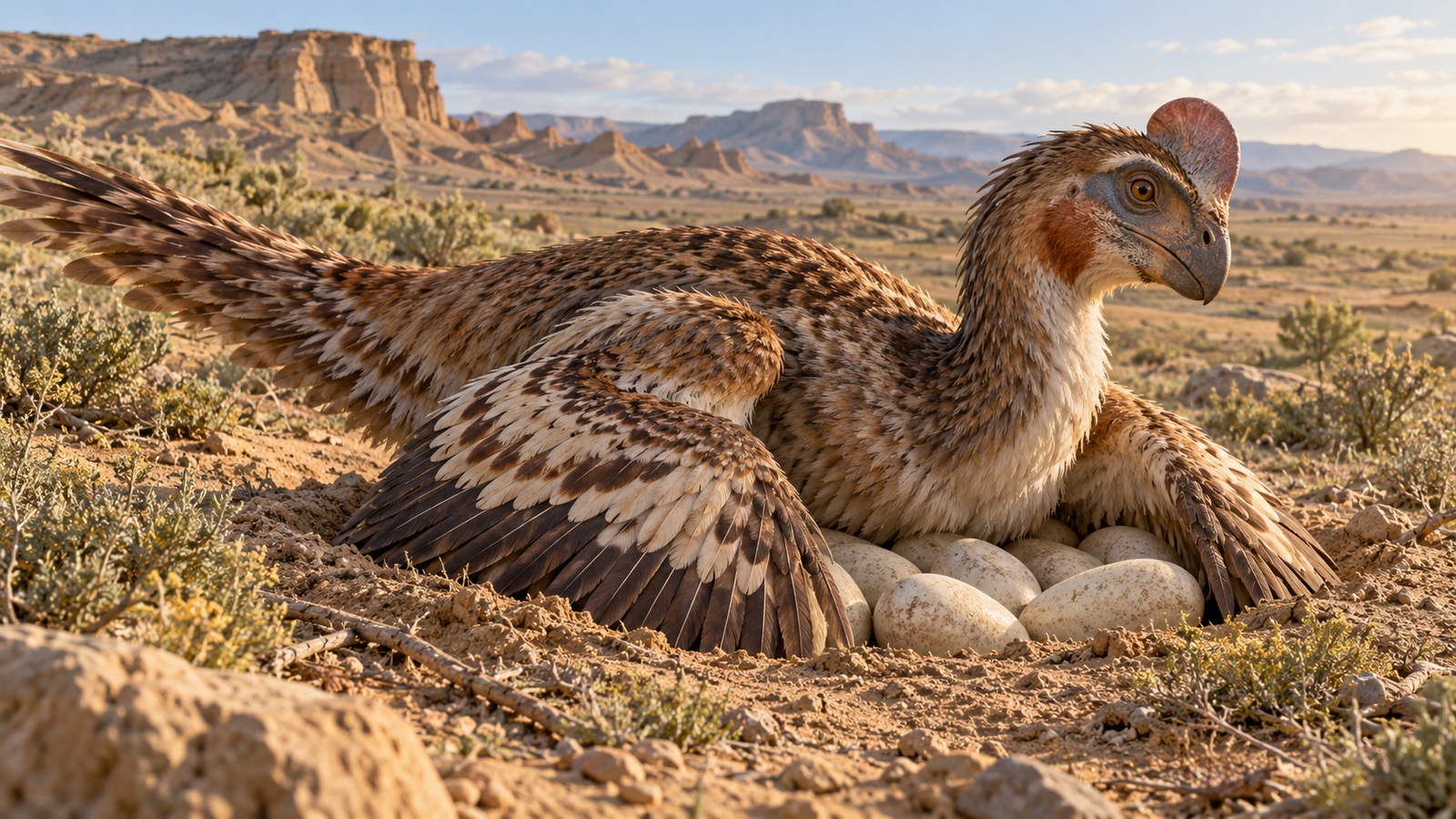
An adult dinosaur rests above a clutch of eggs, its arms arranged around the nest. The scene looks intimate because it records a familiar biological challenge: keeping the next generation alive. Yet this exceptional fossil reveals only one part of dinosaur reproduction. Finding a mate, producing eggs, choosing a nest site, maintaining suitable incubation conditions, and surviving after hatching were separate stages, each leaving different traces. Scientists combine those traces with the biology of birds and crocodilians to reconstruct a life cycle that rarely survives intact. Dinosaurs reproduced sexually and laid eggs, but their reproductive behavior varied across a vast evolutionary family. Some guarded or brooded nests; others probably depended more on suitable burial conditions. The best explanation follows the evidence stage by stage while keeping spectacular possibilities separate from discoveries that can actually be tested.
A: No. Shell construction varied, and some discoveries support comparatively soft eggs.
A: A crest alone cannot establish sex; growth and individual variation also matter.
A: Fossil eggs do not establish permanent pair bonds.
A: Usually not. Nest counts do not identify the sex of all adults in the breeding population.
A: The reproductive biology of their living relatives supports that inference more strongly than egg shape alone.
A: Usually they do not preserve enough seasonal information for a calendar date.
A: No. Nest burial and environmental heat also require consideration.
A: Growth increments in embryonic teeth have supported estimates for particular species.
A: Protection, incubation, and provisioning are separate behaviors.
A: Eggs and nests fossilize more readily than reproductive soft tissues and brief interactions.
Reproduction begins before anything recognizable as a nest
Producing offspring required sexually mature males and females to encounter one another, followed by internal fertilization. The fertilized egg then acquired the coverings needed for development outside the female. This basic sequence is much better supported than any one mating ritual. Lasting pairs and brief breeding associations are different possibilities, and a nest alone cannot distinguish them.
Large crests, elaborate horns, and feather displays could have helped individuals assess potential partners or competitors. A conspicuous structure can carry information about identity, size, or condition, but demonstrating its precise message is difficult. Researchers investigate growth, variation, and mechanical properties to test possible functions. A structure used during courtship could also have served recognition or other social purposes outside breeding. Courtship hypotheses are most useful when they predict observable patterns, such as how a feature changed with maturity or varied among individuals. Those predictions can be compared with a growth series. If the expected pattern is absent, the explanation may need revision even when it makes an appealing reconstruction.
Sexual anatomy is much less visible than shells and bones
Internal fertilization is inferred from dinosaur relationships and the reproductive biology of living archosaurs. The exact anatomy and physical positions involved in mating are poorly documented for most extinct species. Soft tissues usually decay, and skeletons provide only indirect constraints on how large bodies could align. A credible reconstruction must allow the hips, tail, and limbs to move within plausible limits while admitting how much remains unknown. Detailed cinematic scenes often supply more precision than the evidence warrants. We can be confident about the broad reproductive process without claiming a single universal mating posture or assigning every species identical reproductive organs.
Identifying a reproductive adult takes more than measuring size
A nearly full-sized skeleton does not automatically identify an animal that had already reproduced. Skeletal growth and sexual maturity are different biological milestones, even when they influence one another. Growth lines in bones can help estimate age and growth stage. These measurements become more informative when several individuals of a species can be compared.
Some dinosaur bones preserve tissues interpreted as medullary bone, a temporary calcium resource associated with egg production in living female birds. Such identifications need careful microscopic and chemical evaluation because other bone changes can resemble parts of the pattern. When supported, this evidence can identify an egg-producing individual at a particular moment. It does not provide a general visual rule for distinguishing males and females in every museum skeleton.
Reconstructing maturity therefore requires multiple clues rather than a body-size threshold borrowed from another animal. A population could include growing adults that were already reproductively active. Fossils rarely reveal the age of first successful nesting directly. Statements about dinosaur adulthood are clearest when they specify whether they concern reproduction, growth, or simply the dimensions of the skeleton.
An egg protects development while remaining connected to the environment
Inside the egg, the embryo depended on stored nutrients and protective membranes rather than continued nourishment from its mother’s body. The shell provided a boundary, but not an airtight container. Gas exchange and water balance remained essential throughout development. This created a complicated design problem involving strength, permeability, and the conditions surrounding the clutch.
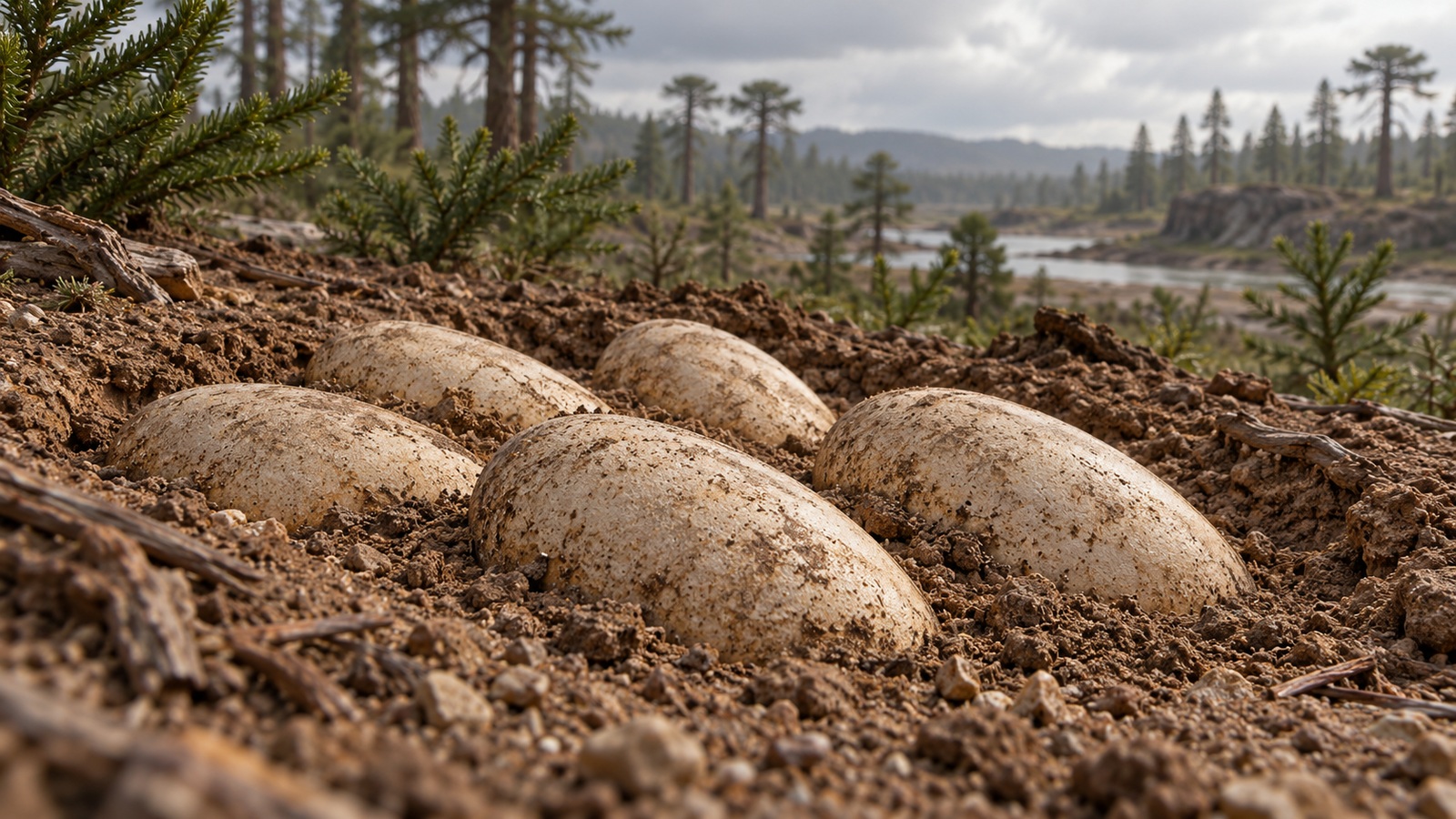
Eggs did not have to resemble oversized chicken eggs. Dinosaur groups produced different shapes and shell structures, while preservation strongly favors some kinds over others. The adult’s size also did not scale directly into an equally gigantic egg. Reproduction placed physical limits on a package that had to support an embryo and still permit it to breathe.
Matching an egg to its maker requires a biological connection
The history of Oviraptor makes that distinction memorable. Eggs discovered in Mongolia were initially assigned to Protoceratops because that horned dinosaur was common nearby; an Oviraptor skeleton at a clutch was interpreted as an egg thief. In 1993, an AMNH expedition found an oviraptorid embryo inside a matching egg. The occupant identified this egg type as oviraptorid rather than Protoceratops. Adults preserved over clutches then fit a nesting interpretation instead of automatically recording robbery. An identifiable embryo completed the biological connection that proximity alone had failed to provide.
A nesting place was a compromise among competing needs
A female choosing a place to lay faced conditions that could change within days. Moisture helped prevent excessive drying, but flooding could destroy a clutch. A sheltered surface might reduce exposure while limiting suitable space or making adults easier to locate. Favorable nesting terrain also depended on temperature and the stability of the ground.
Repeated nest layers at a locality can suggest that animals returned to a useful breeding area. That interpretation becomes stronger when separate nesting surfaces are distinguished clearly in the sediments. Several clutches on one apparent surface do not automatically prove that all eggs were laid simultaneously. Time, erosion, and burial can combine separate events into a deceptively compact fossil scene.
Nesting close to neighbors could have advantages without requiring permanent family groups. It might reflect shared habitat needs or reduced individual risk, but also competition and vulnerability to disturbances. The fossil pattern must establish what happened before explanations for its benefits are ranked. A breeding colony describes a place and association; it does not by itself reveal every relationship among the adults.
Incubation could involve an adult, the ground, or both
Some theropod fossils preserve adults positioned above eggs in postures consistent with brooding. This supports a direct role at the nest, although the balance between warming, shading, and protection requires additional study. Egg arrangement influences how heat might move through a clutch. A large adult seated within an open center would interact differently with eggs than a bird covering a compact cluster. Its body could occupy the gap while feathered forelimbs extended toward the surrounding eggs. Such geometry helps explain how attendance was physically possible without assuming the animal sat directly on every shell. It also connects body size with reproductive behavior: space for an adult was part of the nest’s working arrangement, not merely an empty patch within an attractive fossil display.
Other eggs and nest settings support incubation within sediment or other covering material. Heat and humidity could then depend strongly on the local environment. Neither strategy should be assigned universally across dinosaurs. Brooding and burial represent biological possibilities that must be evaluated for a particular lineage and fossil locality.
Development inside the shell had its own timetable
Incubation duration determines how long an embryo remains exposed to nest hazards and how much time an attending parent might invest. Erickson and colleagues’ embryonic-tooth study estimated roughly eighty-three days for Protoceratops and 171 days for Hypacrosaurus: about three and six months, respectively. The calculation used daily tooth increments and an estimate of when tooth formation began. These are approximate, species-specific reconstructions, not a calendar for every dinosaur egg. Their scale makes the reproductive challenge tangible: a clutch could need suitable conditions across a substantial part of a season before any young animal emerged.
Hatching changed the problem from incubation to survival
Breaking out of an egg did not mean a young dinosaur was ready to live exactly like an adult. Small bodies experienced the environment differently and could be vulnerable to predators that posed little threat to their parents. Proportions, limb development, and feeding anatomy help researchers investigate early capabilities. Even a mobile hatchling could benefit from protection or access to a safe feeding area.
Conversely, a nest containing young animals does not automatically demonstrate prolonged parental feeding. The youngsters might have remained near the hatching site for other reasons, or the assemblage might combine different moments. Evidence for dependence is stronger when developmental anatomy and nest context agree. Different dinosaur lineages probably occupied different positions along the spectrum between early independence and extended care.
Growth after hatching could transform ecological roles dramatically. An animal that eventually became enormous began life within the dimensions permitted by an egg. Its first foods and safest habitats need not match those of a full-grown adult. Reproduction therefore shaped entire populations, continually adding small individuals with their own needs rather than simply producing miniature adults with identical habits.
Parental care is a collection of behaviors rather than a single trait
Guarding eggs, maintaining a nest, assisting hatchlings, and feeding young are distinct forms of investment. Evidence for one cannot establish all the others. An adult above eggs strongly supports attendance at that nest, yet does not reveal whether the same individual later provisioned the hatchlings. Nor can its sex always be determined from the association alone.
This distinction makes comparisons with birds and crocodilians more useful. Both groups show that living archosaurs can invest in offspring, but their particular routines differ considerably. They offer hypotheses and anatomical comparisons rather than complete scripts for extinct species. Dinosaur parental care is best reconstructed as a set of supported actions, each tied to its own evidence.
The missing reproductive record is unevenly distributed
Hard mineralized eggshell is more likely to survive than delicate membranes or the soft structures involved in mating. Chemical alteration can further change what remains recognizable. A study proposing soft ancestral dinosaur eggs highlighted how preservation can distort the apparent history of reproduction. The exact evolutionary pattern continues to require comparison among newly discovered eggs and analytical methods. An absence of familiar shell fragments is not equivalent to an absence of nesting animals. Fossil abundance reflects both ancient biology and the likelihood that evidence endured burial, rock formation, exposure, and collection.
A diverse reproductive history survives in separate pieces
The clearest answer combines a firm foundation with carefully drawn boundaries. Dinosaurs reproduced sexually, deposited eggs, and developed outside the mother’s body. Fossil nests, embryos, eggshell, and occasional attending adults reveal multiple approaches to incubation and early life. These discoveries support real behavioral diversity rather than one reproductive routine repeated unchanged across the Mesozoic.
When assessing a reconstruction, ask which part of the life cycle its fossil actually records. An embryo identifies a developing animal; a nest arrangement constrains laying and incubation; an adult’s position may preserve attendance. Courtship and long-term family life usually require more inference. Treating each connection separately makes the surviving evidence more compelling, because the remarkable discoveries can speak clearly without being asked to prove events they never preserved.