A fossil’s geological age is different from the animal’s age at death
A dinosaur bone can come from rock tens of millions of years old while preserving the remains of an animal that lived for only part of a human lifetime. Those are two different ages, reconstructed through different evidence. Geological dating places the fossil in Earth’s history; biological age estimation asks how many years the individual survived before it died. For that second problem, some of the most useful clues lie inside the bone. Microscopic tissues can preserve growth marks, remodeling, and changes near the outer surface that help researchers estimate age and maturity. The record is rarely perfect. Earlier layers can disappear, marks can be ambiguous, and a small dinosaur can be an adult rather than a baby. Scientists therefore build an age estimate from several observations instead of reading a birthday directly from the skeleton.
A: It dates geological events, not the individual's years of life.
A: Spacing measures tissue added, whereas elapsed time depends on the interpretation of the boundaries. The two measurements should not be interchanged.
A: Faint, interrupted, or closely spaced boundaries can be scored differently; stated counting criteria make that disagreement examinable.
A: The first growth interval may represent only part of a year, rather than a full annual cycle.
A: It establishes survival after damage, not an advanced chronological age.
A: Other individuals help constrain missing portions of the developmental record.
A: An oblique slice changes the apparent geometry and spacing of tissue boundaries, so section orientation belongs with the observations.
A: It can reveal structures previously missed or clarify ambiguous marks.
A: The evidence establishes at least that much time, with additional unrecorded intervals possible.
A: A range or qualified minimum can better match incomplete evidence.
Define the age being asked for before choosing a method
If a museum says an animal lived in the Late Cretaceous, it is locating the species or fossil in geological time. If a study says an individual was a growing juvenile, it is describing a developmental stage. If it estimates an age in years, it is attempting a more specific reconstruction of that individual’s lifespan up to death. These statements answer related but separate problems. A radiometric date for a volcanic layer cannot reveal whether a dinosaur nearby was three or thirteen years old. Conversely, a thin section showing several growth marks does not identify the geological period in which the animal lived. Clear terminology prevents two valid methods from being mistaken for interchangeable clocks.
Histology examines the architecture hidden inside a bone
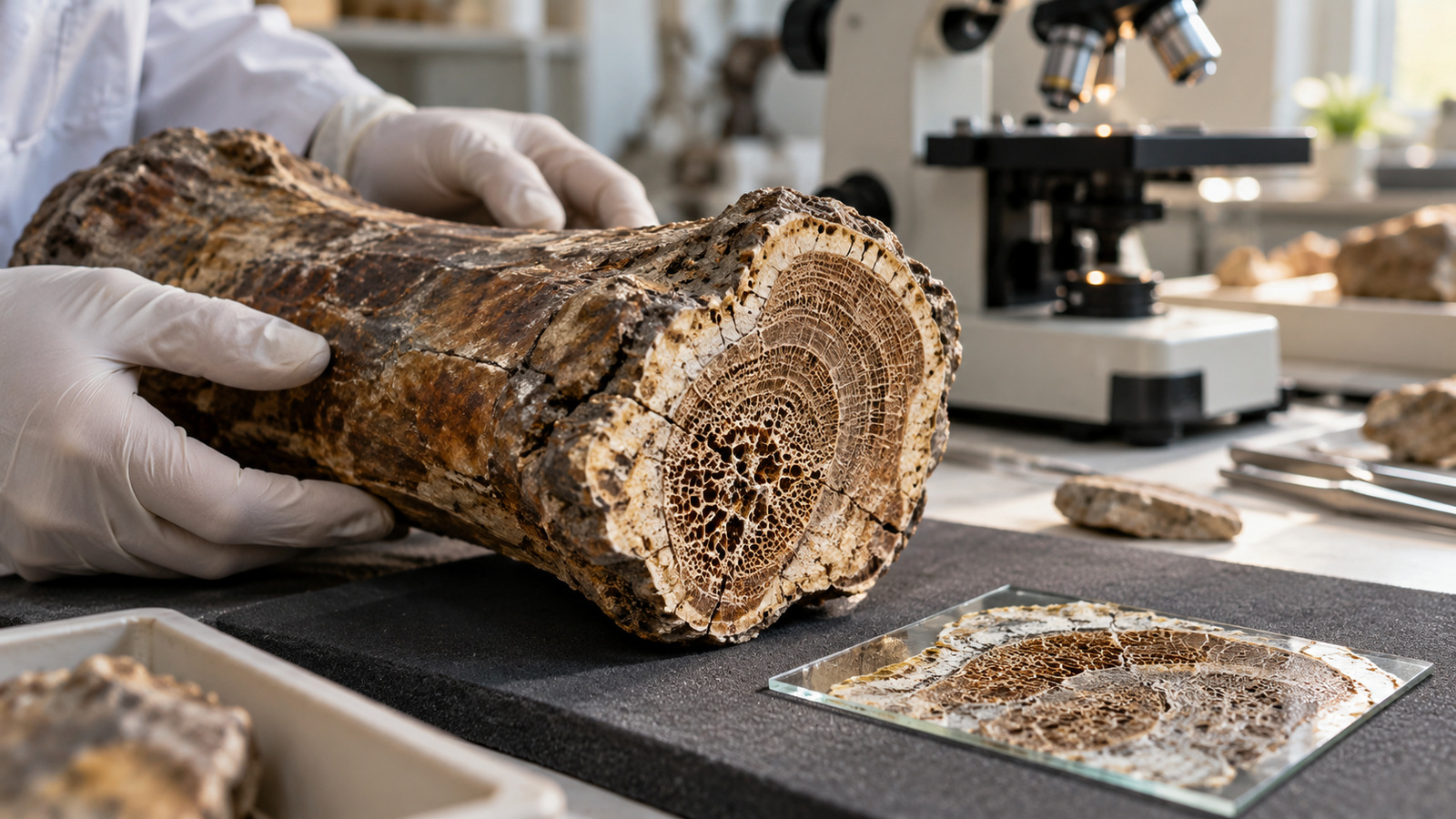
Histology is the study of microscopic tissue structure. In fossil bone, researchers investigate surviving patterns of deposition, vascular spaces, and later remodeling. Preparing a thin section allows light to pass through a small sample so that those structures can be examined. Sampling is a scientific and curatorial decision because removing material can affect a valuable specimen.
The bone chosen and the position sampled matter. Different elements do not necessarily preserve identical records, and the center of a limb bone can differ from its outer regions. Researchers document the sample’s location and compare equivalent regions when possible. That context helps distinguish biological information from differences created by sampling methods or preservation.
Growth marks can preserve repeated intervals of development
Many dinosaur bones contain changes associated with slowing or interruption of deposition. Lines of arrested growth are among the features used to investigate age. Their interpretation draws on the organization of the surrounding tissue, comparisons with living animals, and patterns across the skeleton. A visible dark line is not automatically an annual mark merely because it resembles one.
Where annual interpretation is justified, the sequence can provide a minimum record of elapsed growth intervals. Spacing between marks also informs the reconstruction: broad zones and closely packed outer marks can indicate different developmental conditions. However, the bone surface does not preserve an exact calendar date of hatching. Researchers reconstruct years and stages with uncertainty around the missing beginning and incomplete intervals.
The familiar tree-ring comparison is useful but imperfect. Bone remodels extensively and can lose its earliest deposited regions, while the skeleton contains many elements with different histories. A tree-like picture of intact concentric birthdays can therefore be misleading. The challenge is to establish which parts of the record survive and how they relate to the living animal’s development.
A Gorgosaurus fibula shows the count becoming an age
In Erickson and colleagues’ 2004 study, the Gorgosaurus specimen FMNH PR 2211 supplied an unusually clear example. A thin section of its fibula preserved five growth lines in a record the researchers considered complete. They interpreted the animal as having died early in its sixth year. The observed result was five lines; the age statement included the unfinished interval after the last one. Because the early record survived, they did not need to invent extra missing years for that section. An older, remodeled bone presents a different calculation: its surviving count may omit the beginning, requiring comparison with smaller specimens or other elements to estimate what was lost. Thus a complete five-line record can be more informative than a larger count with an unknown missing center. The reported age follows from both the marks and the condition of the tissue containing them, rather than from counting dark rings alone.
Several bones can cross-check one individual’s history
A dinosaur skeleton can contain elements preserving complementary information. Expansion of a limb bone’s internal cavity can remove its earliest tissue, while a rib or another element retains useful marks. Comparing their records helps locate a gap rather than merely produce competing totals. A count corrected for lost tissue should identify the inferred addition separately from the marks still visible. Agreement across elements strengthens the resulting history, though their different growth and remodeling need not leave identical sequences.
Local growth and mechanical demands can affect tissue. A difference between two bones need not mean one analysis is automatically wrong. Researchers must consider whether the samples occupy comparable positions and whether damage or unusual remodeling obscures the record. The goal is a coherent account of the individual, not simply selecting whichever section produces the most impressive age.
Additional samples also help evaluate pathology. Disease, injury, or abnormal loading can alter local bone formation in ways that complicate a normal growth interpretation. These changes need to be identified before they are treated as ordinary annual signals. Anatomical and microscopic observations work together in making that distinction.
Maturity provides a stage, not necessarily an exact number
Slowly deposited outer tissue and tightly spaced marks can indicate that substantial skeletal growth was approaching an end. Researchers may also examine fusion and changes in surface texture. Such evidence helps distinguish a rapidly growing individual from one near mature size. It does not automatically reveal the exact year of birth or first reproduction.
Fusion is particularly easy to overinterpret. Different bones and joints can fuse on different schedules, and those schedules vary among lineages. One fused structure cannot universally classify every dinosaur as an old adult. Maturity assessment is stronger when several anatomical and tissue indicators agree.
Small does not always mean young, and large does not always mean old
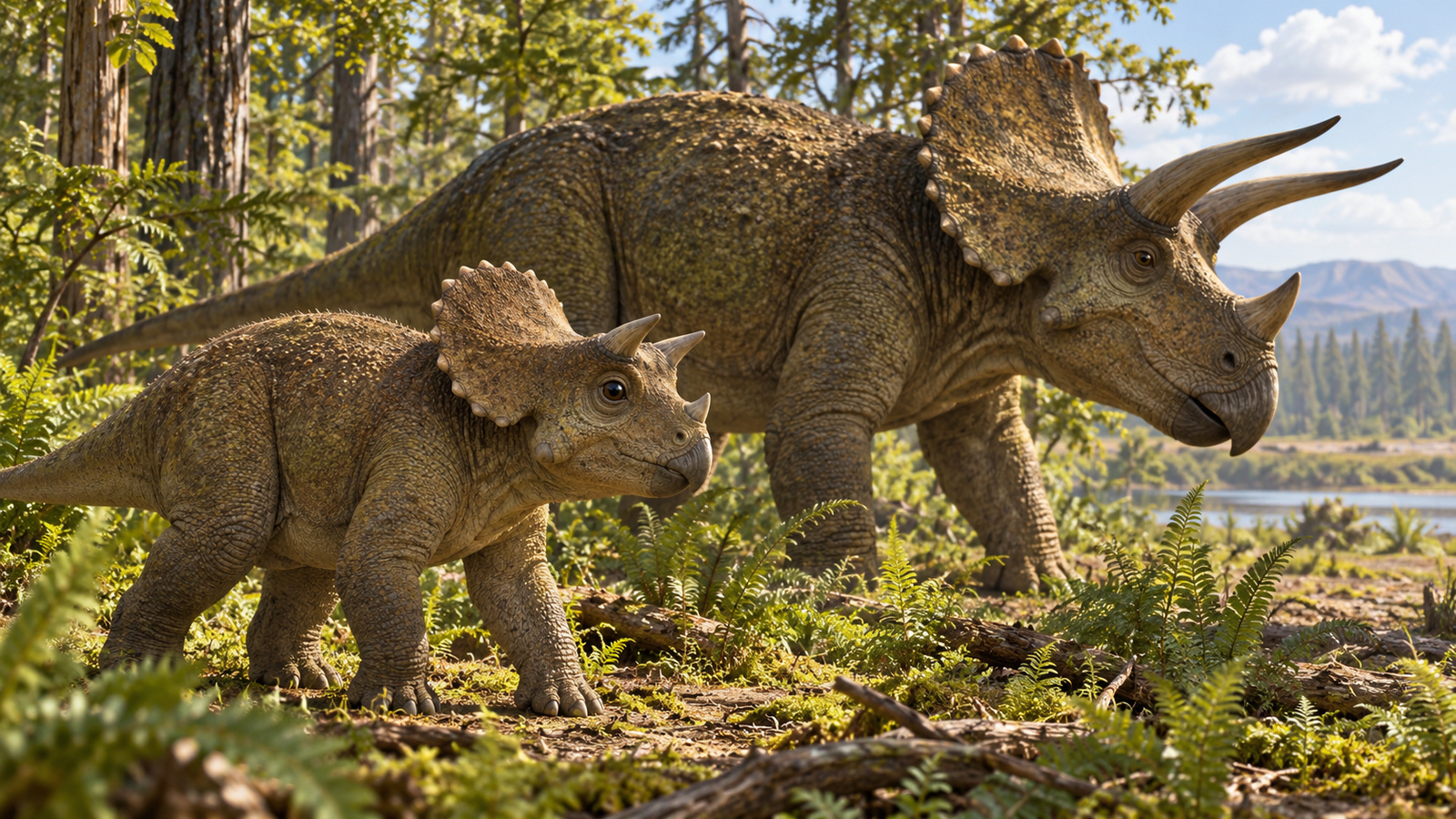
Body size depends on species identity, individual variation, and developmental history. A small adult species can resemble the juvenile stage of a larger relative, especially when material is incomplete. Conversely, a large individual may still preserve evidence of continuing growth. Age estimates must therefore begin with a defensible identification rather than letting size decide both species and maturity. A useful analysis tests those interpretations against anatomy and tissue. This prevents a circular argument in which a fossil is called juvenile because it is small and then used to prove that all small fossils belong to one large species.
Growth series help recover what one skeleton cannot
A set of specimens can represent several stages of a species’ life. Measurements, tissue features, and age estimates allow researchers to explore how size changed over time. Younger individuals may help estimate the early record missing from an older bone. Older specimens can clarify whether a proposed trajectory actually approaches a plausible mature condition.
A series needs sufficient coverage. If the smallest stages are missing, early growth remains weakly constrained; if only one very large animal is known, the final slowdown may be uncertain. Mathematical models can connect the available observations, but they cannot create new fossils. The resulting uncertainty should remain visible in both age and growth conclusions.
Specimen reassessment can also change the series. Research on Nanotyrannus and Tyrannosaurus illustrates why species identification matters when interpreting small tyrannosaur fossils. An individual belonging to a different species should not be forced into a growth curve simply because it is smaller. Histology and detailed anatomy provide separate evidence that must be reconciled.
Improved imaging can reveal a more complicated record
The visibility of microscopic structures depends partly on preparation, illumination, and the preserved material. Examining a section under different conditions can expose features that were previously difficult to distinguish. Researchers can then revisit whether earlier mark counts captured the full surviving record. A changed count does not mean the bone acquired new years; it means the interpretation of the evidence improved.
New analyses must still explain which structures are being counted and why. A more elaborate image is not automatically a more accurate age estimate. The interpretation should be reproducible and connected with tissue organization, comparisons, and model assumptions. Transparent methods allow others to evaluate the revision rather than merely accept a different number.
The oldest known individual does not establish maximum lifespan
A fossil sample contains animals that happened to die, preserve, survive geological change, and be discovered. It is not a complete record of every individual in a population. The greatest estimated age in that sample is therefore the oldest documented individual under the method used. It need not represent the maximum possible lifespan of the species.
Missing older animals can reflect rarity, preservation, or collecting history. On the other hand, claims of dramatically longer lifespans require positive support rather than speculation about what remains undiscovered. A responsible summary distinguishes an observed age range from a proposed biological ceiling. That distinction is especially important when familiar dinosaur ages are repeated as fixed facts.
Population life histories require still more information. Age distributions can be influenced by the cause of a bonebed, transport, and differences in preservation between young and old individuals. Researchers investigate those effects before interpreting a collection as a normal mortality pattern. An impressive sample can be informative while still representing a particular event rather than an entire living population.
Injury and wear offer supporting clues with important limits
Healed damage shows that an animal survived after an injury, but usually does not provide a direct age in years. Worn teeth may reflect food, replacement, and use rather than simple chronological accumulation. Skeletal wear and pathology can add information about an individual’s history, yet they are not universal age meters. A battered skeleton may have experienced a demanding short life, while an older individual could lack conspicuous external damage. These observations are most useful when combined with histological age indicators and a well-supported developmental assessment. They enrich a biography without replacing the evidence needed to estimate how long it lasted.
Report the estimate at the precision the evidence permits
A strong study distinguishes visible marks, inferred missing intervals, developmental stage, and modeled age. It identifies the sample and explains uncertainty from preservation or interpretation. Depending on the evidence, the appropriate result might be a minimum age, a plausible interval, or a more specific estimate. Unnecessary precision can make a careful analysis sound more certain than it is.
For readers, useful checks are straightforward: Was bone tissue examined? Could early marks be missing? Is the animal securely identified? Are geological age and age at death kept separate? Those details reveal how much evidence sits behind an apparently simple statement that a dinosaur was a certain number of years old.
Microscopic evidence adds years to a prehistoric biography
Scientists estimate dinosaur age at death by interpreting bone growth records and comparing them with maturity indicators, other skeletal elements, and developmental series. The approach can reveal much more than whether an animal was small or large. It connects an individual body with a history of growth. Preservation and biological remodeling impose limits, but those limits can be investigated rather than ignored. The result is strongest when the evidence and assumptions remain attached to the number. A fossil’s geological date tells us when its world existed; histology helps ask how long this particular animal lived in it. Keeping those clocks separate makes both more meaningful. Together they place a dinosaur not only within deep time, but within its own finite lifetime.