Becoming enormous involved a life history, not one universal growth rate
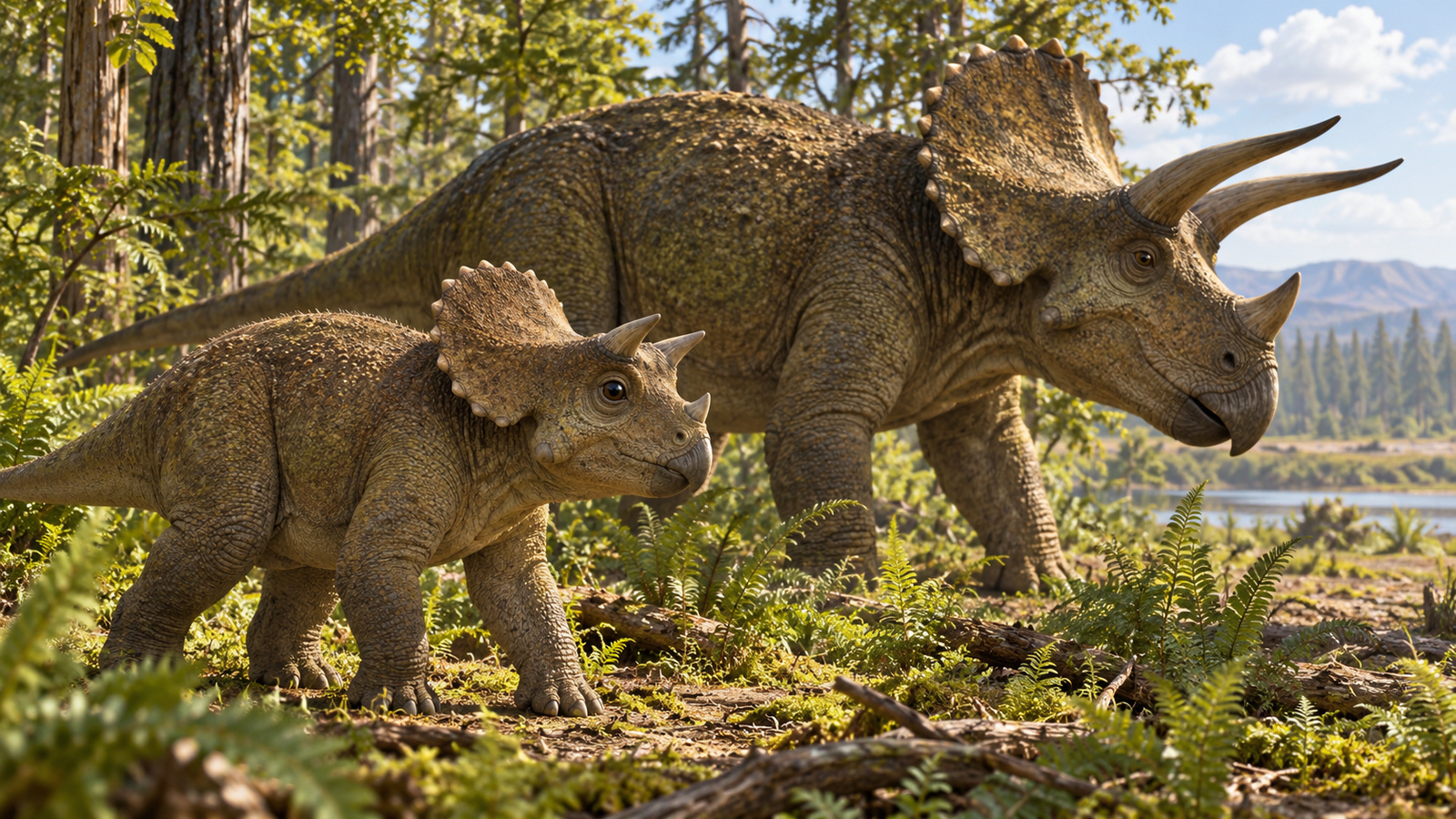
A dinosaur that eventually weighed many tonnes began life inside an egg. Between those extremes lay years of feeding, bone formation, changing proportions, and survival through vulnerable stages. Some dinosaurs added body mass remarkably quickly, but their growth did not follow a single timetable shared across the group. A small feathered theropod, a horned herbivore, and a gigantic sauropod faced different demands and inherited different developmental patterns. Even the word mature can refer to several milestones: an animal might reproduce before its skeleton approached final size. Scientists reconstruct those histories from microscopic bone tissues, growth marks, anatomical series, and models that connect size with age. A useful answer gives actual estimates with their context: an older T. rex model peaked at roughly two kilograms of mass gain per day, while a 2026 reconstruction extended the approach to final size into the late thirties. Maiasaura research describes a different, much shorter route to skeletal maturity. These are study-specific estimates, not interchangeable numbers. Together they show why the journey from an egg to adult size needs both a scale and a timetable.
A: No. Rates and developmental schedules varied among lineages and individuals.
A: No. Three-dimensional shape and changing proportions complicate that relationship.
A: It approximates an older modeled peak annual T. rex gain divided across a year, rather than identical gains measured on successive days.
A: Lost tissue and difficult-to-see marks can make the surviving record incomplete.
A: Its preferred model approached leveling-off size at about thirty-five to forty years, later than earlier estimates; this is a modeled timetable, not a universal lifespan.
A: Their diversity and uneven fossil sampling make a universal rate inappropriate.
A: Different elements can preserve different portions of an individual's growth history.
A: Size depends on species and development as well as chronological age.
A: That is biologically plausible, but a specific cause needs supporting fossil context.
A: New specimens, identification changes, imaging, and modeling can alter the reconstruction.
First decide which kind of growth is being measured
Growth can describe increasing length, expanding bone circumference, or accumulating total body mass. These measures are related but not interchangeable. An animal can change shape while growing, so twice the length does not mean twice the weight. A useful rate must specify both the quantity and the interval over which it was estimated.
Average growth across several years also differs from a short interval of especially rapid growth. A daily figure in a popular account often comes from dividing a modeled annual increase by the number of days, rather than from evidence that the dinosaur gained an identical amount each day. Fossils generally support a trajectory more securely than a precise daily schedule. Interpreting a published rate requires understanding that distinction.
Species comparisons need the same care. A larger animal can add more kilograms while increasing by a smaller proportion of its existing mass. Absolute growth and relative growth answer different biological problems. Both can be informative when their definitions and uncertainty remain visible.
The familiar T. rex timetable is still being tested
Older T. rex estimates gave the growth spurt a dramatic scale. Erickson and colleagues’ 2004 analysis placed especially rapid mass increase in adolescence, approximately between ages fourteen and eighteen. Its 2015 correction reported a modeled peak of roughly 774 kilograms per year using the instantaneous calculation. Dividing that by a year gives about two kilograms a day, but it describes the steepest part of a fitted curve, not a fossilized sequence of daily weigh-ins.
A 2026 analysis by Woodward and colleagues proposed a slower, more prolonged route toward final size. Its preferred model approached its leveling-off size at about thirty-five to forty years, roughly fifteen years later than previously reported. The researchers included more visible growth marks and compared statistical fits. That changes the biological picture from a relatively compressed adolescent expansion to a longer subadult phase. The older peak rate and the newer timetable belong to different reconstructions and should not be combined as though they describe one agreed life history.
The distinction between a model’s final plateau and a fossil’s age matters here. A curve can estimate the point at which further increase becomes small even when no specimen preserves that entire lifetime. Thirty-five to forty years is therefore a modeled approach to adult size, not proof that every T. rex lived forty years. Likewise, a growth spurt does not mean that earlier or later years contributed no new tissue.
Which fossils enter the curve also affects the answer. Some small tyrannosaurs once included as young T. rex have been reassessed as Nanotyrannus, a distinct animal. The defensible comparison keeps the study, sample, and measured quantity attached to each result. Both generations of work describe rapid development into a huge body; they disagree substantially about how the years of that development were distributed.
Maiasaura supplies a contrasting timetable
A 2015 study of fifty Maiasaura shinbones reconstructed a much shorter developmental schedule for this duck-billed dinosaur. During its third year, the modeled animal had reached about 1,260 kilograms, around thirty-six percent of the fitted final mass; skeletal maturity followed after about eight years. These estimates describe a sampled population and particular model, not all hadrosaurs. Even so, they offer a useful contrast with a tyrannosaur approaching giant size over decades. The difference cannot be summarized merely as all dinosaurs growing quickly: species differed in adult mass, early tissue production, and the time taken to approach mature dimensions.
Sauropod giants faced a different scaling problem
Sauropods combined relatively small beginnings with extraordinary adult size. Growing into that body required substantial tissue production over an extended period and a reliable supply of resources. Histological evidence supports rapid growth during important parts of development in many studied sauropods. It does not provide a universal number of years to full size for the entire group.
Length and mass are particularly easy to confuse in these animals. An elongating neck or tail changes total length without adding the same mass as an equivalently enlarged trunk. Reconstructing body mass from incomplete material therefore introduces uncertainty into calculated growth rates. A credible estimate connects the bone sample, the individual, the body reconstruction, and the mathematical conversion explicitly.
Bone formed an internal record while the animal lived
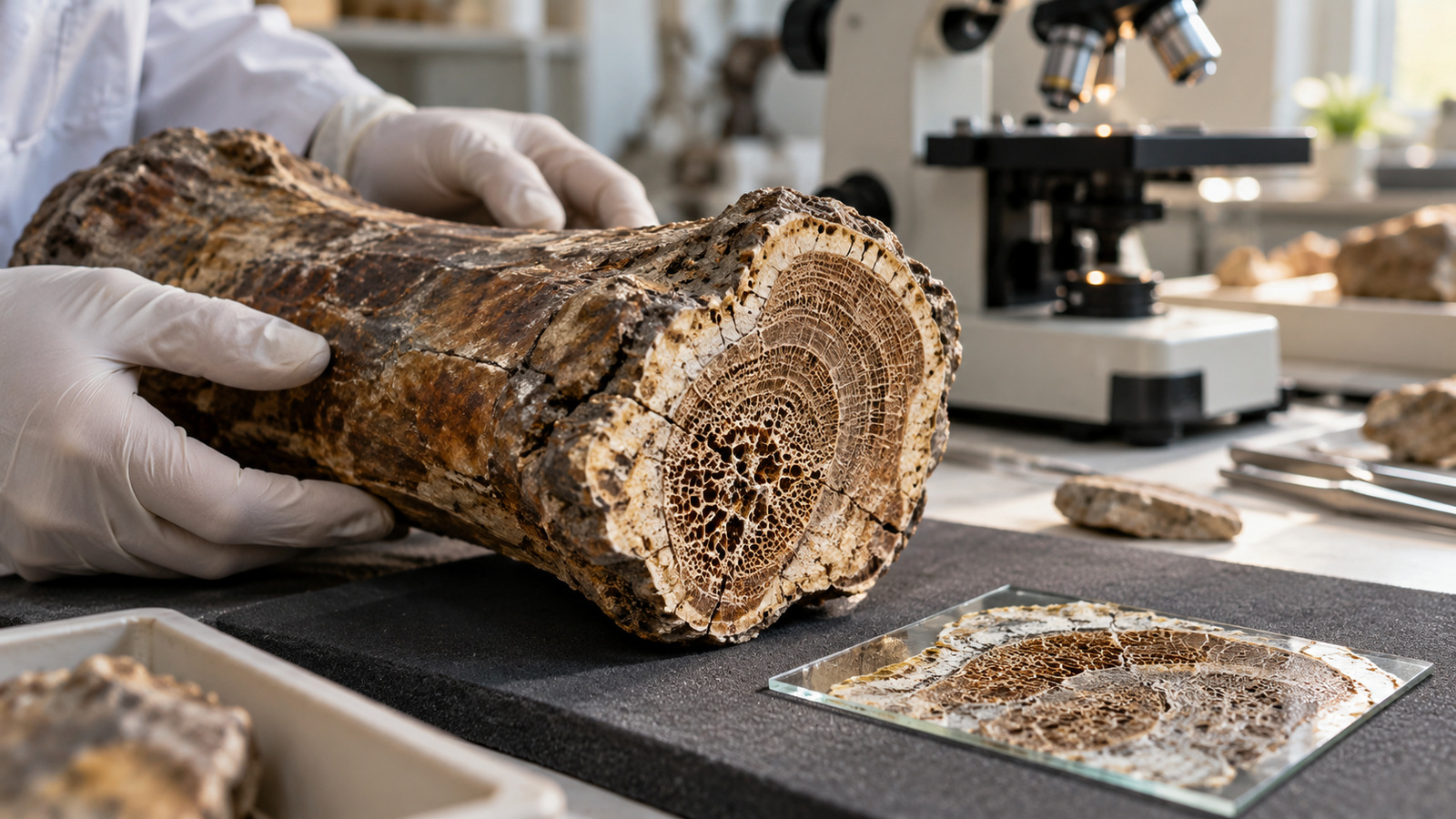
Bone is living tissue, supplied by blood vessels and altered as the body develops. New material expands a limb bone, while internal remodeling can remove older layers. A thin section reveals that architecture under a microscope, including changes invisible on the outside of an intact skeleton. The surviving record therefore resembles an edited diary: later chapters may be clear even where part of the beginning has gone. Comparing elements and smaller individuals helps recover the missing context. Those observations supply the age estimates needed before researchers can calculate a growth rate.
Growth marks help turn tissue into a timeline
Many dinosaur bones contain changes in tissue deposition, including lines of arrested growth. These can mark intervals when deposition slowed substantially or stopped. Repeated patterns are often interpreted within an annual framework, informed by living-animal comparisons and broader tissue organization. Their spacing can help reconstruct how growth changed through life.
Counting visible marks is not always enough. Expansion of the central cavity and remodeling can remove older tissue, while closely spaced or subtle marks can be difficult to recognize. An animal may therefore have been older than the surviving count initially suggests. Researchers investigate missing portions and compare samples instead of treating every visible line as an uncomplicated birthday.
Rapid tissue formation did not mean every dinosaur grew identically
Vascular organization and bone texture provide information about deposition rates. Some dinosaur tissues indicate substantial, sustained growth compared with the slowest-growing living reptiles. That broad result helped change older pictures of dinosaurs as uniformly sluggish animals. It does not establish identical physiology or a single rate across every lineage.
Different bones can record different aspects of the same individual. A limb region supporting rapidly changing loads may not preserve the same record as another element. Sample choice therefore affects comparisons. Using multiple elements or consistent sampling positions helps reduce the risk that local differences are mistaken for species-wide biology.
Tissue also changes as growth progresses. Rapidly deposited inner regions and more slowly deposited outer layers may document a changing trajectory within one bone. Those patterns are especially valuable when interpreted together with growth marks and overall size. Anatomy, age indicators, and tissue organization provide complementary evidence rather than competing shortcuts.
A growth curve combines individuals into a proposed history
A fossil animal usually supplies one death point rather than observations spanning its entire life. Researchers combine specimens interpreted as different ages and sizes to reconstruct a curve. Mathematical models can describe early growth, an interval of faster mass increase, and a later slowdown. The shape depends on data quality, sample coverage, and the chosen model. Very young animals and the largest adults are often poorly represented, creating uncertainty near the ends of the trajectory. A curve is therefore a tested synthesis of specimens, not a direct measurement of one individual from hatching to death. Its reliability improves when assumptions, error ranges, and alternative fits are reported clearly.
Reproductive maturity and near-adult size could arrive separately
An animal can become capable of breeding before it finishes growing. Evidence interpreted as medullary bone, a temporary calcium-related tissue associated with egg production in living birds, has helped investigate reproductive status in some dinosaurs. That evidence addresses a particular biological milestone. It does not automatically prove that the individual’s skeleton had stopped increasing in size.
Conversely, a slowdown in skeletal growth does not reveal the exact date of first reproduction. Different kinds of maturity require different evidence. Research combining reproductive indicators and growth analysis showed why dinosaur life histories cannot simply be forced into one familiar living-reptile pattern. Broad conclusions remain useful even when particular specimen ages or identifications are later reassessed.
Near the outside of some bones, tightly spaced growth marks and slowly deposited tissue can indicate a strong reduction in growth. Researchers evaluate these features in anatomical context rather than declaring every large specimen fully grown by appearance. Size alone is especially misleading when related species differ in adult dimensions. A relatively small mature animal is not necessarily a juvenile of the largest species nearby.
Growing quickly offered benefits with real costs
Increasing size could reduce vulnerability to some predators, expand the range of available foods, or change competitive relationships. These potential benefits help explain why growth strategy matters ecologically. But new tissue requires resources, and a rapid trajectory can be difficult to sustain when conditions deteriorate. Fast growth was not automatically advantageous under every circumstance.
Life history involves tradeoffs among growth, maintenance, reproduction, and survival. Fossils provide only some of the information needed to quantify those tradeoffs. A large adult skeleton establishes successful growth to that point, while saying less about the individuals that died before reaching it. Population-level conclusions therefore need more than a collection of unusually impressive survivors.
The strongest estimates state both the achievement and the uncertainty
To assess a dinosaur growth claim, identify the species, the specimens, the sampled bones, and the quantity being estimated. Then ask how ages were reconstructed and whether missing tissue or uncertain identification could change them. A rate without those foundations is difficult to evaluate. Even a well-supported estimate should not be transferred automatically to unrelated dinosaurs.
Many dinosaurs grew substantially faster than the slowest-growing reptiles familiar today, and some achieved enormous increases in mass. Their developmental schedules nevertheless varied, and maturity was not one event shared across the group. Bone histology and growth modeling make those differences increasingly accessible. The most useful answer explains how a lineage grew, which evidence supports that history, and which parts remain open to revision.
That approach preserves the wonder of a hatchling becoming a giant without inventing precision. A microscopic mark can reveal a stage of development, while a growth series connects those stages with changes across the skeleton. Together they turn size into a biological history. Further discoveries can then refine the timetable rather than merely adding another oversized number to a prehistoric fact sheet.