A walking ostrich offers clues, but it cannot stand in for every dinosaur
Watching an ostrich cross a field makes a two-legged dinosaur easier to imagine. The bird balances a forward-projecting body over alternating hind limbs, places its toes carefully, and adjusts its posture without thinking about the mechanics. Yet copying that walk onto Tyrannosaurus would overlook major differences in tail mass, hip anatomy, and overall size. An elephant provides another useful comparison for supporting a huge body, but its limbs and feet cannot simply replace those of a sauropod. Scientists use modern animals as testable comparisons rather than complete substitutes. Fossil joints, muscle attachments, body proportions, and trackways determine which features transfer convincingly. Dinosaurs walked and ran using the same physical principles that govern living animals, while combining those principles in body plans for which no exact modern counterpart survives.
A: They are living dinosaurs, although highly specialized descendants.
A: The conspicuous lower bend is the ankle region, not the knee.
A: It informs loading comparisons without reproducing the extinct anatomy.
A: They provide the other living archosaur lineage for anatomical comparisons.
A: Speed and gait mechanics need to be evaluated separately.
A: Some living animals use running mechanics without an aerial phase.
A: Whole-body mass distribution and joint anatomy must first support that proposed posture.
A: Its forces, joints, and anatomy still need independent tests.
A: Experiments reveal how anatomy and substrate jointly shape impressions.
A: None; comparisons work best for specific structures and mechanical problems.
Birds are relatives with a long history of their own
Modern birds belong within the dinosaur family, making them especially valuable for investigating extinct theropods. Their muscles, tendons, balance systems, and developing skeletons can be studied directly. Shared ancestry supports comparisons that would be much harder to establish from appearance alone. Nevertheless, living birds are specialized descendants, and their anatomy includes changes accumulated after their ancestors diverged from other dinosaur lineages.
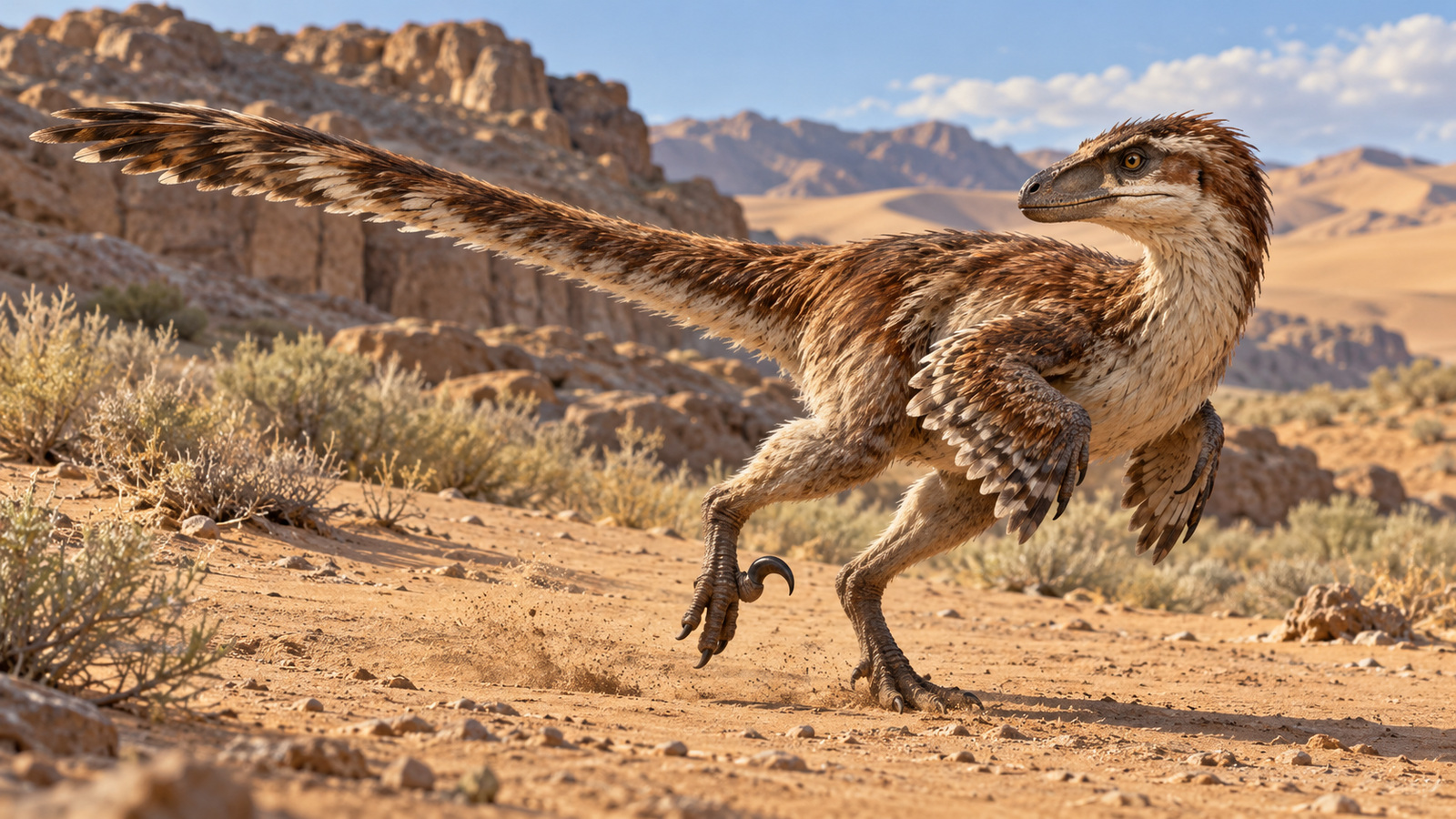
A typical bird has a shorter bony tail than many nonavian theropods and carries its body differently over the legs. The thigh can remain relatively tucked forward while motion farther down the limb contributes prominently to a step. A long-tailed theropod distributed more mass behind its hips. These differences affect balance and muscle demand, even when both animals leave alternating three-toed tracks.
Research connecting archosaur body shape with locomotion demonstrates why changes in the whole body matter. A reconstruction should therefore compare individual anatomical relationships rather than assign an entire modern gait by resemblance. A bird may illuminate a muscle action while remaining a poor model for the extinct animal’s complete posture. Relatedness is a powerful guide, but it is not a license to ignore structural differences.
A backward-looking joint is usually not a backward knee
The conspicuous backward bend in a standing bird’s leg is the ankle region. Its knee sits higher, often concealed by feathers and body tissue, and bends in the familiar forward direction. Birds and many extinct dinosaurs support themselves on their digits, leaving an elongated part of the foot above the ground. The visible outline therefore differs from a human leg even though the major joints can be matched. At a museum skeleton, start at the pelvis and follow the thigh bone to the knee, then the lower leg to the ankle and onward to the toes. This gives each bend a location before a reconstructed pose is compared with a living animal. The distinction also changes how a step is understood: bending the ankle, lifting the toes, and rotating the thigh move different segments and create different paths through space.
Crocodilians help recover anatomy beyond the skeleton
Birds and crocodilians bracket the living archosaur lineages around extinct dinosaurs. When corresponding structures occur in both groups, researchers can use that distribution to evaluate whether an extinct relative probably possessed them. Muscle reconstructions draw on this approach together with attachment evidence on the fossil itself. The comparison is about evolutionary relationships and anatomical correspondence, rather than assuming a dinosaur moved like a crocodile.
Living crocodilians also demonstrate a greater repertoire of terrestrial posture than the familiar low sprawl alone suggests. Their movements help researchers investigate how muscles operate under different arrangements. But the hip, limb proportions, and body distribution of a dinosaur can impose a very different solution. A shared muscle need not have identical leverage or contribute equally to every phase of locomotion.
Combining both living groups is stronger than choosing whichever single animal produces the most dramatic animation. If a proposed muscle arrangement conflicts with preserved attachments or joint geometry, the reconstruction needs revision. Where soft tissues remain uncertain, models can test several plausible versions. Anatomical bracketing narrows the possibilities without preserving every detail of the extinct animal’s movement.
Mammals provide mechanical tests rather than family portraits
Horses, elephants, humans, and other mammals offer abundant observations of locomotion, but they are not close dinosaur relatives. Their value lies partly in showing how physical demands change with size, posture, and speed. Force measurements and motion studies can reveal general relationships between support, propulsion, and energy use. Those relationships can inform a dinosaur model while its anatomy remains reconstructed from more appropriate evidence.
An elephant is useful when considering how a heavy animal supports itself and manages loading. It does not establish that a sauropod placed each foot in the same sequence or used identical joint motion. Likewise, a sprinting mammal cannot supply a theropod’s speed simply because the animals have similarly long legs. Shared physical constraints must be separated from inherited structures and specialized performance.
Walking and running have more than one mechanical definition
In ordinary language, running often means moving quickly, but researchers can distinguish gaits through foot contact, the motion of the body’s center of mass, and patterns of energy exchange. Walking commonly uses mechanics compared with an inverted pendulum, while running often involves spring-like compression and rebound. These are useful models rather than perfect descriptions of every step. An aerial phase, when no foot contacts the ground, can be informative, but its absence does not automatically resolve every unusual gait. Some living animals show grounded running mechanics. For extinct dinosaurs, fossils seldom reveal all the variables needed to apply every definition directly. Researchers therefore need to explain whether they mean contact pattern, mechanical behavior, or simply relatively rapid travel when they describe a reconstructed run.
Footprints let living comparisons face fossil evidence
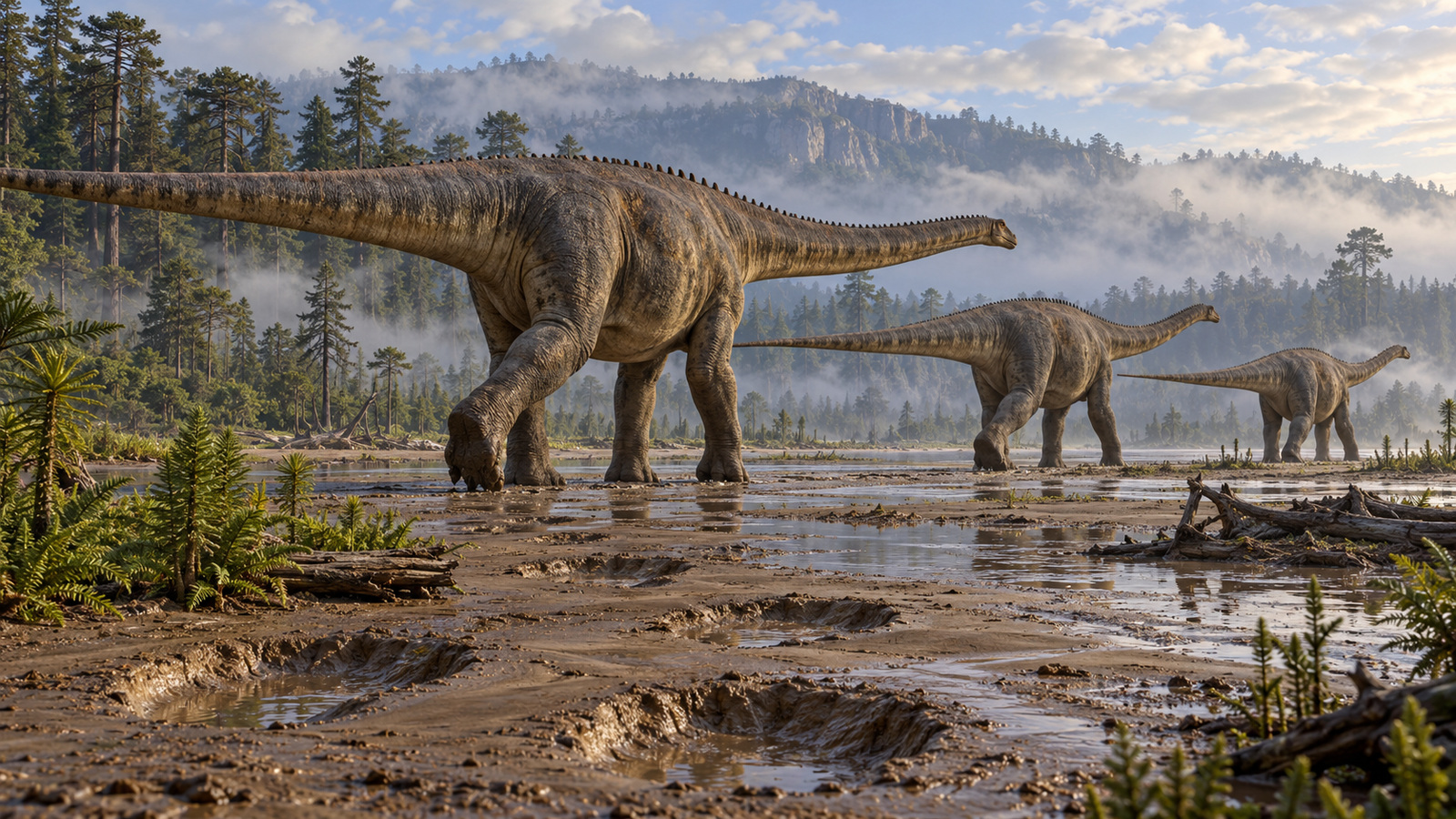
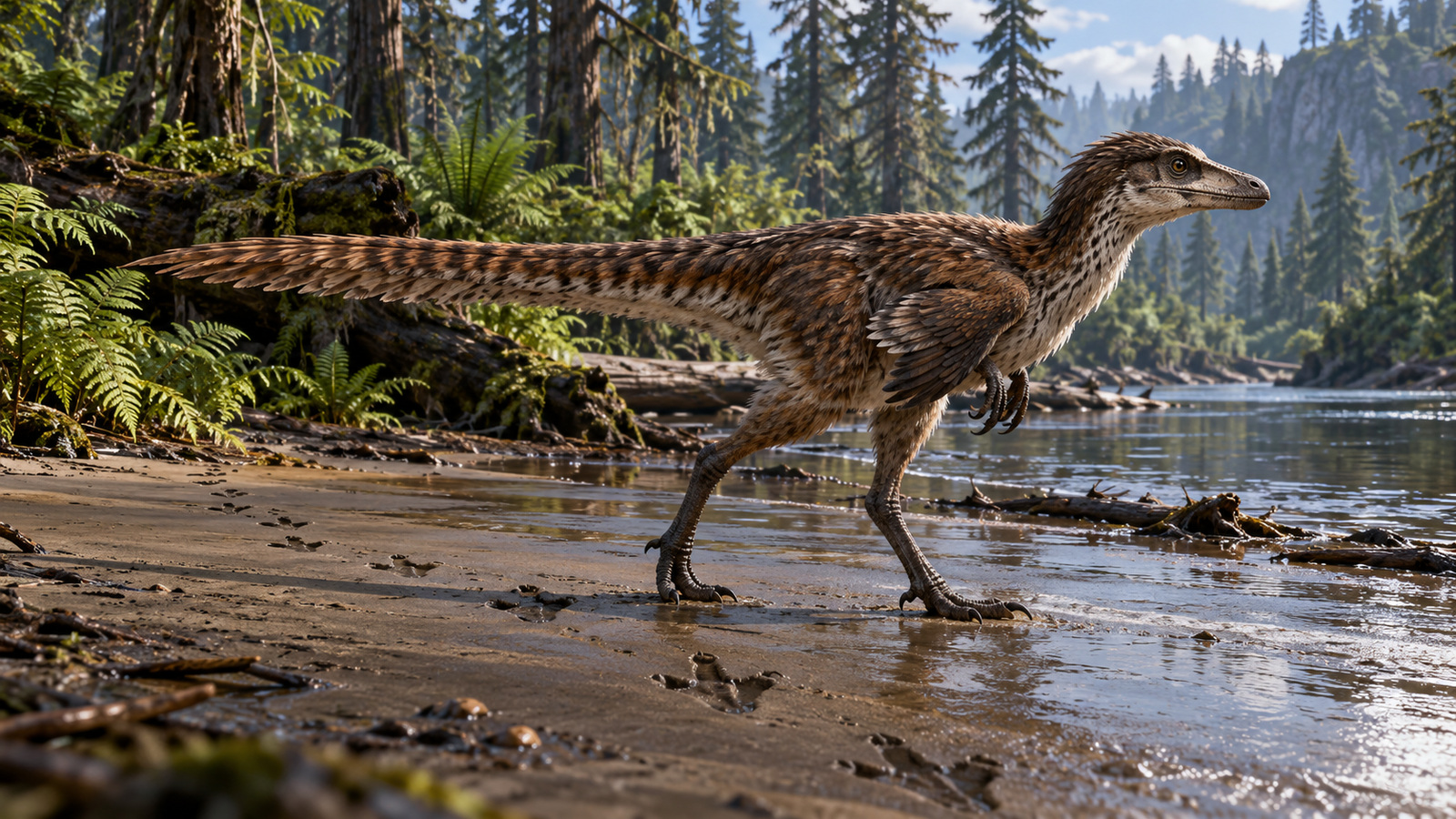
A model predicts where feet should land and how stride length changes with body size or speed. A trackway can supply independent evidence of actual placements. The comparison becomes useful when estimates of the maker’s dimensions, the substrate, and preservation are considered together. The resulting interpretation connects a real passage with anatomical possibilities rather than relying entirely on an animated skeleton.
The Australian Museum’s account of dinosaur locomotion describes how stride and estimated limb dimensions contribute to speed estimates. That is a reconstruction of a recorded movement, not a measurement of the maker’s maximum ability. Living animals help establish relevant relationships, but uncertainty in identifying and sizing a trackmaker remains. A familiar footprint shape cannot erase those limits.
Tracks also record interactions with deformable ground. A foot can sink, slip, withdraw, or leave pressure traces below the original surface. Modern experiments help explain these effects and prevent sediment distortion from being mistaken for unusual anatomy. A strong comparison asks whether both the animal and the ground could have produced the observed pattern, rather than treating each print as a perfect outline of a foot.
A long tail changes the balance problem
Many extinct dinosaurs carried a substantial muscular tail that has no close equivalent in most living birds. It contributed mass behind the hips and provided attachment or origin regions for locomotor muscles. Reconstructing its volume and position changes the distribution of the whole body. A model with an unrealistically thin tail may therefore reach different conclusions about support and muscle requirements.
The tail’s effect on turning also depends on its mass distribution and flexibility. A modern animal with a much shorter tail may rotate its body differently even if its feet look superficially similar. These issues make whole-body reconstructions essential. A comparison based only on the hind legs can miss an important part of how the extinct animal controlled its motion.
Big dinosaurs could not simply scale up small-animal gaits
Size changes the loads that limbs must withstand and the amount of force required to accelerate a body. A small animal’s rapid movement cannot be transferred to a multi-tonne dinosaur by enlarging each frame of an animation. Bone dimensions, muscle leverage, joint loading, and stability must remain feasible. The consequences of a fall also become different as mass increases.
Modern large animals provide useful tests of these constraints, but there is no living terrestrial animal matching the largest sauropods in both mass and body plan. Models must therefore explore conditions beyond direct modern examples. This does not make the problem hopeless. It makes sensitivity testing and clear statements of uncertainty especially important when evaluating proposed speeds or unsupported gaits.
Efficiency and maximum speed must also be separated. A giant animal could travel effectively at a sustainable pace without being able to perform a spectacular sprint. Small gains in economical movement might matter during repeated trips between feeding areas. Comparing every dinosaur by its fastest imagined chase overlooks the performance most relevant to ordinary life.
Growth can change which modern comparison is useful
A hatchling and an adult need not distribute their weight in the same proportions. As the head, trunk, limbs, and tail change, support and locomotor demands can shift. Evidence from Mussaurus growth stages, for example, has been used to reconstruct changes in stance during development. That does not establish an identical transition for every dinosaur. It shows why a reconstruction based solely on an adult can conceal important earlier mechanics. A living comparison must match the feature and growth stage being investigated, while fossil growth series determine whether the proposed change actually fits the extinct lineage.
Animation is a result to test, not independent proof
A digital animal can be made to move smoothly even when its muscles would be unable to supply the required forces. Attractive motion is therefore only an initial presentation of a hypothesis. Mechanical tests must evaluate support, joint limits, muscle action, and ground contact. Independent trace evidence can then constrain whether the proposed movement fits actual fossil behavior.
Useful studies report how the outcome changes when uncertain inputs vary. If a small change in tail mass or muscle arrangement radically alters the result, that sensitivity belongs in the conclusion. A single number without those assumptions encourages false confidence. Living animals help validate methods, while the fossil anatomy determines how cautiously those methods can be extended.
The strongest answer is a set of specific comparisons
Dinosaurs shared the physical demands of walking and running with modern animals, and living birds preserve a particularly important evolutionary connection. Crocodilians help reconstruct inherited anatomy, mammals broaden our understanding of mechanics, and experiments reveal how tracks form. Each comparison answers a narrower problem. No one animal can replace the entire evidence base for a dinosaur’s gait.
A well-supported reconstruction names what is being compared, explains why the comparison is appropriate, and tests it against fossils. It might borrow insight about muscle placement from archosaurs, loading from large living animals, and foot-sediment interaction from experiments. The result is a dinosaur moving according to its own anatomy, informed by the living world rather than copied wholesale from it.
When you next watch a bird walk, the connection is still worth appreciating. Alternating support, careful placement, and coordinated balance make extinct movement less remote. The scientific task begins when that resemblance is examined in detail. Asking which parts match, which differ, and which evidence could distinguish the alternatives turns an everyday observation into a useful question about prehistory.