Every footprint began with a coordinated living body
A row of dinosaur tracks records more than feet touching mud. Each impression began with a body balancing its weight, joints rotating through a limited range, muscles applying force, and a foot pushing against a surface that could slip or deform. Dinosaurs solved those problems in many ways: small bipeds moved on two hind limbs, giant sauropods supported immense bodies on four, and some lineages changed their relationship to the ground as they grew. Their diversity makes a single dinosaur walk impossible to define. Instead, scientists reconstruct movement by combining skeletons with trackways, living-animal comparisons, and mechanical models. Together those clues show animals whose limbs generally supported them beneath the body, whose tails and trunks contributed to balance, and whose everyday travel mattered just as much as the spectacular running often imagined on screen.
A: Many dinosaurs held their tails clear of the ground; posture varied, and unusual traces require their own interpretation.
A: No. Limbs can support a roughly horizontal trunk from beneath.
A: Usually they support a broader kind of trackmaker more securely than a precise species.
A: No. Body plan, size, and mechanical constraints varied substantially among quadrupeds.
A: A sequence with stride information and size estimates is generally needed for a useful speed reconstruction.
A: They can use different assumptions about joints, muscles, body mass, and gait.
A: No. Growth altered proportions, and some lineages changed how they supported their bodies.
A: No. Changing direction requires control and traction in addition to forward movement.
A: No. Pterosaurs were a separate reptile lineage, whereas birds belong within dinosaurs.
A: Combine skeletal anatomy, trace evidence, and mechanical tests while making assumptions explicit.
Upright support changed the starting position
Most dinosaurs carried their limbs relatively beneath the body rather than projecting them broadly to the sides in the manner of a sprawling lizard. This arrangement helped transmit weight through the skeleton and influenced how muscles produced forward movement. It did not make every dinosaur’s legs perfectly straight or identical. Joint orientation, limb proportions, and foot placement varied across a group with an extraordinary range of shapes and sizes.
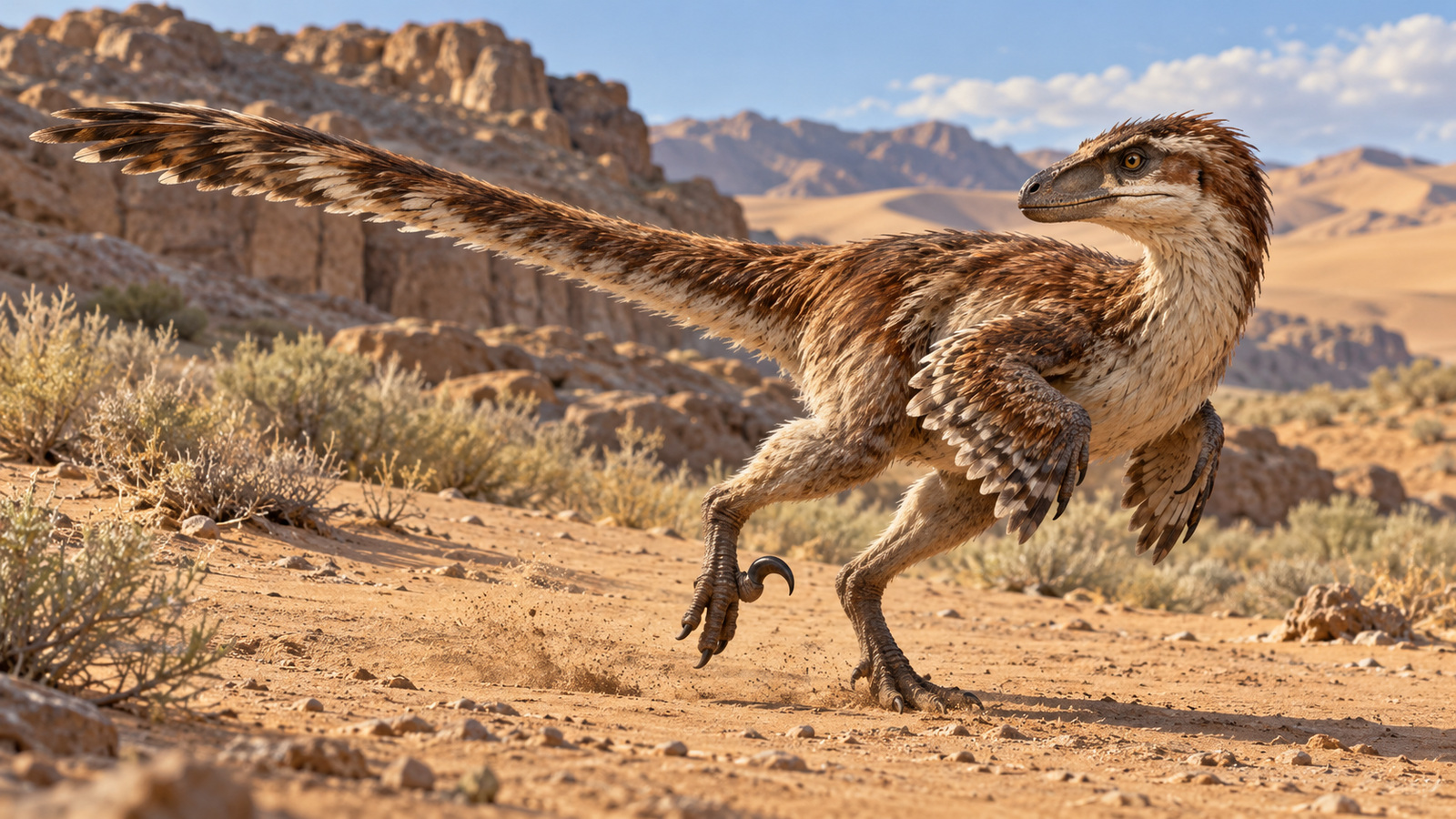
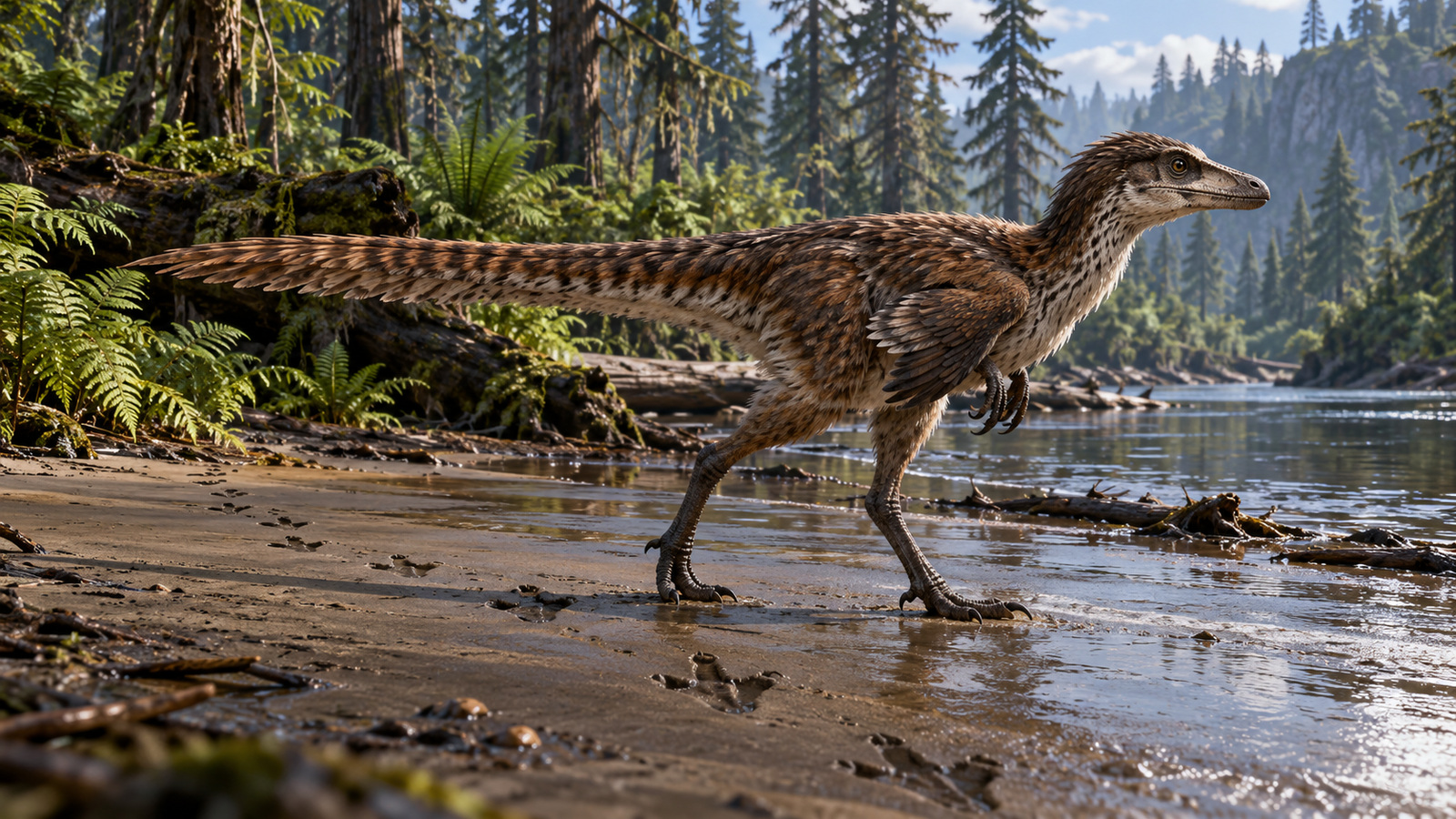
The term upright also needs separating from a vertical torso. A bipedal theropod could have a trunk held approximately horizontally while the hind limbs supported it from below. Older illustrations sometimes placed these animals in a nearly vertical pose with the tail dragging behind. Modern reconstructions generally treat the tail as part of a body balanced over the hind limbs, not as a permanent third leg.
Posture is reconstructed from connected anatomy. The pelvis, limb joints, vertebral column, and feet must fit together in a mechanically plausible arrangement. An attractive pose that forces a joint outside its likely range is poor evidence for movement. The skeleton sets constraints before a model attempts to animate a stride.
Two-legged dinosaurs balanced more than a pair of legs
Bipedal movement requires control of a body that is supported by alternating feet. The head and torso contribute mass in front of the hip region, while the tail contributes behind it. Their combined distribution helps determine where the center of mass lies. Changing the reconstruction of soft tissue can shift that balance and alter estimates of muscle demand.
A moving tail also has mechanical roles beyond serving as a visual counterweight. Muscles associated with the tail could contribute to hind-limb motion, and tail mass affected how the body responded to turning. Different dinosaurs had different tail structures and flexibility. A useful reconstruction evaluates those differences rather than adding the same swinging appendage to every biped.
Four-legged movement distributed support differently
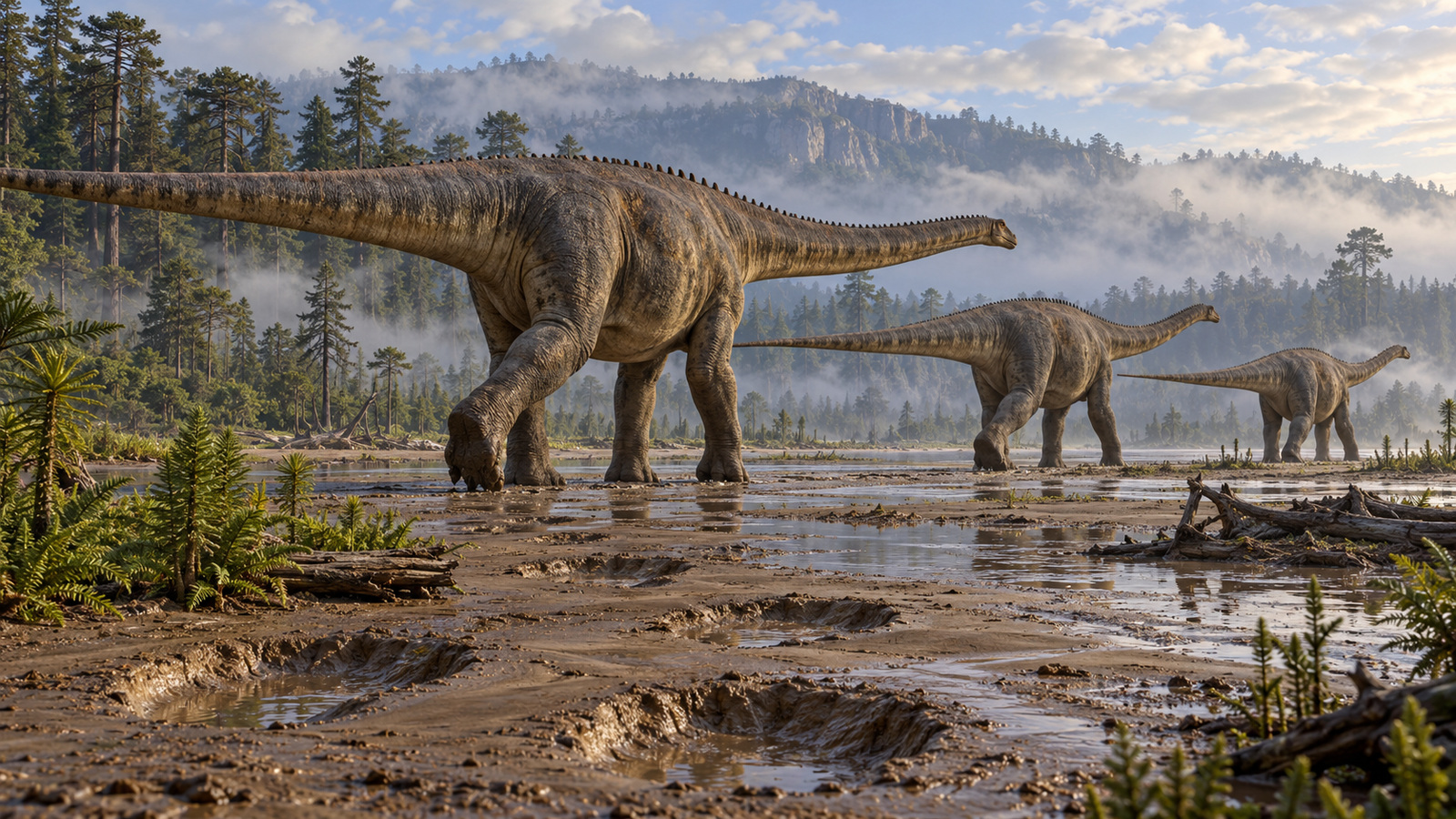
Quadrupedal dinosaurs shared support between forelimbs and hind limbs, but the distribution was not uniform. Sauropods, horned dinosaurs, and armored dinosaurs had different trunk shapes, limb proportions, and foot structures. A long-necked animal shifting its head was dealing with a different balance problem from a low-bodied animal carrying heavy armor. Their walking cycles therefore should not be animated as one generic four-legged gait scaled to different sizes. Fossil hands and feet are particularly valuable because they constrain how each limb contacted the ground. Trackways add evidence of spacing and sequence that a mounted skeleton alone cannot provide.
Feet carried weight and transmitted propulsion
The foot was an interface between a moving body and an unpredictable surface. Toes, claws, pads, and supporting bones distributed pressure and contributed to traction. Some bipeds supported themselves primarily through the toes, while large quadrupeds evolved specialized structures for transmitting substantial loads. A preserved bony foot does not include every soft tissue that shaped its living outline.
That distinction helps explain why a footprint need not resemble a neatly drawn skeleton of the foot. Soft pads broadened contact areas, mud could collapse after withdrawal, and deeper deformation could spread below the surface. A track records anatomy interacting with sediment. It is not simply an ink stamp of bare bones.
Specialized digits could also have roles outside ordinary weight bearing. Dromaeosaurs, including Velociraptor, carried an enlarged second-toe claw that could be held elevated. That feature affected how the foot was used, but does not by itself establish top speed or a particular hunting sequence. Locomotor and prey-handling interpretations must both respect the complete foot.
Ground conditions further changed performance. Wet mud, dry sand, uneven terrain, and firm ground offered different resistance and traction. An animal capable of a certain movement on one surface might choose a slower or more cautious gait elsewhere. Fossil tracks preserve a behavior in particular conditions, not an unrestricted demonstration of everything the animal could do.
Muscles and joints determined the available motion
Bones preserve the framework of locomotion, but muscles generated the forces. Attachment scars, joint surfaces, and comparisons with living relatives help reconstruct where muscles ran and how they acted. Cartilage and other missing tissues complicate the picture, especially where preserved bone surfaces did not directly touch in life. The apparent freedom of a disarticulated fossil is not the range a living joint necessarily possessed.
A computer model can test whether reconstructed muscles supply enough leverage and force during a proposed movement. If a gait requires implausible muscle mass or excessive stress, that result constrains the reconstruction. Yet a model remains dependent on its starting anatomy and assumptions. Its greatest value often lies in identifying feasible ranges and sensitive variables rather than delivering a single definitive animation.
A trackway records successive moments of travel
Trackways reveal how feet were placed relative to one another as an animal moved. Researchers examine footprint length, stride length, step width, direction, and sometimes changes along the path. The sediment itself supplies context for preservation and substrate behavior. Together those observations can support interpretations of walking, faster movement, or changes in direction. As the American Museum of Natural History explains, identifying the maker is usually easier at a broad anatomical level than at the exact species level. A three-toed track may fit a broad kind of dinosaur without proving that one named species made it. Treating track evidence and skeletal identification as separate steps helps prevent a recognizable-looking footprint from acquiring an unjustified owner.
Walking speed and maximum speed answer different questions
A trackway can support an estimate of how fast an animal moved during that recorded passage. Common approaches relate stride length to estimated hip height, using relationships derived from living animals. Uncertainty in the maker’s size and the behavior of the substrate affects the result. Such an estimate should be presented as a reconstruction, not a directly timed measurement.
Maximum speed is a separate problem. An animal may leave most tracks while traveling routinely rather than escaping or pursuing prey at full effort. A slow trackway does not prove the maker was incapable of moving faster. Conversely, a long stride cannot automatically be promoted into a reliable record-breaking speed without considering body size, preservation, and the assumptions behind the calculation.
Biomechanical models approach the upper limit from another direction. They ask what muscles, bones, joints, and available power could plausibly sustain. Agreement between track evidence and anatomical modeling is valuable, but disagreement can reveal missing data or questionable assumptions. Published numbers become more useful when readers know whether they describe a particular walk, a preferred speed, or an estimated performance ceiling.
Enormous size imposed mechanical tradeoffs
Growing larger changes the relationship between body mass and the structures supporting it. Heavy animals must manage substantial loads, and rapid acceleration can be especially demanding. Longer limbs may improve some aspects of travel while body mass increases the consequences of impact or loss of balance. A giant dinosaur should therefore not be treated as a small runner enlarged without changing its mechanics.
This does not mean large dinosaurs were immobile or universally sluggish. They still traveled, fed, interacted, and repositioned substantial bodies. The question is which gaits and speeds were mechanically feasible for a particular form. Strong weight support, economical travel, and rapid sprinting are different performance qualities, and an animal could be effective at one without excelling at all three.
Turning required control as well as forward power
A turn changes the direction of motion and requires interaction with the ground. Foot placement, body lean, joint control, and traction all contribute. Mass distributed far from the body’s turning axis can affect how readily it rotates. A long tail and large head therefore influence more than a side-view balance diagram.
Agility also has several meanings. An animal may be good at tight low-speed turns, rapid acceleration, recovery from disturbance, or maintaining control on uneven ground. None of these is identical to a high straight-line top speed. Comparing dinosaurs through only one sprint ranking conceals much of what would have mattered during ordinary movement.
For predators and prey, movement occurred in ecological context. Vegetation, slopes, obstacles, and the positions of other animals could change the available paths. Fossils can constrain aspects of those interactions, but rarely preserve every variable. A plausible chase reconstruction should remain a hypothesis unless the evidence supports its particular sequence.
Trackways sometimes preserve changes in direction or spacing that make an individual passage more informative. These details can reveal adjustment rather than steady travel. They still need careful geological interpretation, because missing prints or different preservation depths can create misleading patterns. Reading the surface and its history is part of reconstructing the movement.
Some dinosaurs could move through water or air
Birds provide the clearest dinosaur examples of powered flight, but extinct nonavian forms also used water. Halszkaraptor, a small long-necked theropod from Mongolia, was interpreted in its 2017 description as having amphibious adaptations, including forelimbs potentially useful in swimming. A later anatomical reassessment challenged the strength of that interpretation. It is a useful bounded example: unusual limbs and a streamlined outline raise a locomotor hypothesis without supplying a filmed swimming stroke. Pterosaurs were a separate reptile group, whereas flight in birds belongs within dinosaur evolution.
Growth could alter how an animal got around
Mussaurus patagonicus gives this change a name and a direction. A 2019 study modeled its body at successive growth stages and inferred a shift from four-legged support in young animals to two-legged support in adults. Changes in proportions moved the reconstructed center of mass backward. A tiny youngster with relatively different head, neck, and limb proportions therefore faced a different balancing problem from the much larger adult.
The case is particularly striking because the broader sauropodomorph lineage eventually produced enormous, habitually four-legged sauropods. Mussaurus’s individual growth pattern was not a miniature replay of that entire evolutionary transition. It illustrates how development can reorganize support within one species, while comparisons among species address a separate history. Neither size alone nor a family label tells the whole movement story.
Reconstruct movement by combining independent clues
Imagine a three-toed trackway crossing a mud surface beside a mounted theropod skeleton. The skeleton explains how the hips, legs, and tail could support a body, while successive tracks reveal where feet actually landed during one passage. A model can then test whether a proposed gait fits the animal’s muscles and joints. These clues complement one another because they preserve different parts of movement. They reveal dinosaurs walking, turning, and negotiating terrain, even when the maker’s exact species or maximum speed remains unknown.