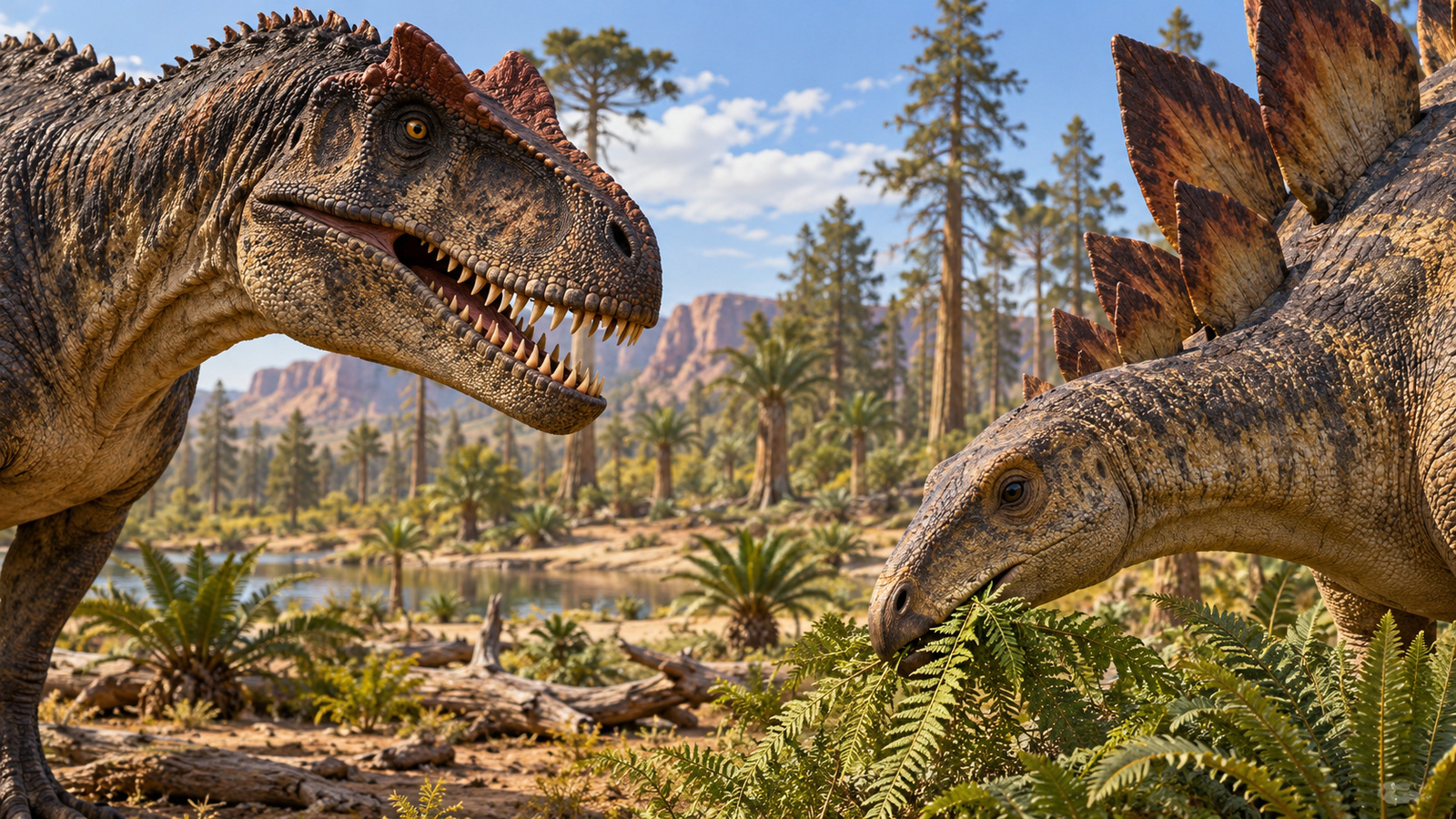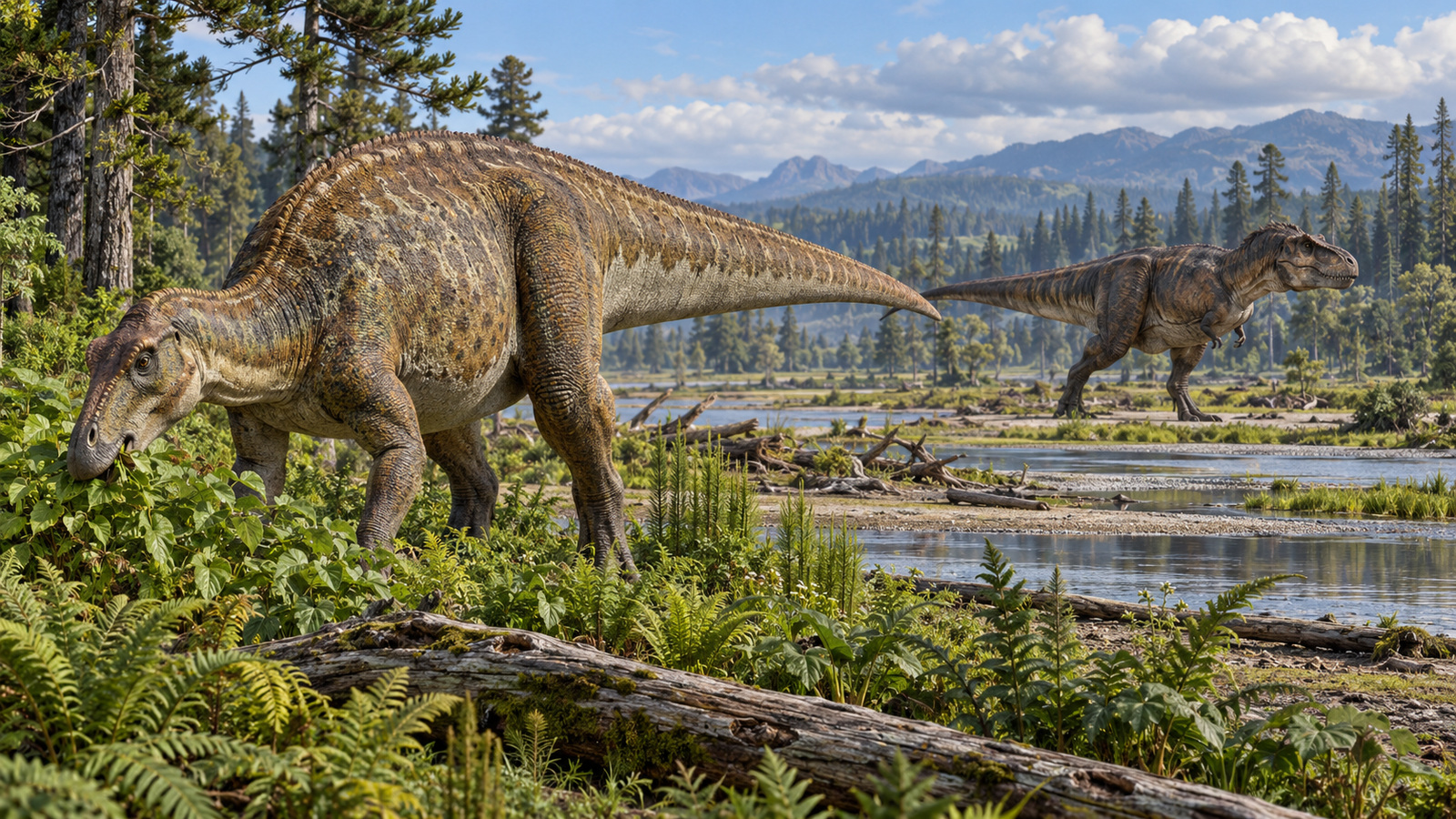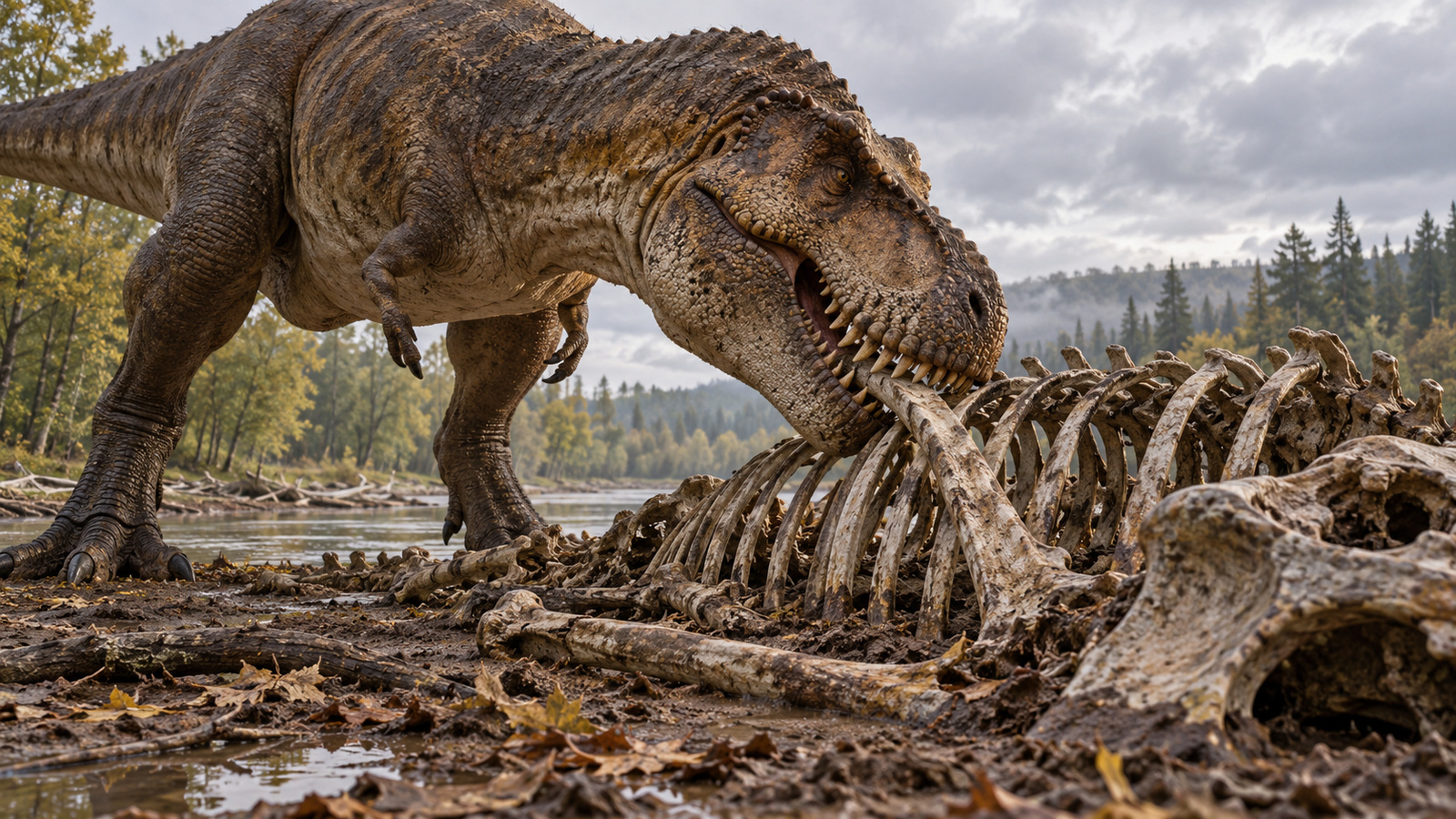
T. rex ate large dinosaurs, including members of its own species
Triceratops feeding damage, a duck-billed dinosaur’s healed tail injury, and tooth-marked Tyrannosaurus bones give T. rex’s diet a concrete fossil foundation. The horned dinosaur’s bones record consumption, the duck-bill survived a living attack, and the tyrannosaur remains support cannibalism. Together they reveal animal resources used by a carnivore capable of tearing flesh and damaging substantial bone. They do not all record the same kind of encounter: a body could have been hunted, found dead, or visited after other feeders had already removed tissue. The most useful account starts with those actual discoveries, then explains how robust teeth, a deep skull, and powerful jaws made the food accessible. It gives Tyrannosaurus a varied feeding life without pretending that every meal began with a chase or that fossils preserve its favorite prey.
A: No. Size and defensive structures made healthy adults potentially dangerous targets.
A: Yes. Feeding traces and mechanical research support substantial bone-processing capability.
A: Bone fragments within a large dropping attributed to a tyrannosaur provide digestive evidence, beyond damage left on an uneaten surface.
A: Not in their normal ecosystems; the two are separated by a vast span of geological time.
A: Flesh, hide, connective tissues, and bone differed in resistance and position; reaching and removing each involved different contacts with the mouth.
A: Not directly. Decay and preservation continue after feeding, so the surviving material does not simply retain its condition at the moment it entered the mouth.
A: Current evidence does not provide a reliable preference ranking across its lifetime diet.
A: Different size and proportions imply different constraints, but exact diets and specimen identities require evidence.
A: Yes. Multiple consumers could visit remains, complicating the interpretation of feeding damage.
A: Reconstructions vary in muscle assumptions, specimen size, tooth position, and the loading conditions modeled.
The available menu belonged to a particular world
Tyrannosaurus rex lived in western North America near the end of the Cretaceous, roughly 68 to 66 million years ago. Its food supply belonged to those communities, rather than to the complete dinosaur cast assembled in films. Jurassic Stegosaurus lived much earlier, and African Spinosaurus inhabited a different part of the world. The relevant landscape included forested floodplains, rivers, and nearby habitats supporting animals of different sizes. A local fossil community therefore provides the setting for a plausible menu before feeding traces identify particular resources.
That menu changed with the body’s condition as well as its identity. A healthy moving herbivore, an injured one, and the remains of the same species after death presented different opportunities. Size alone did not determine accessibility: a large carcass could be available without a chase, while a smaller living animal could escape. The important ecological question is which tissues a tyrannosaur could obtain and handle at that moment. The damaged specimens below connect that general problem with actual animal bodies.
Large herbivores supplied substantial food resources
Triceratops was a substantial source of animal tissue, not simply a horned opponent. Tooth-damaged bones attributed to Tyrannosaurus include a pelvis used in Erickson and colleagues’ 1996 bite-force research. The researchers compared the fossil indentations with experimental loading to investigate the forces required to make them. For a reader interested in food, the underlying discovery is as important as the calculation: tyrannosaur teeth contacted and damaged a large herbivore’s skeleton during feeding.
A carcass offered different resources as it was opened and dismantled. Large muscles around the pelvis and limbs were valuable, but reaching or removing them could bring teeth against bone. A score might form when a tooth dragged over a surface; a deep puncture required a more concentrated contact. Neither action means that every mouthful was a deliberate attempt to crush the skeleton.
Duck-billed dinosaurs supplied a second major line of evidence. The famous healed tail specimen described in 2013 consists of two joined vertebrae enclosing a broken tyrannosaur tooth. The animal was compared with Edmontosaurus annectens rather than identified as a perfectly complete named skeleton. It survived long enough to grow bone around the injury. Thus duck-billed dinosaurs were targets of living attacks, although that particular attack did not provide the attacker with the whole animal as a meal.
Its teeth were built for demanding contact
Adult Tyrannosaurus teeth were not simply oversized versions of delicate cutting blades. Many crowns were thick and robust, with serrated edges and deep roots that helped them tolerate large feeding loads. Tooth position mattered, and different parts of the mouth could contact a carcass in different ways. These features supported puncturing, gripping, pulling, and damaging resistant material. A tooth also worked within a system of jaw muscles, skull bones, ligaments, and neck muscles; its performance cannot be understood as an isolated spike. Biomechanical research supports substantial bone-processing capability, but a model of force capacity does not reveal a precise list of prey or prove that maximum force was used during every bite.
Skull and neck made the bite useful
A powerful jaw must deliver force without its supporting structures failing under the loads involved. The deep skull, tooth roots, jaw muscles, and surrounding tissues together transmitted feeding forces. The neck could position the head and help move material after a bite. Reconstructing these relationships explains why the animal’s feeding capacity was more than a matter of unusually long teeth.
Models can explore different muscle arrangements, tooth contacts, and loading conditions, but they depend on assumptions about structures that no longer survive intact. Estimated forces therefore come with uncertainty. The broad conclusion of formidable feeding performance is better supported than the idea of one exact universal bite-force number. Changing assumptions can alter an estimate without erasing the evidence that this animal could heavily damage bone.
Feeding traces reveal how carcasses were used
Tyrannosaurus could also eat its own kind. Longrich and colleagues’ 2010 study described tooth-marked Tyrannosaurus bones and attributed the large feeding traces to another Tyrannosaurus. Cannibalism here describes consumption of the same species. It does not mean that the consumer necessarily hunted and killed the individual whose bones survived.
Some of the marks occur on relatively low-meat portions of the skeleton. The researchers interpreted this distribution as consistent with feeding on remains after more accessible tissue had gone. That offers a different picture from a dramatic duel followed immediately by a feast: a tyrannosaur could continue extracting food from a body already partly stripped. Late access to remains is one route by which scavenging and intensive carcass use enter the dietary record.
One specimen makes the interpretation particularly concrete. MOR 1602 is part of a right third metatarsal, a long bone within the foot. A score crosses its contact surface with the neighboring second metatarsal. Those bones were tightly bound together in life, so the authors argued that reaching this surface would have been difficult in an intact living foot. The mark therefore supports feeding after the foot had become disarticulated. It reveals a stage in the carcass’s dismantling rather than an injury that identifies the original cause of death.
A carcass offered more than one kind of mouthful
Animal food varied within a single body. Flesh could be gripped and pulled, while hide and connective tissues resisted separation in different ways. A tooth contacting a bone while removing attached tissue was performing a different task from taking a mouthful with little skeletal material. Thick crowns and a strong supporting skull gave Tyrannosaurus useful equipment across these demanding contacts. They did not turn every part of a carcass into the same food or make the entire skeleton equally easy to dismantle.
This distinction helps explain why teeth could leave deep damage without every bite being directed at bone for its own sake. Removing a substantial muscle could expose its attachment region; reaching tissue near a joint could bring teeth between resistant structures. The fossils preserve some of the resulting contacts, while much of the consumed soft tissue disappears. Reconstructing the meal therefore involves the arrangement of the body being eaten, not just the size of the predator’s mouth. The digestive evidence discussed later supplies a separate check on which resistant material actually went down the throat.
Scavenging belongs in the same feeding strategy
A Tyrannosaurus did not need to kill every animal it consumed. A suitable carcass represented an opportunity if it could be found and accessed at an acceptable cost. Its ability to damage bone and handle resistant tissues could remain useful when food was already dead. The relevant ecological issue is how often different opportunities contributed to survival, not whether accepting a carcass somehow disqualified the animal from being a predator.
Large body size could help in some contests over food, but it did not guarantee uncontested ownership. Other animals, terrain, carcass condition, and the costs of confrontation all mattered. Fossils seldom preserve these variables together. Claims that Tyrannosaurus always stole kills, or never scavenged, are both more rigid than the evidence permits.
Even the same carcass could attract several feeders at different times. A tyrannosaur might contact it early, late, or repeatedly. Bone damage can record some of those visits while losing the sequence between them. Separating the identity of a consumer from the origin of the carcass is therefore essential when interpreting feeding traces.
Smaller animals and earlier life stages remain harder to track
The ecological menu available to a carnivore was broader than the dramatic remains most likely to capture attention. Smaller animals and softer foods might leave less distinctive evidence than a deeply bitten large bone. At the same time, a physically possible food should not be promoted into a confirmed staple without support. Diet across growth also demands caution. A young Tyrannosaurus had different proportions and handling limits from an enormous adult, but identifying juvenile specimens and reconstructing their feeding ecology can involve contested taxonomy. Some small tyrannosaur fossils historically treated as young T. rex have been reassessed in recent research on Nanotyrannus. Evidence from another species cannot automatically be used to describe a Tyrannosaurus childhood menu.
Bone consumption added opportunity and complications
A large coprolite from Saskatchewan provides another stage of the story: swallowed food after digestion. Chin and colleagues’ 1998 study described a bone-rich dropping whose size and geological setting supported a tyrannosaur producer, most likely Tyrannosaurus rex. Its fragments show that substantial resistant material entered the gut. They do not identify the exact prey species or reveal whether it was hunted.
Bone processing exposed teeth and jaws to demanding loads, making robust crowns and continual replacement useful. The same feeding apparatus could remove flesh and break skeletal material during one meal. Bone in a dropping is therefore a stronger sign of ingestion than a broken bone lying beside a skeleton, where trampling or burial could also have caused the fracture. This digestive evidence complements the bite traces rather than replacing them.
Daily portions cannot be read directly from a skeleton
Estimates of food demand depend on body mass, activity, metabolism, growth, and the energy available from the food itself. Those quantities are not all known precisely for Tyrannosaurus. A calculation can explore plausible ranges, but an exact kilogram total stated without assumptions creates false certainty. It should not be confused with a measured feeding record.
Meal size and meal frequency are also different variables. Large carnivores can face uneven opportunities rather than a fixed timetable of identical portions. Fossils rarely preserve the spacing between meals or the proportion of a carcass consumed by one individual. A reconstructed diet can be informative without pretending to provide a daily menu.
Ecological context helps constrain possibilities. The abundance and productivity of potential food resources must ultimately support the carnivores using them. Nevertheless, fossil collections are biased samples and cannot always establish living population densities. Calculations of how many predators a landscape supported therefore need uncertainty about the prey community as well as the predator’s energy demand.
Food resources and feeding opportunities made a flexible diet
The best-supported picture is a large carnivore using dinosaur flesh and capable of processing substantial bone. Its robust feeding apparatus mattered after the first contact as well as during it: gripping, pulling, and separating tissues could continue as a carcass was opened and reduced. The surviving samples record several stages of that work. Some identify animal bodies used as food, another captures a living attack, and a dropping takes the record into digestion. Each adds a different part of a feeding life.
How often a tyrannosaur hunted, found a carcass, returned to remains, or lost access to competitors cannot be reconstructed as a fixed timetable. These opportunities could coexist within the same animal’s life. A useful dietary portrait follows the resource from an available body through handling and ingestion, rather than requiring every meal to begin or end identically. That leaves T. rex formidable without turning its diet into an endless repetition of one successful chase.