A prehistoric menu was far bigger than meat versus leaves
A dinosaur meal might have been a mouthful of fern fronds, a struggling fish, a beetle hidden in rotten wood, or flesh stripped from a carcass. Although giant predators dominate popular images of prehistory, plant eaters supplied much of the living weight in many dinosaur communities, and smaller species occupied feeding roles that rarely reach the movie screen. Dinosaurs also existed across enormous spans of time, during which continents shifted and vegetation changed. There was never one universal dinosaur menu. Understanding what dinosaurs ate means matching an animal’s feeding equipment to the resources available in its own habitat, then checking that reconstruction against teeth, stomach contents, bite marks, and other fossil evidence. Those clues reveal a world of specialized feeders, adaptable opportunists, and food relationships more intricate than a simple division between hunters and grazers.
A: No. Many species relied mainly on plants, while others consumed animals or mixed foods.
A: Yes. Some theropods have direct evidence of fish consumption, although their diets need not have been exclusive.
A: No. Feeding height and neck posture varied, and some could collect vegetation much closer to the ground.
A: They can preserve food fragments, but identifying the exact producer is often difficult.
A: No. Oral processing differed greatly between groups such as hadrosaurs and sauropods.
A: There is no reason to assume that a capable hunter always rejected an available dead animal.
A: Some broad plant groups remain familiar, but species and communities changed across the Mesozoic.
A: It records a limited feeding window, not every food that individual or species ever consumed.
A: Living birds demonstrate dinosaur dietary diversity, but each extinct species still needs its own evidence.
A: Usually not. Fossils support broad strategies and particular meals more securely than precise daily menus.
Three dietary labels organize a much richer picture
Carnivores obtain food from other animals, herbivores eat mainly plants, and omnivores use both sources. These labels describe broad patterns rather than complete menus. A fish specialist and a predator of large land animals are both carnivores, yet finding and handling their meals requires very different equipment. Likewise, browsing a tree canopy differs from cropping low vegetation.
Diet also operates at several scales. A species can have a typical feeding strategy while individuals select different foods with season, location, or age. One preserved meal therefore establishes that a food was eaten, but rarely proves how often it appeared in the diet. Paleontologists combine multiple specimens and kinds of evidence before assigning a narrow feeding specialization.
Plant eaters harvested a changing prehistoric landscape
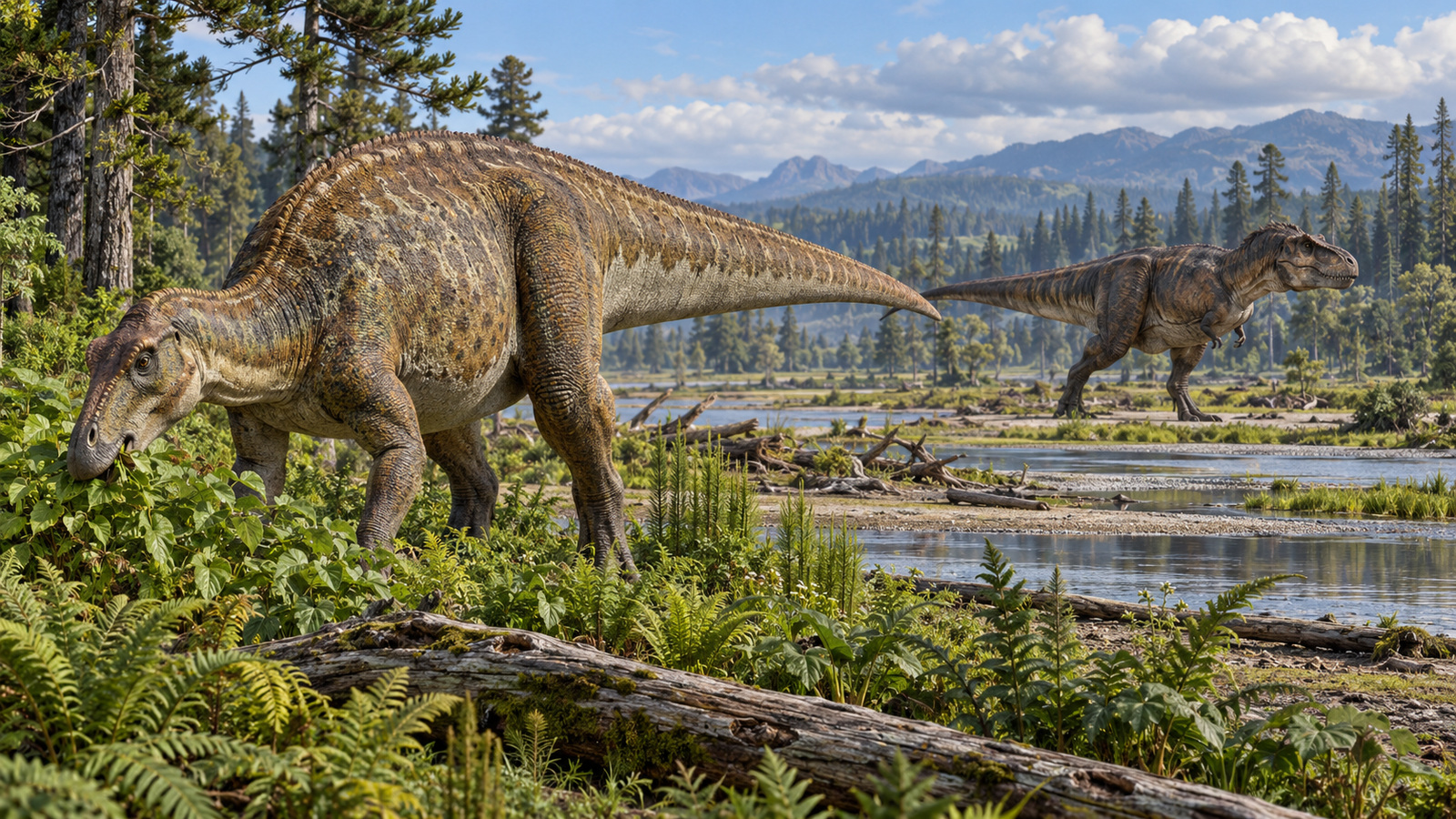
Herbivorous dinosaurs encountered ferns, horsetails, cycads, conifers, and, later, a growing diversity of flowering plants. Which foods were available depended on the period and region. A Jurassic sauropod did not inhabit the same plant community as a duck-billed dinosaur near the end of the Cretaceous. Reconstructing vegetation from pollen, leaves, wood, and sediments helps prevent modern landscapes from slipping into ancient scenes.
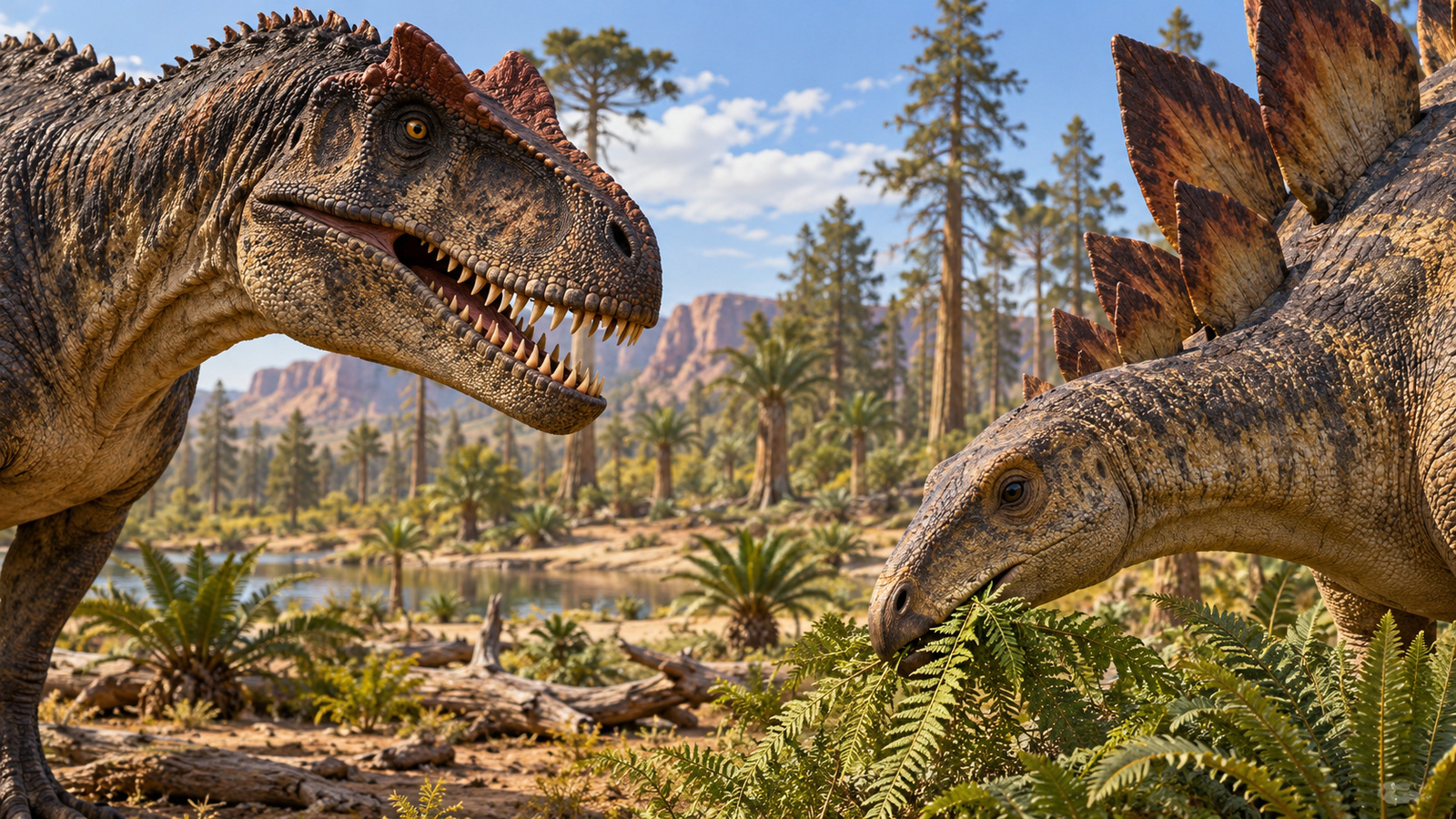
Different body plans opened different feeding spaces. Long-necked sauropods could reach broad areas without moving their heavy bodies at every bite, although neck height and preferred feeding posture varied. Low-slung armored dinosaurs worked closer to the ground. Beaks and teeth helped horned dinosaurs clip and process vegetation, while hadrosaurs possessed elaborate tooth batteries that repeatedly renewed their working surfaces.
Food height alone cannot explain every herbivore community. Selectivity, plant toughness, jaw movement, and digestive capacity also influence what an animal can use. Two species standing at similar heights might favor different plant parts or process the same vegetation differently. Ancient herbivores probably divided resources through combinations of these traits rather than occupying perfectly separated shelves of greenery.
Meat eaters ranged from tiny feeders to enormous predators
Animal food included far more than other large dinosaurs. Small reptiles, mammals, insects, fish, and young dinosaurs offered meals to different carnivores. A lightly built hunter could exploit prey that would barely reward the effort of a giant theropod.
Baryonyx supplies a particularly tangible example. Fish remains in its body region support fish consumption, while its long snout and numerous pointed teeth show an apparatus very different from an adult Tyrannosaurus’s deep skull. These predators belonged to different places and times, but the comparison shows how varied meat-eating equipment became.
Smaller feathered dinosaurs add another kind of meal. A Microraptor specimen described in 2011 contains the partial skeleton of an enantiornithine bird in its stomach region. An enantiornithine was a member of an extinct bird group, so this was one dinosaur eating another in a setting quite unlike the familiar giant-predator scene. Preserved contents connect a named consumer to identifiable food rather than merely suggesting a possible target from tooth shape.
The animal’s size still influenced how it handled that food. A small bird offered flesh, organs, and small bones in one compact package; a giant herbivore’s carcass required much more dismantling. Catching, swallowing, and processing therefore placed different demands on different carnivores. The common label describes where their nutrients came from, not a single way of getting a meal.
Teeth reveal jobs rather than a complete shopping list
Sharp, recurved teeth often help puncture flesh and retain struggling prey. Serrated edges can assist cutting, while thick teeth withstand forces that would threaten slender points. Plant-processing teeth may have ridges, cutting edges, or wear surfaces shaped through repeated contact with food and opposing teeth. These features reveal mechanical demands, making dental anatomy one of the most useful starting points for dietary reconstruction.
There are important exceptions to simple tooth rules. Some plant-eating dinosaurs had pointed teeth suited to stripping vegetation rather than grinding it, and some theropods evolved beaks or other features associated with plant-rich diets. A tooth must be interpreted alongside the entire jaw and skull. Wear patterns, replacement rate, and jaw-joint geometry help turn an isolated shape into a more convincing account of feeding.
Digesting plants demanded more than taking a bite
A leaf contains nutrients, but much of its structure resists easy breakdown. Herbivores must overcome cell walls, often with help from microbes that ferment plant material. Dinosaur digestive organs are rarely preserved, so their exact arrangement usually remains uncertain. Nevertheless, body size, abdominal space, oral processing, and comparisons with living animals provide useful constraints on how different plant eaters extracted energy.
Chewing and gut processing represent different parts of that challenge. Hadrosaurs and horned dinosaurs could reduce vegetation with complex dental systems. Sauropods generally did much less processing in the mouth, swallowing plant material after cropping or stripping it. A large digestive system could then retain food for microbial action, although precise transit times cannot simply be measured from a skeleton.
Swallowed stones require particular care in interpretation. Gastroliths can contribute to food processing in some animals, but stones found near a dinosaur are not automatically stomach stones, and their presence does not establish a universal sauropod grinding mill. Association, number, surface condition, and position all matter. An appealing mechanical explanation needs evidence connecting those stones to the animal’s actual digestive system.
Mixed diets blur the cleanest categories
Some dinosaurs combined animal and plant foods, while others remain difficult to place confidently within a dietary category. Theropods include lineages that departed substantially from the meat-eating pattern associated with Tyrannosaurus. Living birds carry that diversity into the present, with seed eaters, fruit eaters, insect feeders, predators, and species that use several resources.
A 2017 study of coprolites from Utah’s Kaiparowits Formation found crustacean shell fragments mixed with rotten conifer wood. Large plant-eating ornithischians were the likely producers, although the droppings could not be assigned to a particular species. The wood had decayed before ingestion, making a meal of a rotting log quite different from biting fresh timber. Fungi and animals within that material broadened the food package beyond plant tissue alone. This is evidence for feeding flexibility in those animals, not a reason to depict all herbivores hunting crabs.
A meal can survive in several kinds of fossil
Gut contents offer a rare, unusually direct glimpse of feeding. When convincing food remains occur inside the body region of a well-preserved animal, researchers can sometimes identify components of its final meals. The interpretation still depends on preservation: material washed into a carcass after death can mimic a dietary association. Position, surrounding sediments, and the condition of the remains help test competing explanations.
Coprolites provide another route into ancient food webs. Mineralized droppings may contain bone fragments, plant tissues, scales, or other resistant remains. As the Natural History Museum explains, microscopic examination can reveal food details invisible on the surface. Assigning the producer is often harder than recognizing the contents, so a coprolite may reveal a carnivorous feeding event without identifying the exact dinosaur responsible.
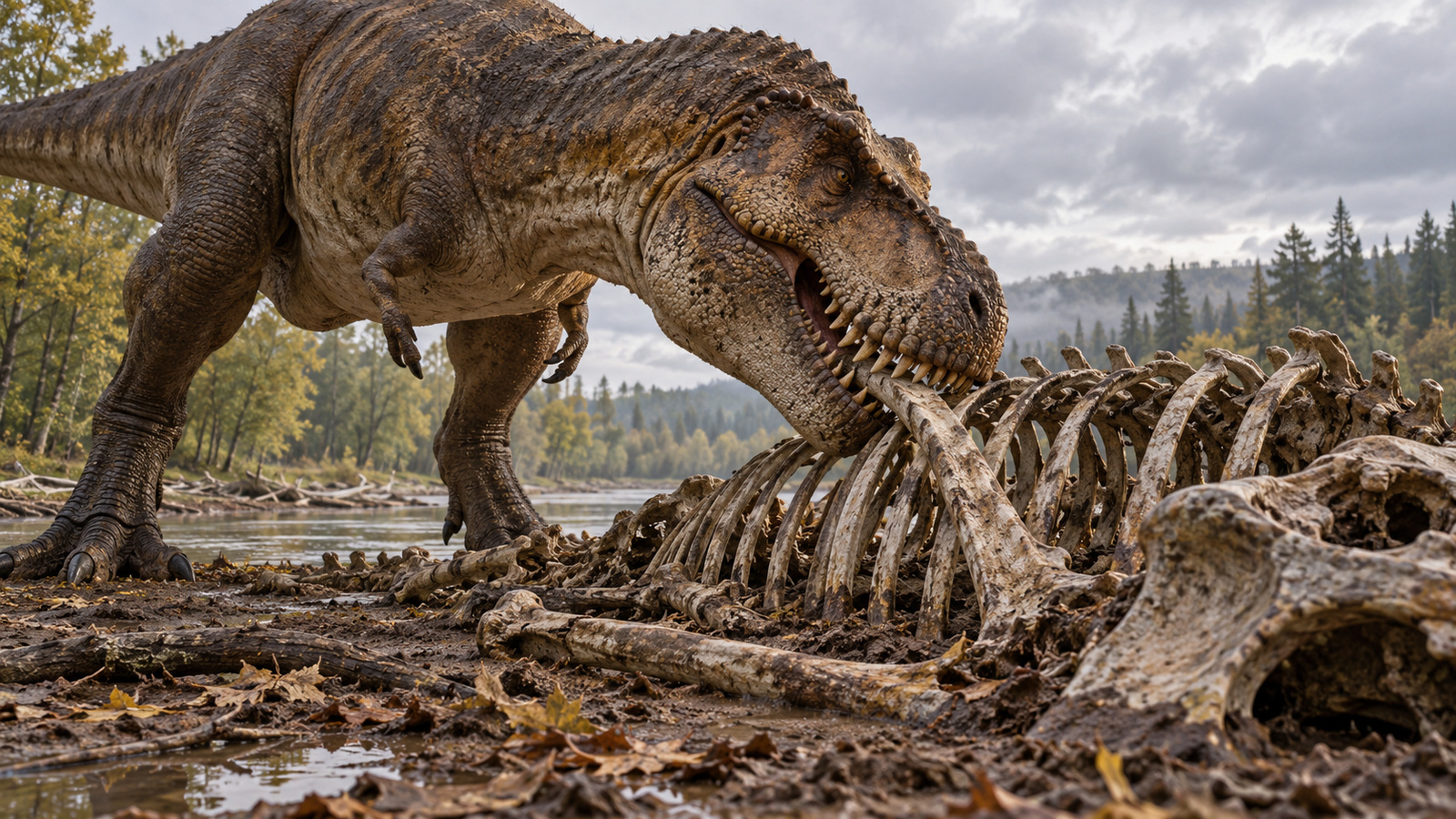
Bite marks link feeding tools to damaged remains, especially when tooth shape or embedded teeth narrow the possible maker. They may show how a carcass was processed, which bones were contacted, or whether an injured animal survived an encounter. However, a mark on a dead animal’s bone does not automatically distinguish killing from scavenging. Several independent clues are needed to move from evidence of eating to a reconstruction of how food was obtained.
Hunters could also take an unearned meal
Hunting and scavenging are feeding behaviors that can occur in the same animal. A predator able to kill prey would still benefit from a suitable carcass when the opportunity arose. The balance depends on access, competition, risk, and the energetic reward of a meal. Fossils rarely preserve enough repeated behavior to calculate that balance for an extinct species. Describing a large theropod as an opportunistic carnivore is often more defensible than demanding that it fit exclusively into one role. A skeleton bearing tooth damage proves consumption more readily than it proves the sequence of events leading to that consumption.
Age and season could change what was worth eating
A hatchling and an enormous adult faced different physical limits. Small animals could handle small prey or tender plant parts that did not supply enough food for larger individuals. As jaws, teeth, reach, and body mass changed, the set of accessible resources could change too. Demonstrating a specific shift requires evidence from identifiable growth stages, rather than assuming every dinosaur followed the same pattern.
Seasonality added another influence. Floods, drought, plant growth, and animal reproduction could alter food abundance within a habitat. A dinosaur with a flexible menu might respond differently from a specialist tied to a narrow resource. These ecological possibilities help frame research, but claims about a particular migration, seasonal feast, or starvation episode need geological and fossil support rather than a plausible story alone.
Food webs explain why meals mattered beyond one dinosaur
Plants captured energy that supported herbivores, and herbivores supported carnivores directly or indirectly. Decomposers and scavengers recycled remains into the wider ecosystem. A feeding relationship therefore connected an individual meal with vegetation, soil, water, competition, and the next generation of animals. Reconstructing those connections helps explain why changes at the base of a food web could affect animals far larger than the plants or small prey involved.
Prehistoric communities also varied enormously through time. Familiar dinosaurs from different continents and periods should not be placed together merely because they share a dietary label. Checking whether species actually overlapped is the first step toward a credible food web. The resulting picture is more informative than a collection of famous animals arranged around an imagined banquet.
Available evidence is also uneven between habitats. River-associated environments can bury remains more readily than some upland settings, so their food relationships may be better represented in collections. Delicate plants and small animals can disappear while teeth and robust bones survive. Researchers account for these biases when deciding whether a missing food item was truly absent from an ecosystem or simply unlikely to be preserved and discovered.
Read every dinosaur menu with a confidence scale
The strongest dietary accounts distinguish an observed fossil association from an anatomical inference and a broader ecological possibility. Preserved food is direct evidence of a meal; teeth reveal processing abilities; habitat reconstruction suggests available resources. Agreement among those clues supports a stronger conclusion than any one clue alone. Disagreement is useful too, because it can expose overlooked feeding flexibility or a mistaken interpretation.
What did dinosaurs eat? Across the group, they ate plants, animals, and mixtures of both, using an extraordinary variety of feeding systems. For a particular species, the more useful answer names the supported foods, explains the evidence, and identifies what remains uncertain. That approach replaces a fixed prehistoric menu with a testable picture of animals making a living in changing environments.