Two kinds of food created very different feeding problems
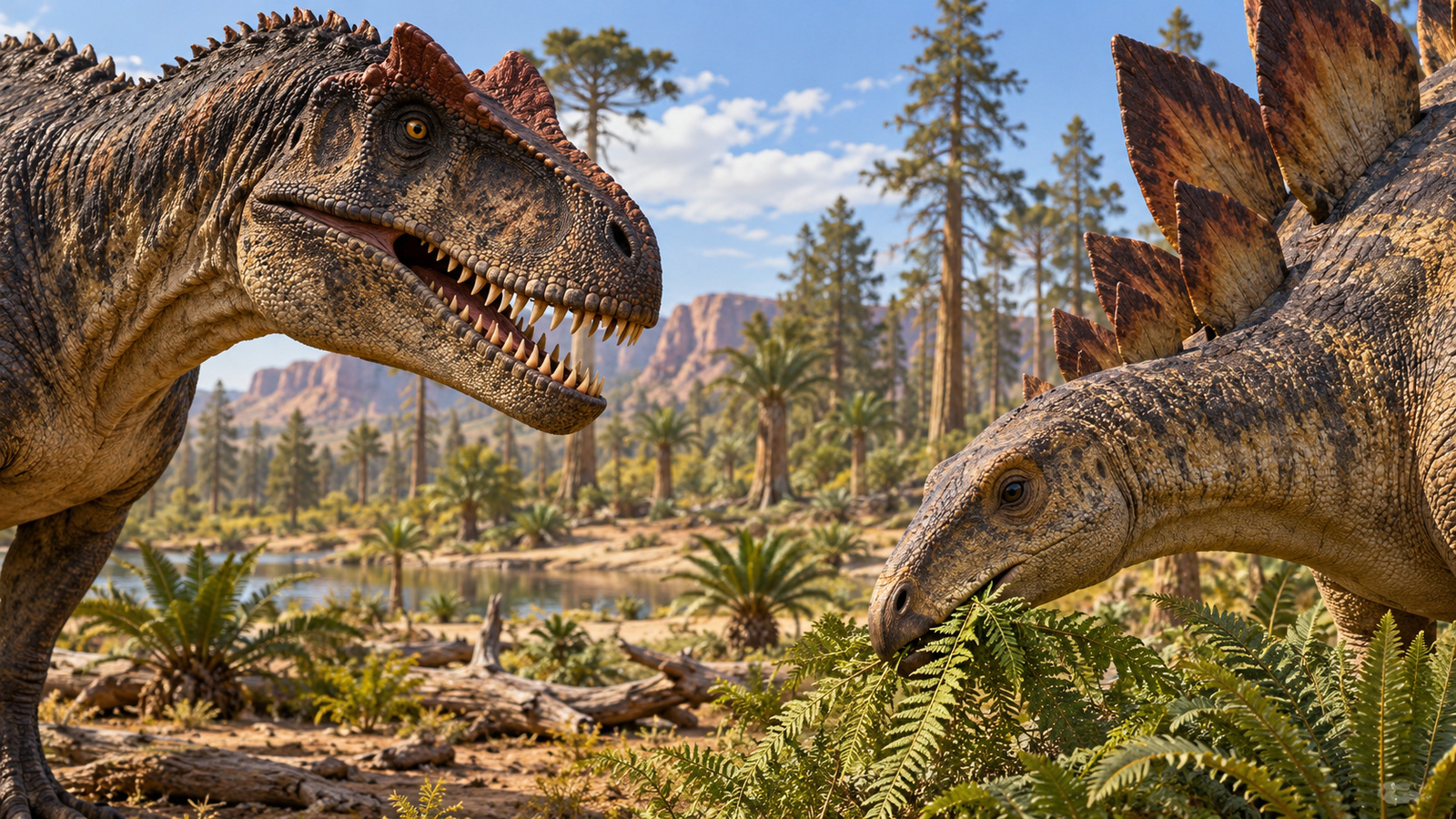
A sharp tooth cutting flesh and a beak clipping a tough stem perform different jobs, even when both belong to dinosaurs walking through the same forest. Carnivorous dinosaurs obtained their nourishment mainly from other animals, while herbivorous dinosaurs relied mainly on plants. That basic contrast influenced how they collected food, moved their jaws, handled resistant material, and used their habitats. Yet the familiar image of every meat eater chasing a giant victim and every plant eater peacefully chewing leaves misses much of the biology. Animal food included insects and fish, plant food differed greatly in texture and availability, and some dinosaurs crossed the boundary between categories. Comparing carnivores and herbivores therefore works best as a study of feeding problems and solutions, supported by fossils, rather than a contest between two uniform teams.
A: No. Plant eaters evolved many different collection, oral-processing, and body-support systems.
A: No. Tooth shape and robustness varied with ancestry and mechanical demands.
A: No. Numerous plant-eating dinosaurs used two legs, and support patterns varied among groups.
A: A beak is a feeding tool, but its presence alone does not establish every food consumed.
A: Some herbivores had highly specialized systems for resistant vegetation; toughness must be evaluated by material and action.
A: Their precise daily schedules are unknown, and feeding time depended on physiology and food quality.
A: No. Encounters involve approach, terrain, surprise, age, and defenses as well as speed.
A: Not by itself. Meal frequency depends on biological factors that teeth alone do not preserve.
A: Soft digestive organs are rarely preserved well enough to reconstruct their full arrangement.
A: No. A mixed diet is a biological strategy; insufficient evidence is a separate reason to leave classification open.
What counted as animal food?
A carnivorous dinosaur could feed on small vertebrates, invertebrates, fish, other dinosaurs, or carcasses. These resources were not interchangeable. Catching a small animal in vegetation demands different movements from removing tissue from a large dead body. An animal’s size and feeding equipment help narrow its likely options, but the entire range of food can rarely be reconstructed from a skull alone.
Some carnivores were much smaller than familiar giant theropods. A small predator could obtain a worthwhile meal from resources that would barely contribute to the needs of a huge adult. This difference matters when reconstructing communities: several meat eaters could coexist while exploiting different prey sizes, habitats, or feeding opportunities. Sharing a broad dietary category does not necessarily mean direct competition for every meal.
Plant food was far from uniform
Leaves, shoots, stems, and other plant parts differ in their water content, defensive compounds, toughness, and digestible nutrients. Herbivores had to collect enough usable material while managing those differences. A dinosaur capable of biting through resistant vegetation was solving a different problem from one selecting softer growth. Size, reach, mouth width, and processing ability all influenced which foods could provide a practical return.
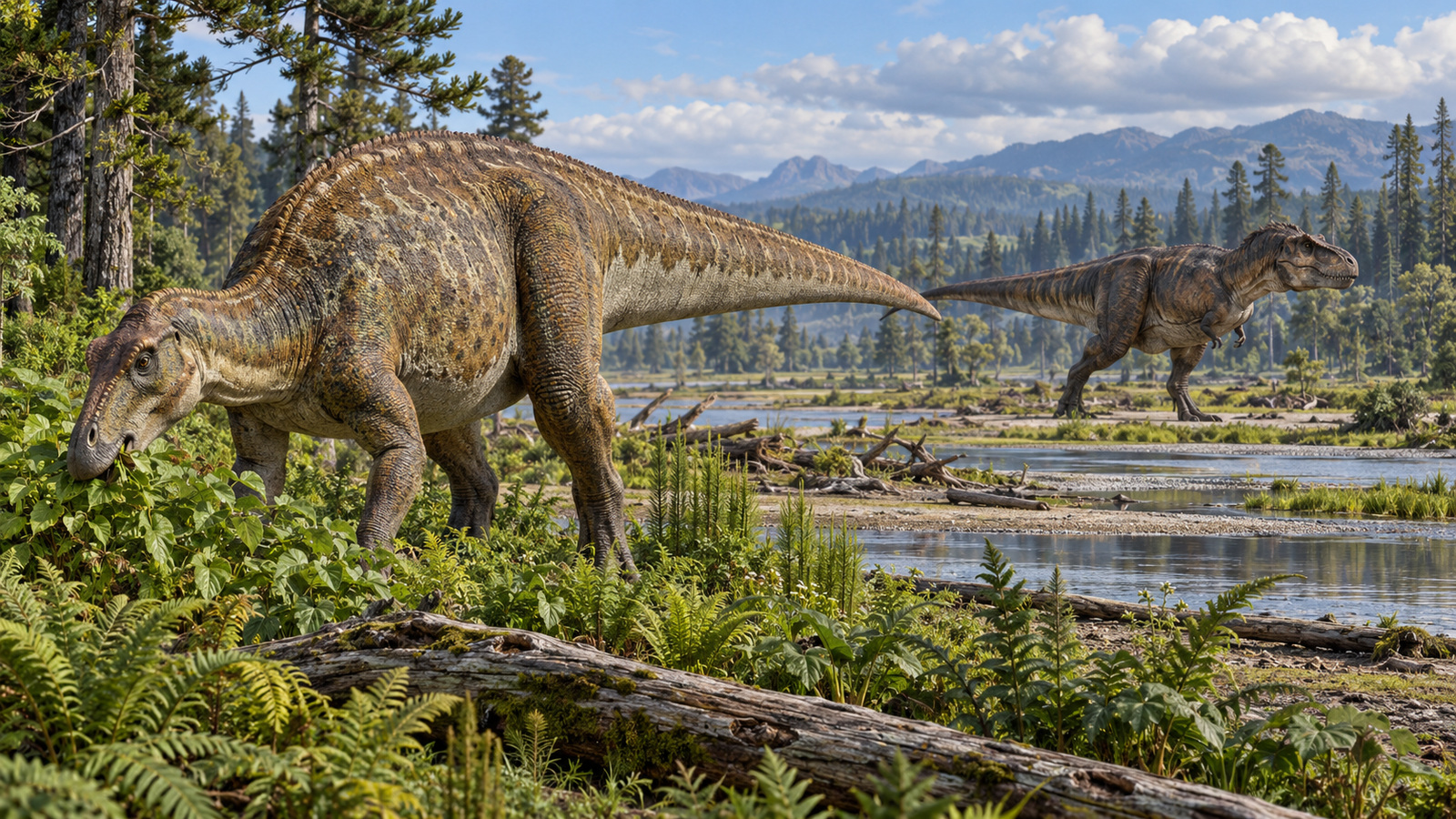
The available vegetation changed across the Mesozoic. Ferns, horsetails, conifers, and cycads occurred in many settings, while flowering plants became increasingly important during the Cretaceous. Modern grassland scenery should not be treated as the default backdrop for all plant-eating dinosaurs. Regional plant fossils and sediments provide a better guide to the vegetation available at a particular time and place.
Even neighboring herbivores might partition resources. One could browse higher, another work near the ground, and another use a different plant texture at a similar height. Such separation is rarely perfect, and overlap does not automatically create ecological failure. Seasonal abundance and differing feeding efficiencies could allow several plant eaters to use some of the same resources.
A tooth’s shape follows the stresses of its job
Many carnivorous theropods had curved, pointed teeth that punctured and retained animal tissue, often with serrations that assisted cutting. Herbivorous dinosaurs displayed a wider range of processing arrangements than the phrase flat teeth suggests. Sauropods commonly used relatively simple teeth to crop vegetation with little chewing, while hadrosaurs and ceratopsians developed elaborate dental systems that repeatedly brought working surfaces against food. The useful comparison is therefore between piercing, cutting, cropping, and oral processing. Teeth also had to survive loads, remain anchored, and be replaced as they wore. Pointed crowns do not automatically establish carnivory, and a broad body does not demonstrate herbivory. Strong interpretations combine the teeth with jaw geometry, wear, replacement patterns, and direct dietary evidence.
Collecting a meal and processing it are separate tasks
A beak could detach plant material before teeth farther back reduced it. A narrow muzzle might allow more selective collection than a broad cropping surface, although precise food preferences still require evidence. Horned dinosaurs demonstrate how an effective collection tool can be paired with a powerful cutting system inside the mouth. The front and back of a feeding apparatus need not perform the same operation.
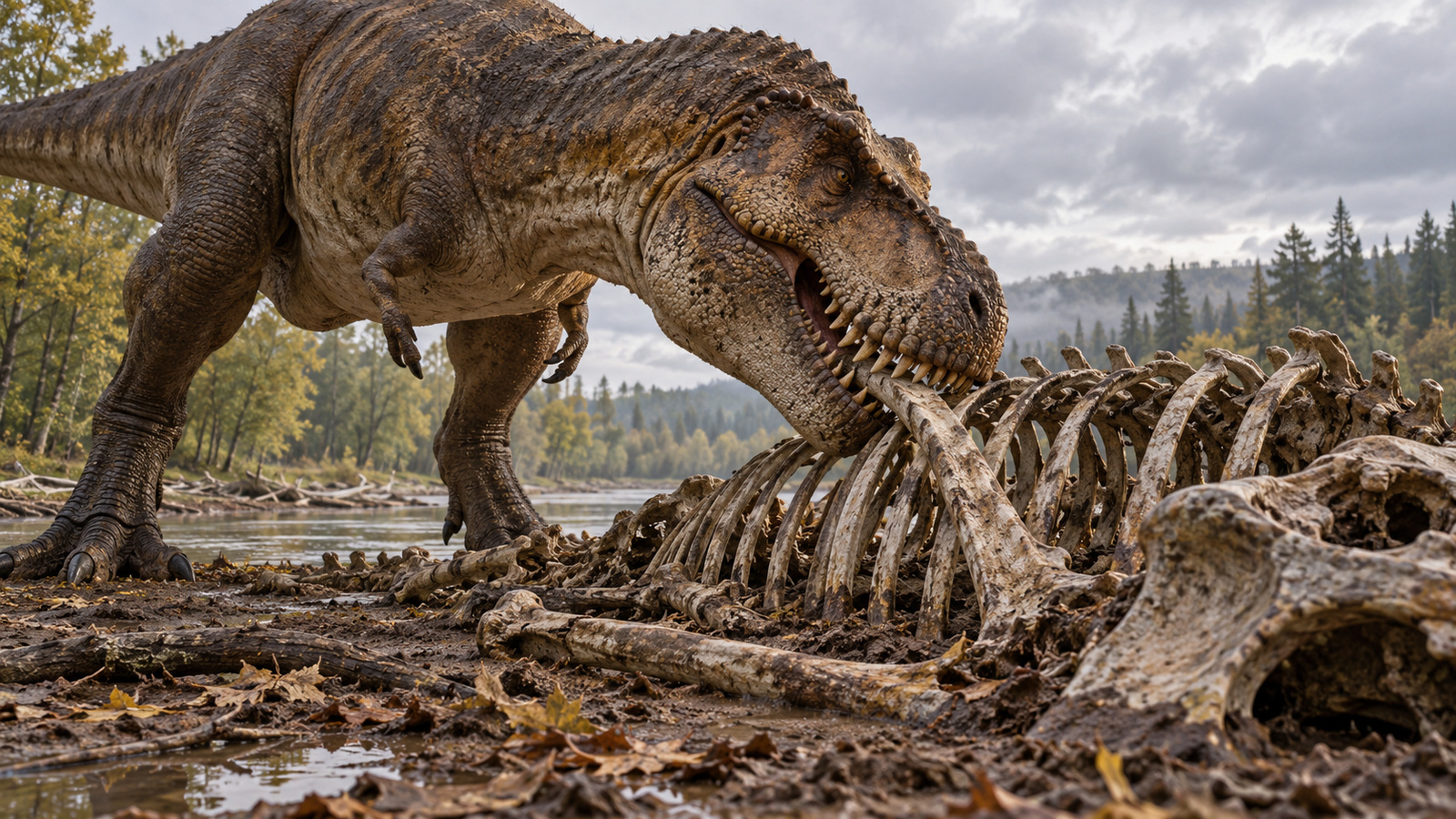
Carnivores likewise needed more than a puncturing tooth. Neck movement could help pull tissue, jaw muscles closed the mouth against resistance, and skull structure transmitted the resulting forces. Different theropods combined those components in different ways. A long, narrow snout and slender teeth should not be assigned the same handling behavior as the deep skull and thick teeth of an adult Tyrannosaurus.
Plants made digestion an especially demanding stage
Plant cell walls contain structural material that an animal cannot necessarily break down efficiently by its own enzymes. Microbial fermentation can make some of that material useful, but it requires suitable conditions and time. Large herbivorous dinosaurs therefore had to solve both the collection problem and the extraction problem. A huge pile of swallowed leaves would not be valuable unless the digestive system could recover enough nourishment.
Oral processing can increase the surface area available for digestion. Hadrosaurs and ceratopsians reduced vegetation with complex teeth, whereas sauropods generally swallowed much less thoroughly processed food. Their feeding systems represent different approaches rather than a simple ladder from primitive to advanced. A strategy that works at enormous body size need not resemble the strategy of a smaller selective browser.
Exact digestive chambers remain uncertain for most dinosaurs because soft organs seldom fossilize. Rib-cage dimensions and comparisons with living animals help constrain possibilities, but they do not reveal a complete internal map. Claims about multiple stomachs, precise retention times, or universal stone-filled grinding organs go beyond what a typical skeleton establishes. Digestive reconstruction should remain explicit about where anatomy ends and inference begins.
Animal tissue offered benefits without guaranteeing easy meals
Animal tissues contain concentrated resources, but carnivores faced the costs of locating food and gaining access to it. Living prey could escape or injure an attacker; a carcass might already attract competitors. Different tissues also presented different handling problems. Soft flesh, hide, tendons, and bone did not require identical forces or yield the same immediate reward.
Scavenging could reduce some risks while introducing others. A dead animal might be easier to approach than a healthy adult herbivore, yet the food could be scarce, contested, or degraded. Hunting and scavenging could coexist within one feeding strategy. Fossil evidence of consumption often cannot determine which route supplied a particular meal, so the two behaviors should not be treated as mutually exclusive identities.
Diet affected movement without dictating one body plan
Reaching food linked feeding anatomy with locomotion and posture. A long neck extended a sauropod’s collecting area, while an upright biped could move and maneuver without placing its forelimbs on the ground. Neither feature belongs exclusively to one dietary category. Many herbivores walked on four limbs, but other plant-eating dinosaurs used two, and some lineages changed how they supported themselves during growth.
Predatory movement likewise varied with size, anatomy, and feeding opportunity. Long limbs can improve some aspects of travel, but they do not supply an exact top speed. A carnivore processing a carcass needed stability and force transmission as much as pursuit ability. Treating every meat eater as a sprinter replaces several different ecological strategies with a single cinematic scene.
Defenses further complicate the comparison. Armor, horns, large size, and tail weapons could change the risks associated with attacking some herbivores, but these structures could have additional roles. Their presence does not show that every feeding encounter became a fight. Ecological reconstructions need to account for avoidance, vulnerable growth stages, and access to already dead animals as well as direct confrontation.
Mixed feeding makes the boundary useful but imperfect
A broad cropping mouth can gather more than one kind of material in a mouthful. Crustacean-bearing coprolites from the Kaiparowits Formation contain decayed wood and animal remains together. Their likely large ornithischian producers therefore obtained food outside a strictly plant-only menu. The discovery does not turn them into specialized hunters. It shows that the resources collected by a herbivore could include animals living within its plant food.
The useful comparison remains the main feeding strategy. A dedicated carnivore needed to find and handle animal bodies repeatedly, whereas an occasional invertebrate in a mass of vegetation involved a different collection problem. An omnivore could depend substantially on both sources. These categories describe where nourishment mainly came from; the mouth and digestive system explain how it became available. Keeping those two levels separate allows a surprising meal to refine the comparison without erasing it. It also prevents a single animal ingredient from outweighing the rest of a dinosaur’s feeding anatomy and ecological setting.
Named dinosaurs make the comparison more concrete
Baryonyx and Nigersaurus show how different collecting equipment worked. The carnivorous Baryonyx had an elongated snout and numerous pointed teeth; the Natural History Museum lists fish and Iguanodon among its foods. Its mouth could engage separate animal bodies rather than harvesting a broad swath of vegetation. Fish and dinosaur tissue also differed in size and handling demands, so even this one carnivore resists a single picture of a standard meal. The contrast concerns what the mouth encountered, not a claim that every Baryonyx used the same hunting maneuver.
The herbivorous Nigersaurus carried an expanded muzzle with teeth concentrated across the front of the jaws. Its skull and tooth study interpreted this arrangement as a system for gathering and slicing relatively soft vegetation near ground level. Replacement teeth continually renewed the working edge. This animal was a sauropod, yet feeding low was central to the reconstruction: a long neck did not automatically mean browsing at the tops of trees. Compared with Baryonyx, the striking difference is repeated collection of plant material across a low feeding zone rather than capture and handling of individual animals.
Triceratops adds a different herbivore arrangement. Its beak collected food at the front, while the dental batteries farther back processed material inside the mouth. An adult Tyrannosaurus combined thick teeth and powerful jaws that could puncture flesh and damage bone. These are contrasting sequences of work: detach vegetation and reduce it, or grip animal tissue and pull it free under substantial loads. Neither skull gives a complete lifetime menu, but both explain why the broad plant-versus-animal distinction corresponds to real differences in feeding equipment.
Why a meat-versus-plants comparison still helps
The distinction draws attention to different routes through an ecosystem. Herbivores transferred energy from vegetation into animal bodies; carnivores obtained resources from those bodies and from other animal food. Both groups depended on wider communities, including decomposers, competitors, and the organisms supporting their food supply. A change in vegetation could therefore affect predators even when they never ate the plants directly.
It also helps explain why feeding systems evolved repeatedly. Plants and animals presented recurring challenges, while each dinosaur lineage inherited a particular anatomical starting point. Similar ecological demands could produce some comparable solutions without erasing those differences. The result was a diversity of workable strategies rather than a single ideal carnivore and a single ideal herbivore.
Judge each dinosaur by the evidence for its own meals
A practical comparison begins by asking what food was available, how the mouth collected it, how the teeth processed it, and what direct traces support consumption. It then separates well-supported conclusions from plausible extensions. This sequence prevents stereotypes about size, aggression, or familiar names from doing the work of evidence. It also makes new discoveries useful: a surprising gut content can improve a model rather than merely contradict a label. Carnivorous dinosaurs mainly ate animals, and herbivorous dinosaurs mainly ate plants, but the most interesting differences lie in how they made those resources usable. Mouths, digestive strategies, body sizes, habitats, and opportunities combined in many ways. Comparing those combinations reveals prehistoric animals meeting real biological demands, with more variation and flexibility than the simplest two-column picture suggests.