Powered flight was assembled before it entered the fossil record
When recognizable pterosaurs appear in Late Triassic rocks, they already possess the defining equipment of powered flight: an immense fourth finger, membrane-controlling wrist bones, reinforced shoulders, lightened skeletons, large muscle attachments, and hind limbs coordinated with the wing. Their closest known relatives do not yet form a neat ladder of half-wings, so the transformation must be reconstructed from relationships, biomechanics, developmental patterns, and traits shared with neighboring archosaurs. The result was not one miraculous mutation. It was an accumulating system in which climbing, leaping, body covering, balance, breathing, and forelimb control could each become useful before sustained flapping united them. Pterosaurs became the first vertebrates to fly under their own power because natural selection joined those parts into a launchable, steerable, metabolically supported animal.
A: Lagerpetids currently rank among the strongest candidates near their branch.
A: It is plausible, but no complete transitional glider is yet known.
A: Concentrated support created a long controllable spar while other fingers stayed useful.
A: Related respiratory traits may have preceded flight and were later intensified.
A: Climbing is possible, but current evidence does not exclude mixed or terrestrial habits.
A: It could slow falls, stabilize leaps, and improve controlled descent.
A: Insulation supported the sustained muscle activity demanded by aerial locomotion.
A: Its foundations likely accompanied early hand-supported terrestrial movement.
A: Tiny hollow bones and upland habitats rarely produce articulated skeletons.
A: An older articulated near-pterosaur preserving hands, shoulders, and body outline.
Powered flight required more than staying airborne
Gliding converts height into forward travel; powered flight adds energy through repeated wing strokes. A true flier must create enough lift to support weight, enough thrust to overcome drag, and enough control to avoid tumbling. It must also launch, land, breathe during exertion, repair tissues, and grow without losing function. Pterosaur origins therefore cannot be reduced to the first elongated finger.
Many reptiles evolved membranes that improved a leap. Rib-gliding lizards, kuehneosaurids, and other extinct forms demonstrate that controlled descent can be advantageous for escape or movement between trees. None transformed one finger into the dominant spar or remodeled the shoulder in the pterosaur fashion. Similar starting behavior does not imply direct ancestry.
The family tree narrowed toward small archosaurs
Pterosaurs belong within Ornithodira, the archosaur branch that also contains dinosaurs and their close relatives. Detailed studies increasingly place lagerpetids near pterosaurs. Lagerpetids were small Triassic animals once interpreted mainly from hind limbs; newly associated skulls and forelimbs revealed sensory and anatomical features relevant to pterosaur origins. They were not flying pterosaurs, but their position helps define the ancestral body from which flight evolved.
Small size, an erect gait, agile limbs, and advanced balance systems may have preceded wings. These traits suit active ground travel, climbing, or rapid leaps. Precisely which habitat hosted the transition remains unresolved. A tree-based origin and a ground-based launch are not mutually exclusive if animals moved through both settings.
Relationships are tested through hundreds of characters, and fragmentary Triassic species can move as matrices change. A proposed precursor matters only if shared traits follow evolutionary order rather than superficial resemblance. Foot length alone or a membrane-like outline cannot establish ancestry.
Forelimb control existed before extreme elongation
Archosaur shoulders and wrists already allowed active positioning of the forelimb. Selection for climbing, prey capture, display, or controlled descent could favor stronger muscles and greater precision before a full stroke generated body weight support. As the arm lengthened, small changes in motion produced larger aerodynamic effects at the tip.
The fourth digit eventually became the principal spar while digits one through three stayed free. Development had to extend growth in one finger dramatically without losing joints or blood supply. Pterosaur embryos show that this was a stable inherited program, not a deformity repeated in adults. The fifth finger was reduced, though its long toe counterpart helped support membranes in many early forms.
A skin fold became an engineered airfoil
A simple membrane can slow a fall, but flapping loads wrinkle and stretch it. Pterosaur wings solved that problem with layered tissues. Actinofibrils reinforced the surface, muscles adjusted tension, vessels kept it alive, and nerves reported local conditions. The propatagium smoothed the leading edge while the main brachiopatagium generated most lift.
Early stages may have involved smaller membranes spanning arm, body, and leg. Even a modest surface could improve stability during leaps. Selection would favor broader controlled area only if the skeleton and muscles could keep pace; an enlarged membrane attached to a weak arm becomes a liability in wind.
Membrane evolution also changed daily life. Tears needed healing, folding had to protect the surface on the ground, and blood flow influenced heat exchange. A wing became part locomotor organ, part sensory sheet, and part physiological boundary.
The shoulder became a flight engine mount
Powerful downstrokes require muscles anchored across the chest and shoulder. The pterosaur humerus developed a pronounced deltopectoral crest, increasing attachment area and leverage. The shoulder joint supported wide movement while resisting dislocation. Rigid torso elements transmitted reaction forces across the body.
Early powered strokes were probably less efficient than those of later specialists. They only needed to improve survival and reproduction relative to the prior condition. A short burst across a gap, an uphill flutter, or controlled escape could reward stronger strokes before long-distance cruising evolved.
Hollow construction lowered inertial cost
Every stroke accelerates the wings, so mass far from the shoulder is expensive. Thin-walled bones and internal struts placed material where stress demanded it while minimizing weight. Skull openings and elongated lightweight jaws reduced rotational burden. Pneumatic spaces later became extensive in many large pterosaurs.
Lightness had limits. Launch imposed forces several times body weight, and the wing finger endured bending and twisting. Cross-sectional geometry often matters more than wall thickness. Evolution favored a strong hollow beam, not a fragile tube.
Skeletal pneumaticity also points toward air sacs associated with efficient archosaur lungs. Respiratory improvements may predate full flight, as related dinosaurs possessed similar systems. Once flapping increased oxygen demand, existing unidirectional airflow or air-sac ventilation could be intensified rather than invented from nothing.
Insulation supported sustained muscle output
Pycnofibers covered pterosaur bodies by the time exceptional fossils preserve them. Insulation slows heat loss and helps active animals maintain muscles near effective temperatures. Small ancestors lose heat rapidly, so a covering could evolve for thermal reasons before flight and later make prolonged aerial activity more economical.
Branched pterosaur fibers have raised the possibility that feather-like coverings originated deep within Ornithodira. The debate depends on microscopic structure, preservation, and developmental homology. Whether every fiber shares one origin, early pterosaurs were not naked cold animals waiting for sunlight before each launch.
Balance and vision made a wing controllable
Air is an unstable three-dimensional environment. The inner ear detects rotation and acceleration, while vision tracks horizon, obstacles, and landing sites. Braincase studies suggest that pterosaur relatives were already refining sensory systems before extreme flight anatomy appeared. Pterosaurs expanded neural coordination alongside the wing.
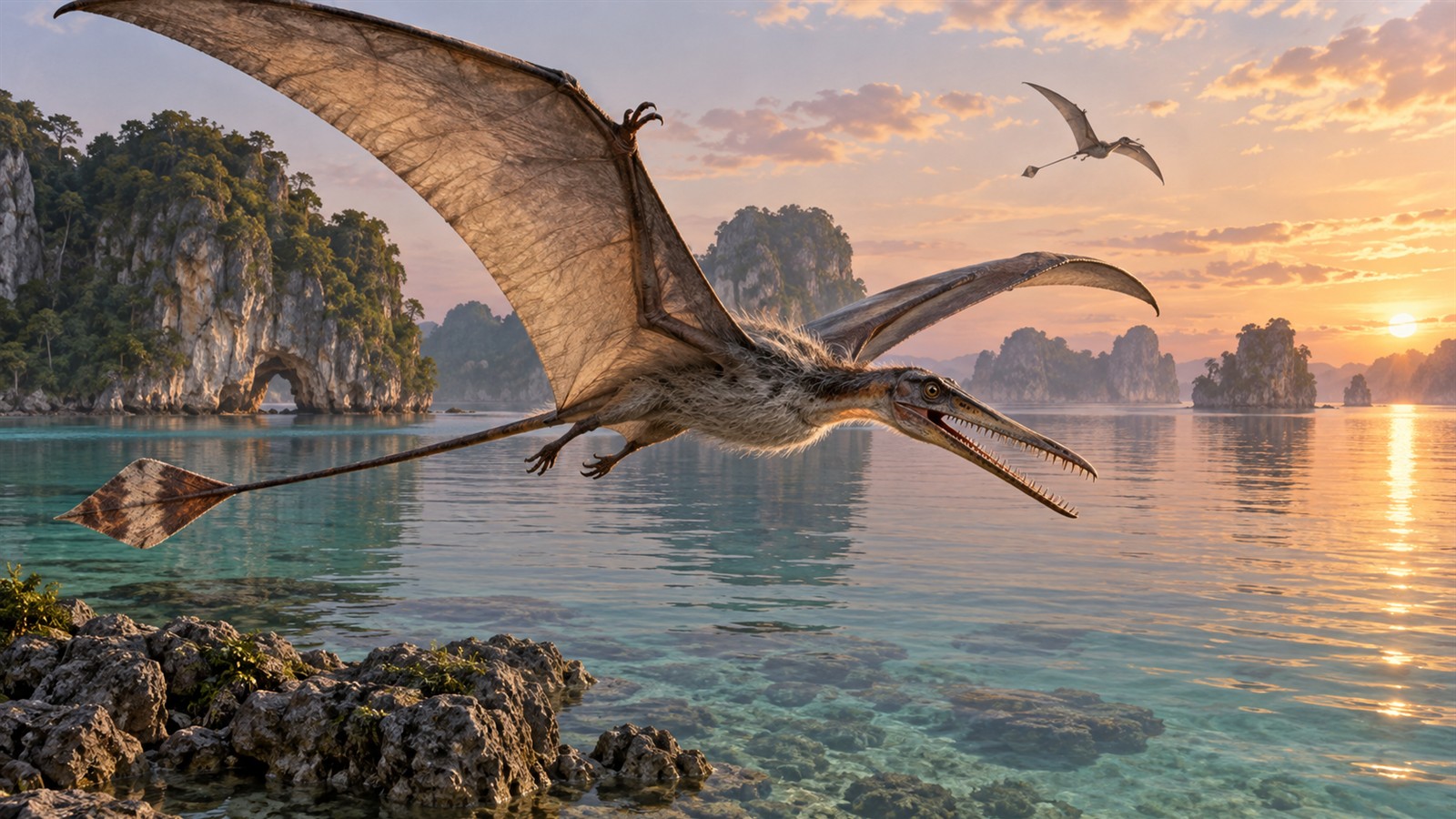
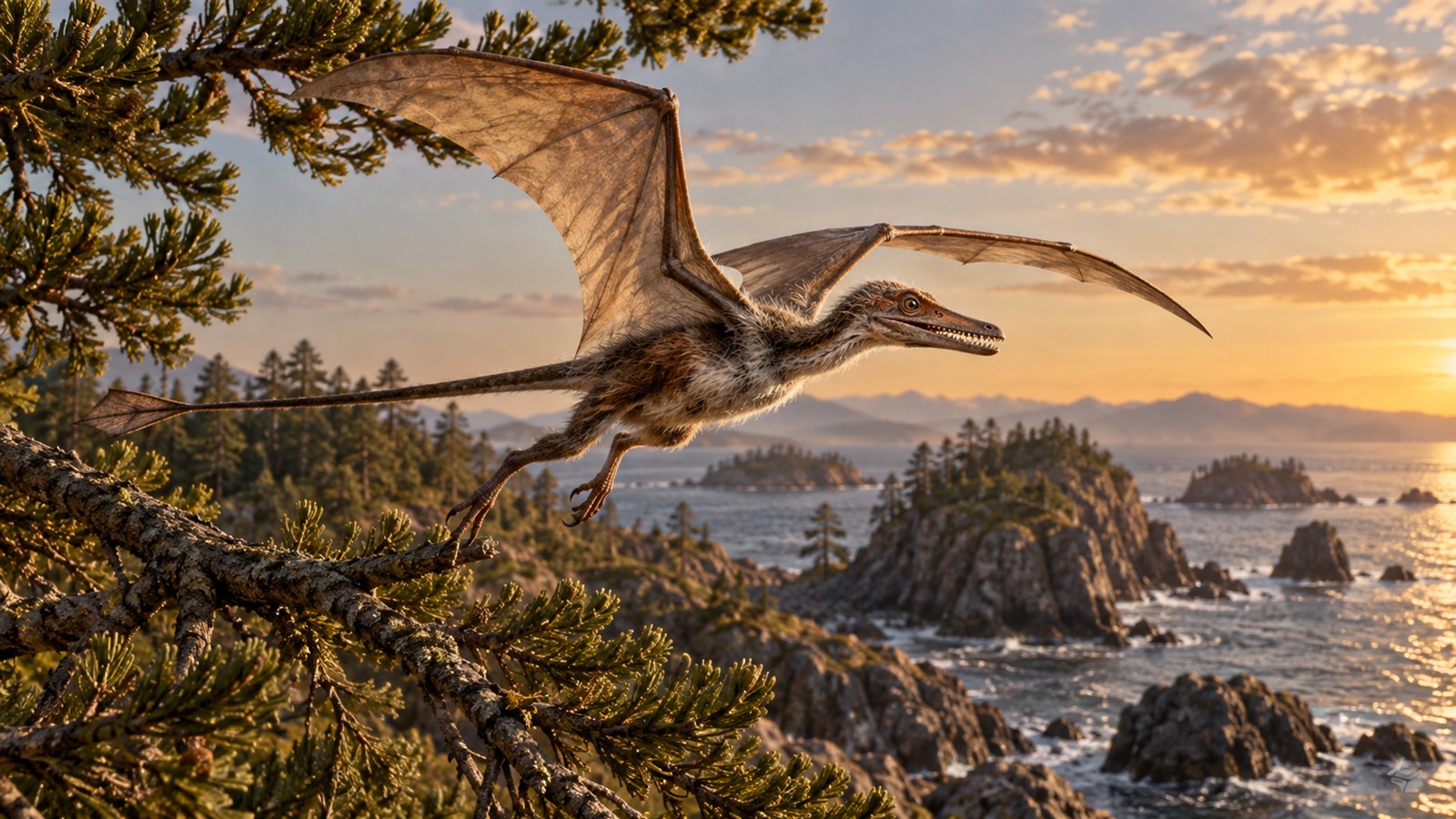
Membrane nerves could report stretch and airflow, enabling rapid correction. Head, tail, hind limbs, and wing surfaces changed pitch and yaw together. Early long tails stiffened by bony rods may have stabilized the body, with terminal vanes adding aerodynamic influence. Later pterodactyloids shortened the tail after other control surfaces and proportions changed.
Control evolves through small advantages. A glider that lands more accurately survives even without flapping; a flapper that senses stall sooner wastes fewer strokes. Sensory and mechanical changes can reinforce one another across generations.
Four-limbed launch reused the strongest apparatus
Because pterosaurs walked on their hands and feet, the forelimbs could contribute to takeoff. A vault powered through the arms placed the flight muscles under heavy load immediately before the first stroke. This solution differs from birds, whose wings cannot push against the ground while the legs launch.
Quadrupedal takeoff may have developed from bounding or climbing movements long before giant size. Strong arms useful on trunks or steep surfaces could propel a leap. As membranes enlarged, the same push provided clearance for unfolding the wing finger. Launch and flight therefore evolved as one linked performance system.
Climbing and ground activity both remain plausible
The old argument framed pterosaur origins as trees down versus ground up. Fossils do not demand that binary. Small agile animals can forage on the ground, climb inclined surfaces, and leap between branches within one day. Curved claws and joint mobility vary among early taxa, suggesting mixed capabilities.
A gliding stage is plausible but not directly fossilized. Selection could also favor wing-assisted running, jumping, or controlled parachuting. Each proposal must explain how the membrane avoids interfering with terrestrial movement and how the launch transitions into a stroke. No living species provides a complete duplicate.
Environmental context remains elusive because the earliest pterosaurs occur after flight was established. Desert, coastal, and island deposits prove rapid ecological spread, not the birthplace of the wing. Older fine-grained continental rocks are priority targets.
The earliest fossils already show several experiments
Preondactylus, Austriadraco, Eudimorphodon, and other Late Triassic genera differ in skulls, teeth, and proportions. That variation means the common flying ancestor was older. Some early specimens are disarticulated or known from one individual, leaving relationships unstable.
Triassic pterosaurs were not crude prototypes. Their wing joints, tails, and feeding structures supported real ecological specialization. Multi-cusped teeth in some species contrast with simple cones in others. Caelestiventus occupied an arid interior, demonstrating that flight had already opened routes beyond humid coastal forests.
The fossil gap is expected but not permanent
Tiny, thin-walled skeletons decay, scatter, and crush easily. Arboreal environments often erode rather than bury intact bodies. A membrane-bearing precursor could be mistaken for a small archosaur when only hind limbs survive. These biases help explain why a complete sequence is missing without making every hypothetical stage equally likely.
Researchers revisit museum drawers because an isolated ankle, hand, or braincase may gain significance after new relatives are recognized. CT scanning reveals inner-ear anatomy and hidden sutures. New Triassic localities with volcanic ash can provide precise dates. The origin story will likely improve through several incomplete animals rather than one perfect missing link.
Trace fossils might also contribute. Small tracks can establish gait and hand use, though assigning them to a near-pterosaur without associated bones is difficult. An impression resembling membrane is only convincing when anatomy and sediment exclude plant or decay artifacts.
Birds and bats repeated the challenge differently
Bird flight evolved later within feathered theropod dinosaurs, using the entire forelimb and feathers to form the wing. Bats appeared much later among mammals, spreading skin over several elongated fingers. Pterosaurs concentrated support in digit four. The three designs evolved independently and reveal that powered flight has more than one viable structural solution.
All three origins involved small ancestors, high activity, sensory control, and forelimb transformation, but their launch systems and surfaces differ. Similar necessities reflect physics; different bones reflect inheritance. Comparing them helps identify general demands without importing a bird stroke wholesale into a pterosaur shoulder.
Flight unlocked a new evolutionary landscape
Once powered flight worked, selection could refine efficiency rather than merely prevent falling. Wings became narrow for travel or broad for maneuvering. Tails shortened, skulls enlarged, teeth specialized, and crests expanded. Pterosaurs crossed oceans and occupied islands, lakes, deserts, forests, and plains.
The crucial transition was therefore a threshold, not an endpoint. Membrane, finger, shoulder, launch, lung, covering, and senses had to function together well enough for reproduction. After that threshold, more than 150 million years of diversification tested the system at body sizes and habitats no first flier could have anticipated.
Pterosaurs became first not because evolution aimed toward the sky, but because one small archosaur lineage accumulated useful changes whose interactions opened it. The oldest fossils preserve the successful machine; relatives and biomechanics reveal the groundwork. Future discoveries may redraw the route, yet the central lesson will remain: major evolutionary innovations arise when ordinary advantages become connected.