Pterosaurs were the first vertebrates to master powered flight
Flying reptiles usually means pterosaurs, a diverse branch of archosaurs that flew above Earth for more than 150 million years. They were not dinosaurs, although they were close relatives and lived through the same Mesozoic landscapes. They were not birds or bats either. A pterosaur wing was chiefly a skin-and-muscle membrane supported by an enormously lengthened fourth finger, with the remaining fingers free near the wrist. Some species could fit on a hand; others spread wings as wide as a small airplane. Their skulls ranged from delicate insect-catching forms to toothless giants with towering crests. Understanding pterosaurs begins by setting aside the single leathery monster of old art and meeting a whole radiation of warm, active animals adapted to coasts, forests, lakes, deserts, and inland plains.
A: They were close archosaur relatives outside Dinosauria.
A: Both used membranes, but pterosaur support centered on one elongated finger.
A: Their anatomy and modeling support powered launch and soaring flight.
A: Trackways demonstrate an erect four-limbed walk.
A: Many later groups lost teeth completely.
A: Hairlike pycnofibers insulated at least many species.
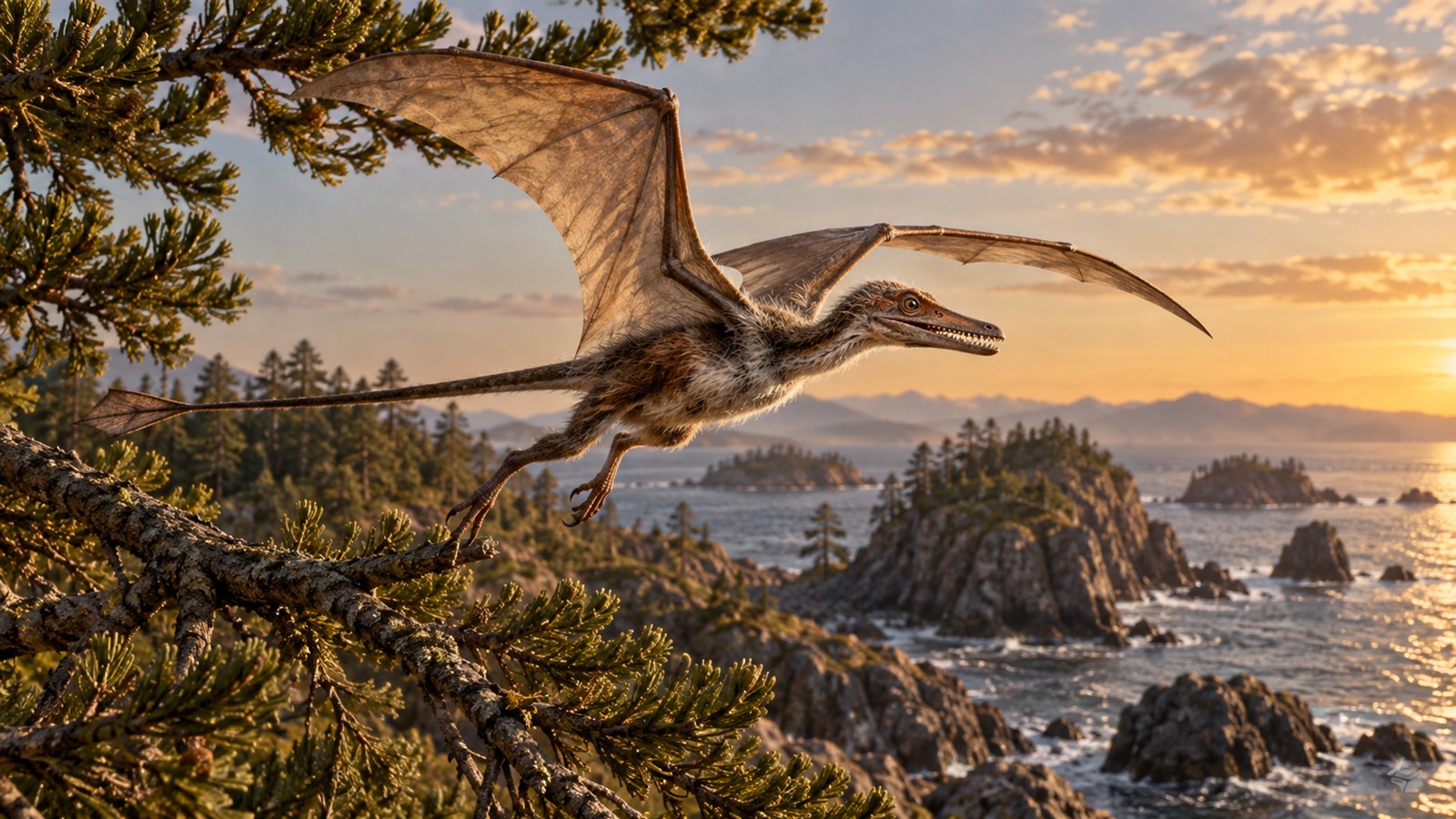
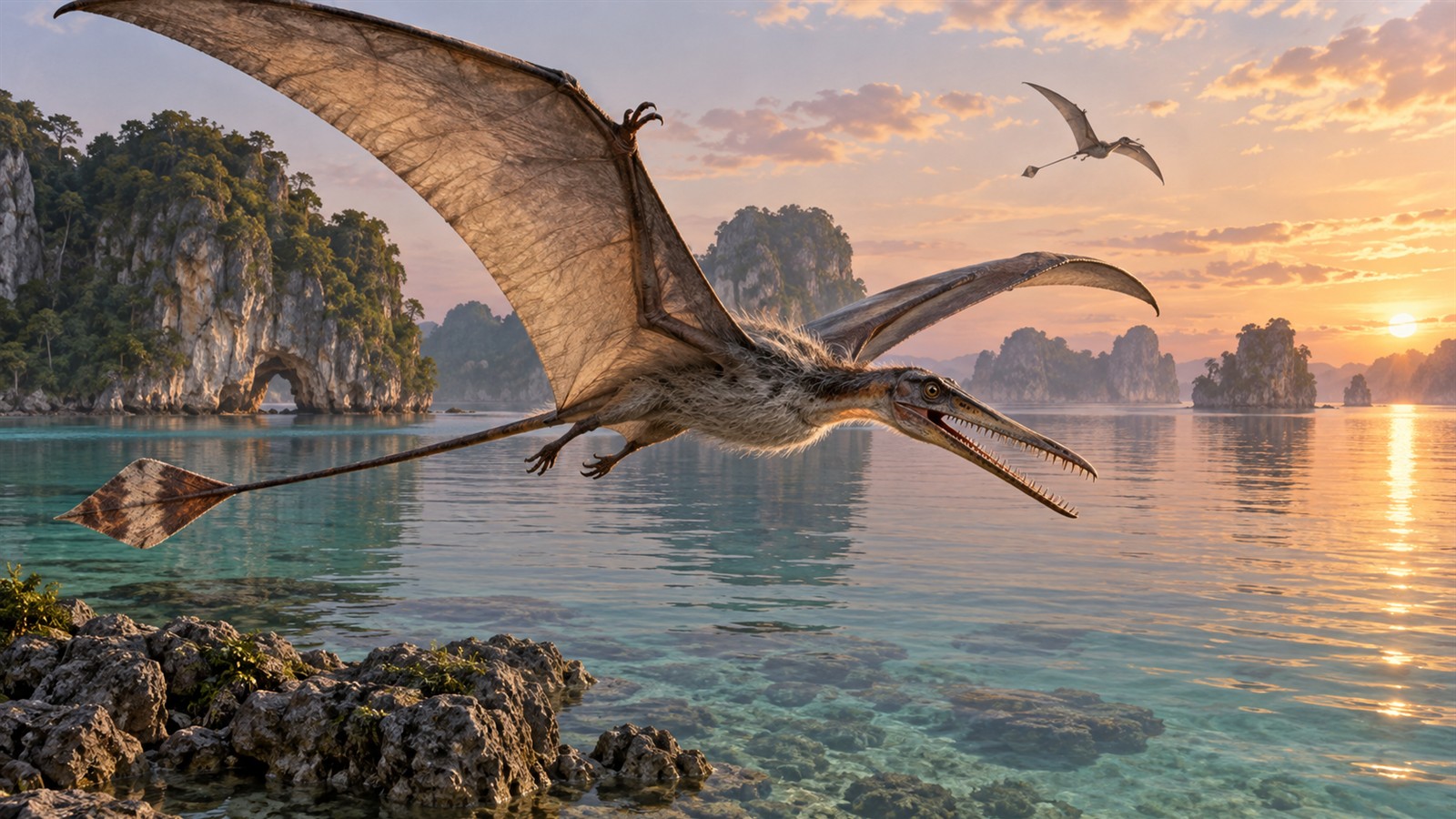
A: Stiff tails and terminal vanes likely aided stability in several early forms.
A: Diets included fish, insects, tiny aquatic prey, shellfish, carrion, and small land animals.
A: Embryos and eggshells confirm egg laying in pterosaurs.
A: End-Cretaceous ecosystem collapse removed the surviving lineages.
The name pterosaur covers the true flying reptiles
Pterosauria is a natural evolutionary group with a shared ancestor and many specialized descendants. The word means winged lizard, but pterosaurs were not lizards. Their closest living relatives are birds and crocodilians within Archosauria, although the exact fossil branches near their origin remain debated. Diagnostic features include the enlarged wing finger, a distinctive wrist bone called the pteroid, lightened skeletons, and shoulder structures built for powerful flight muscles.
Other reptiles have glided without evolving the pterosaur system. Draco lizards spread membranes supported by elongated ribs, while extinct Coelurosauravus used rod-like skin bones. Sharovipteryx carried a membrane around elongated hind limbs. These animals descended through the air but lacked the anatomy for sustained flapping flight seen in pterosaurs.
They were close to dinosaurs but outside Dinosauria
Pterosaurs and dinosaurs occupy neighboring branches within the archosaur family tree. Both likely descended from small, active ancestors, and both share features linked to an upright gait and efficient breathing. Pterosaurs split away before the common ancestor that defines Dinosauria. A flying Pteranodon is therefore no more a dinosaur than a crocodile is, even though all three belong to the broader archosaur story.
Birds complicate ordinary language because they are living theropod dinosaurs and also flying vertebrates. In a strict sense, birds are flying dinosaurs rather than flying reptiles of the pterosaur kind. Museum labels use these nested terms to preserve ancestry. Popular conversation may be looser, but recognizing the distinction makes the independent origins of flight visible.
The nickname pterodactyl creates another mix-up. Pterodactylus is one genus from Late Jurassic Europe, while pterodactyloid names a broad advanced subgroup. Calling every pterosaur a pterodactyl is like calling every cat a lion.
A single finger carried most of the wing
The pterosaur’s fourth finger became longer than the body in many species. A membrane called the brachiopatagium stretched from that finger toward the torso and hind limb. Closer to the shoulder, the propatagium connected wrist and body, smoothing airflow over the leading edge. A separate membrane between the hind limbs is called the uropatagium, although its size and division differed across the group.
Fossils from exceptional deposits preserve fibers within wing membranes. These actinofibrils helped control shape and resist unwanted stretching. The membrane also contained blood vessels, nerves, and muscle layers, making it a living adjustable surface rather than a passive sheet of skin. The exact attachment near the ankle remains debated for some species, but it did not generally end at the hip in the narrow batlike triangle once common in art.
The skeleton was light without being flimsy
Many pterosaur bones had thin walls, internal struts, and air spaces linked to the respiratory system. This construction reduced mass while resisting bending, much like a hollow beam with reinforcing braces. Large openings in the skull removed unnecessary material. Fusion among torso vertebrae and shoulder elements created a firm platform against the repeated pull of flight muscles.
Thin-walled fossils crush easily, which biases the record toward calm lagoons and fine sediment. A flattened bone may look delicate after burial even if it was strong in life. CT scans reveal internal supports that surface photographs miss. Strength must be evaluated from cross-section, material distribution, and loading direction rather than wall thickness alone.
Lightness did not mean minimal muscles. Launching and flapping required substantial chest and forelimb power. Restored bodies need enough tissue around the shoulder and upper arm to operate the joints. Skeletal silhouettes with shrink-wrapped necks and torsos underestimate the living animal.
Early forms often had long tails and teeth
Triassic and many Jurassic pterosaurs had relatively short hand bones, long fifth toes, toothed jaws, and lengthy stiffened tails. Eudimorphodon had varied tooth shapes, while Rhamphorhynchus carried forward-pointing teeth and a tail ending in a soft-tissue vane. Dimorphodon combined a large skull with robust limbs and probably differed ecologically from lagoon-skimming stereotypes.
Pterodactyloids changed the proportions
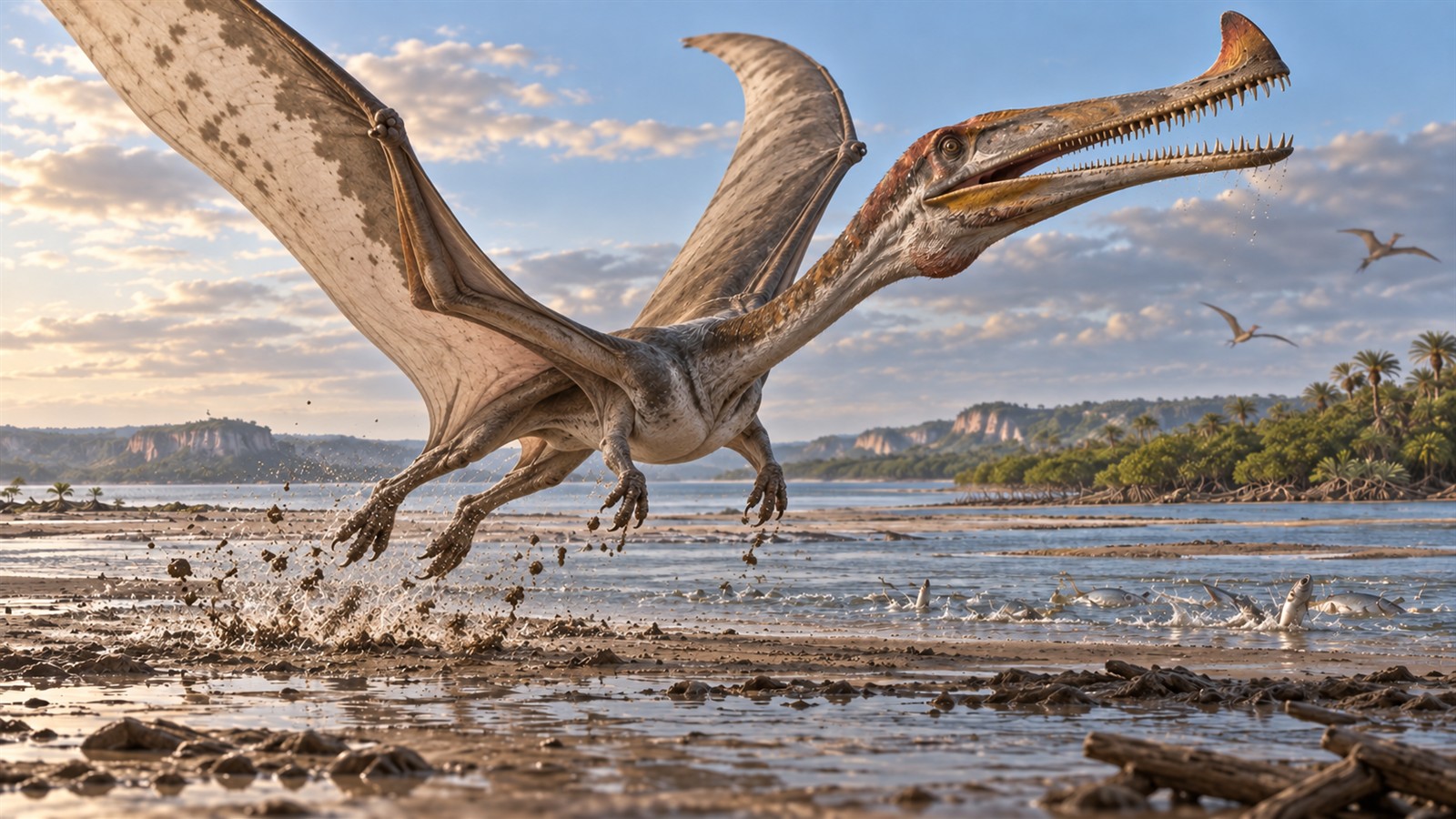
Later pterodactyloids generally shortened the tail, lengthened the hand before the wing finger, and altered the neck and skull. Pterodactylus remained modest in size, while ctenochasmatids developed combs of fine teeth for straining small food from water. Dsungaripterids carried strong skulls and rounded rear teeth capable of processing hard prey. Tapejarids had deep beaks and elaborate crests.
Pteranodontids and nyctosaurids became specialized marine soarers, often losing teeth. Ornithocheirids and related forms retained large conical teeth suited to grasping fish. Azhdarchids evolved long necks, large heads, and terrestrial proportions, producing the biggest known pterosaurs. Advanced does not mean superior; it simply identifies a later branching assemblage with shared anatomy.
Crests were more than decorative sails
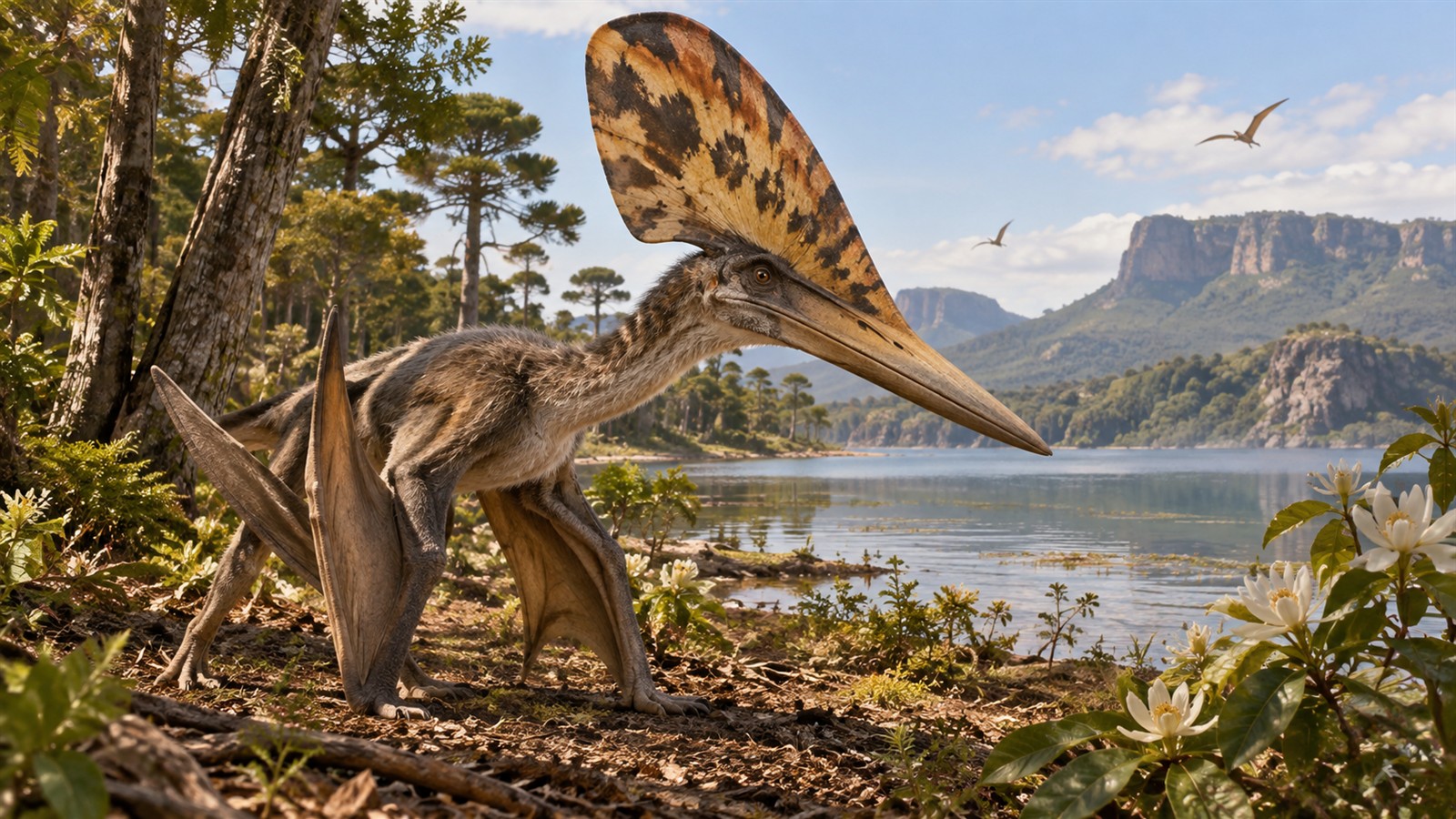
Pterosaur crests arose from the skull, jaw, or both and varied by age and species. Bone sometimes supported a much larger keratinous or soft-tissue extension. Crests may have displayed species identity, maturity, condition, or sex, although proving one function requires population samples. Aerodynamic effects are possible for some shapes but unlikely to explain every flamboyant structure.
Juveniles can lack the full crest of adults, so growth may once have produced extra species names. Preservation further complicates comparison because thin crest bone breaks and soft tissue disappears. A crest should be reconstructed from the individual specimen when possible rather than copied from the most spectacular relative.
Color is almost always uncertain. Pigment-bearing structures have been reported in rare pterosaur soft tissues, but translating microscopic evidence into an exact whole-head pattern is difficult. Display organs make bright colors plausible without turning a possibility into a recorded fact.
Feet and tracks reveal capable walkers
Pterosaur trackways show four-limbed movement on the ground. The hands planted in front of and outside the feet, with the wing finger folded clear of the surface. Many tracks indicate a stable, erect quadrupedal gait rather than belly-dragging. Different foot proportions suggest that some species favored firm ground, mudflats, climbing surfaces, or other settings.
Pterodactyloid hips and limbs often supported efficient terrestrial travel. Azhdarchids in particular had long, straight limbs suited to walking through open habitats. Early long-tailed forms may have been more adept on uneven or inclined surfaces, with curved claws useful for clinging. Ground ability varied instead of improving along one universal scale.
Launch probably used all four limbs
A common model proposes that many pterosaurs vaulted from a crouch using powerful forelimbs, adding the hind limbs before opening the wings. Quadrupedal launch fits their strong arms and avoids requiring a giant species to reach flight speed through a birdlike two-legged run. Trackways, joint ranges, and comparisons with vampire bats inform the model, while computer simulations test acceleration and clearance.
Not every species had identical proportions or habitat. Small pterosaurs may have used rapid leaps, climbing launches, or drops from height. Large soarers needed suitable wind and space but were not necessarily trapped on cliffs. A valid launch reconstruction must clear the long wing finger without striking the ground and must fit the preserved joints.
Landing reversed the problem: wings had to slow the body before hands and feet accepted weight. Flexible wrists, membranes, and body pitch could absorb energy. Fossil trackways rarely capture the instant of touchdown, so landing remains harder to test than ordinary walking.
They ate far more than fish
Fish were important for many coastal species, supported by tooth shape, stomach contents, regurgitated pellets, and coprolites. Other pterosaurs caught insects, filtered tiny aquatic organisms, cracked shelled animals, probed sediment, or seized small land prey. Beak shape alone can mislead because living birds use similar bills in different ways. Neck flexibility, limb proportions, wear, and habitat improve dietary interpretation.
Azhdarchids are often reconstructed as terrestrial stalkers that walked through floodplains and picked up small animals or carrion. This model fits their stiff necks, long limbs, and inland fossils better than continuous ocean skimming. Tapejarids have been proposed as fruit eaters, but direct evidence is limited and their beaks may have handled varied foods.
Skin coverings changed their appearance
Fine hairlike structures called pycnofibers covered at least parts of many pterosaur bodies. Some exceptionally preserved examples show branched forms, prompting debate about whether pterosaur coverings and dinosaur feathers share a deep origin. Whatever their terminology, the fibers likely contributed insulation, sensation, display, or combinations of functions.
Wing membranes were not normally furry across their entire aerodynamic surface. Body fibers concentrated around the torso, neck, and head in many restorations, while membrane texture followed preserved evidence. Insulation supports active heat production, yet physiology should be inferred with bone growth and respiratory anatomy as well.
Soft-tissue crests, throat pouches, foot webbing, and tail vanes further changed the outline. Exceptional fossils are essential, but one species cannot supply every feature to every other pterosaur. A careful reconstruction distinguishes widespread anatomy from local novelty.
Eggs and young record a distinctive life cycle
Pterosaur eggs had relatively thin, sometimes flexible shells compared with rigid bird eggs. Fossils from China and Argentina include embryos, nests, and repeated egg accumulations. Some eggs may have absorbed water from buried substrates rather than remaining exposed in open nests. Adult associations can suggest colonial breeding, although floods may gather remains.
Embryonic wings were well developed in several specimens, leading to proposals that hatchlings flew early. Bone maturity, muscle development, and growth rates remain debated, and early flight does not mean complete independence. Parents might still have guarded sites or supplied food. Juveniles can also occupy different feeding habitats from adults.
Size ranged from tiny fliers to terrestrial giants
Some pterosaurs had wingspans measured in tens of centimeters, while Quetzalcoatlus, Hatzegopteryx, and other giant azhdarchids approached roughly ten meters across in many estimates. Wingspan is reconstructed from incomplete series, and isolated giant bones can be difficult to assign. Head height on the ground could rival a giraffe in the largest forms, but mass remained limited by flight requirements.
Giant size favored soaring, efficient long-distance travel, and powerful quadrupedal launch. It also made juveniles proportionally important to understanding growth. A smaller individual could represent another species or an immature giant. Histology and overlapping anatomy decide between those possibilities.
Scale comparisons should show posture. Wings folded tightly beside the body on land rather than stretching across the ground, and a standing animal’s height depends on shoulder, neck, and wrist position. Sensational diagrams often mix maximum wingspan with an unnaturally upright stance.
The fossil record leaves a recognizable pterosaur
A beginner should look first for the elongated fourth finger, compact free fingers, long forearm, and shoulder adapted to flight. Skull crests, teeth, tail length, and hand proportions then narrow the group. Geological age and locality can rule out tempting names. A toothless marine soarer from the Late Cretaceous differs from a long-tailed Jurassic lagoon hunter even when both are drawn with narrow wings.
Pterosaurs vanished at the end of the Cretaceous, leaving birds as the surviving powered fliers from the Mesozoic. Their disappearance may reflect food-web collapse and low diversity among the latest lineages, although small late pterosaurs are probably underrepresented. For most of their history, they were neither failed birds nor background companions to dinosaurs. They were a major vertebrate radiation with their own solutions for flight, walking, feeding, display, and reproduction.