A 180-million-year story written across changing seas
Prehistoric marine reptiles did not inhabit one eternal ocean. They rose after the greatest mass extinction in Earth history, crossed shifting continents, diversified in shallow continental seas and deep basins, and endured several ecological crises before most major lineages vanished. Their record includes compact shoreline hunters, shell-crushing specialists, dolphin-shaped cruisers, four-flippered ambush predators, giant marine lizards, ocean-going crocodile relatives, and turtles whose descendants still migrate today. An ultimate guide must therefore travel through time as well as taxonomy. Rock formations, fossil quarries, changing sea level, and revised family trees explain why particular animals appear together and why celebrated genera sometimes change name, age, or reconstructed appearance.
A: Several ichthyosauriform and coastal lineages emerged early in the Triassic.
A: Their durable body plan spread around the Triassic-Jurassic transition.
A: Their histories overlap only partly, and ecosystem turnover was more complex.
A: Triassic remains occur in Nevada and other regions around the former Panthalassan realm.
A: Its sediments preserve changing Cretaceous communities across central North America.
A: Known material supports substantially more modest estimates.
A: Fully pelagic metriorhynchids disappeared by the Cretaceous.
A: Turtle lineages crossed the boundary, although many specialized forms vanished.
A: New overlap exposes variation, synonymy, or previously hidden diagnostic anatomy.
A: Anchor every animal to age, place, specimen, and confidence level.
The Triassic recovery opened the oceans
The end-Permian extinction devastated marine ecosystems about 252 million years ago. Recovery created ecological space in which several reptile lineages entered coastal habitats. Early ichthyosauriforms such as Cartorhynchus and Chaohusaurus retained elongated bodies and less extreme paddles than later cruisers. Hupehsuchians evolved stiff trunks and unusual layered ribs in China. Their diversity demonstrates that marine adaptation accelerated within a geologically short interval.
Shallow Tethyan seas around present-day Europe and Asia supported pachypleurosaurs, nothosaurs, placodonts, and tanystropheids. Some remained amphibious; others were increasingly water-bound. Placodonts divided into relatively streamlined shell crushers and heavily armored forms that superficially recall turtles. Their armor evolved independently, and their skulls preserve broad palates packed with crushing teeth.
Ichthyosaurs reached astonishing extremes
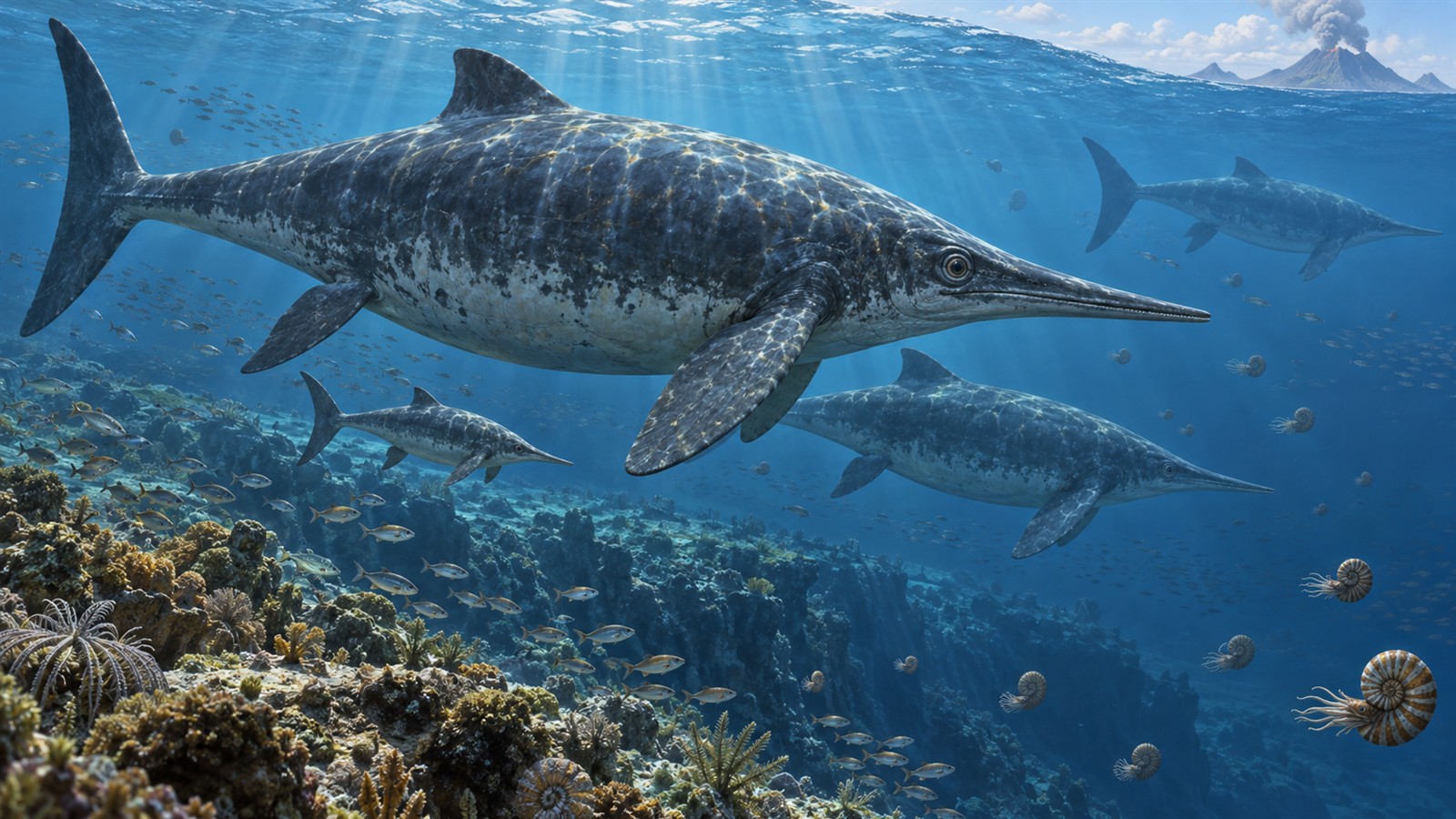
Middle and Late Triassic ichthyosaurs expanded from small hunters to giants. Cymbospondylus had a long body and tail unlike the compact tuna profile of later species. Shonisaurus from Nevada and enormous fragmentary relatives from other regions show that whale-scale reptiles evolved surprisingly early. Their exact lengths depend on matching incomplete bones with appropriately proportioned species, so records should be treated as estimates rather than fixed rankings.
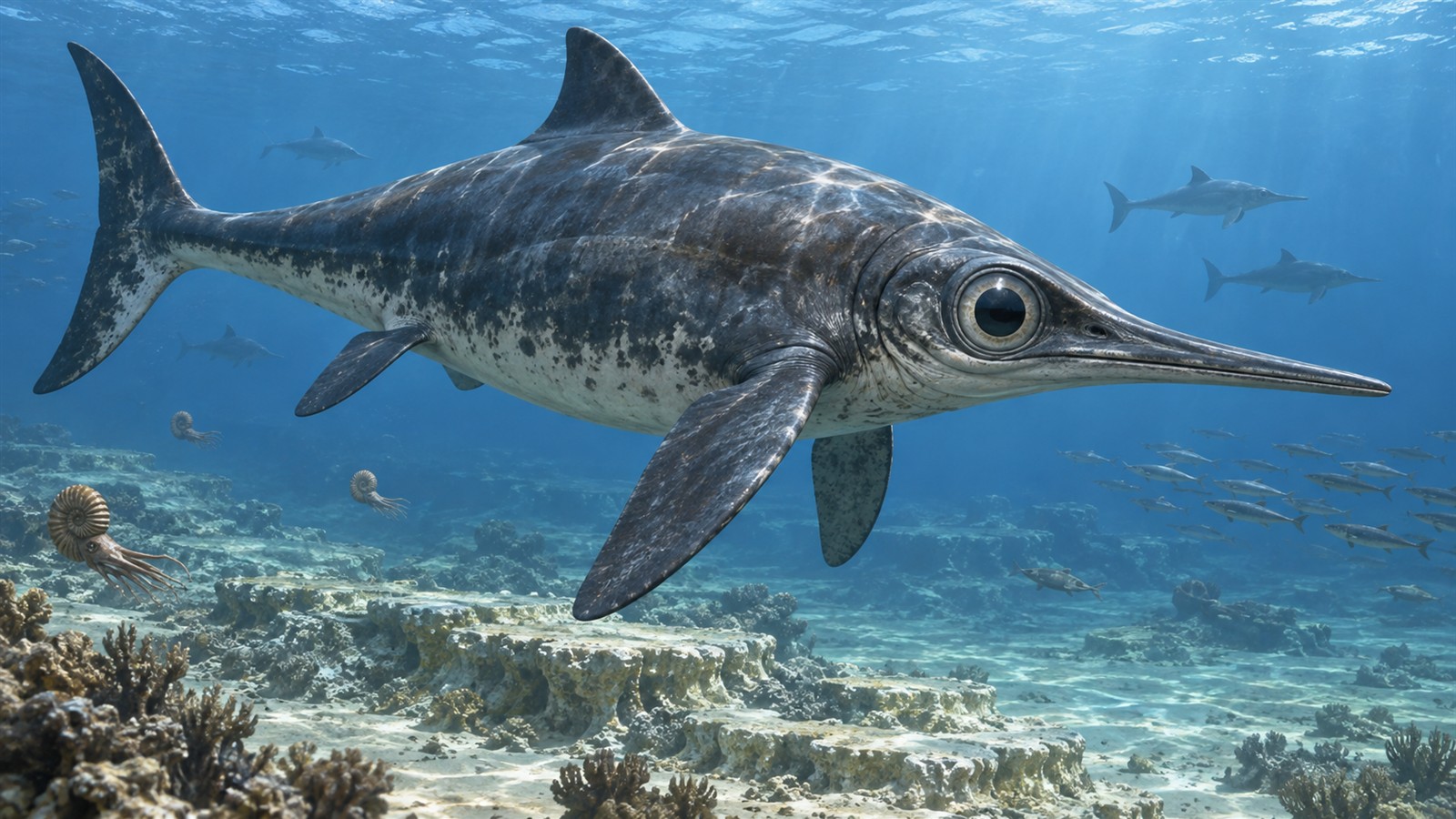
Jurassic ichthyosaurs became more visibly fish-shaped. Ichthyosaurus, Stenopterygius, and Temnodontosaurus are known from European deposits that sometimes preserve body outlines, stomach contents, and embryos. These fossils established the dorsal fin and crescent tail now central to restoration. They also expose ecological variation: some species had delicate teeth for small prey, while large skulls and robust crowns imply more powerful feeding.
Ophthalmosaurids carried the lineage through the Late Jurassic and into the Cretaceous. Ophthalmosaurus is famous for exceptionally large eyes, short jaws, and a body suited to sustained swimming. Cretaceous genera retained broad geographic ranges before the final ichthyosaurs disappeared early in the Late Cretaceous. Their extinction preceded the asteroid impact by tens of millions of years.
Plesiosaurs began a longer dynasty
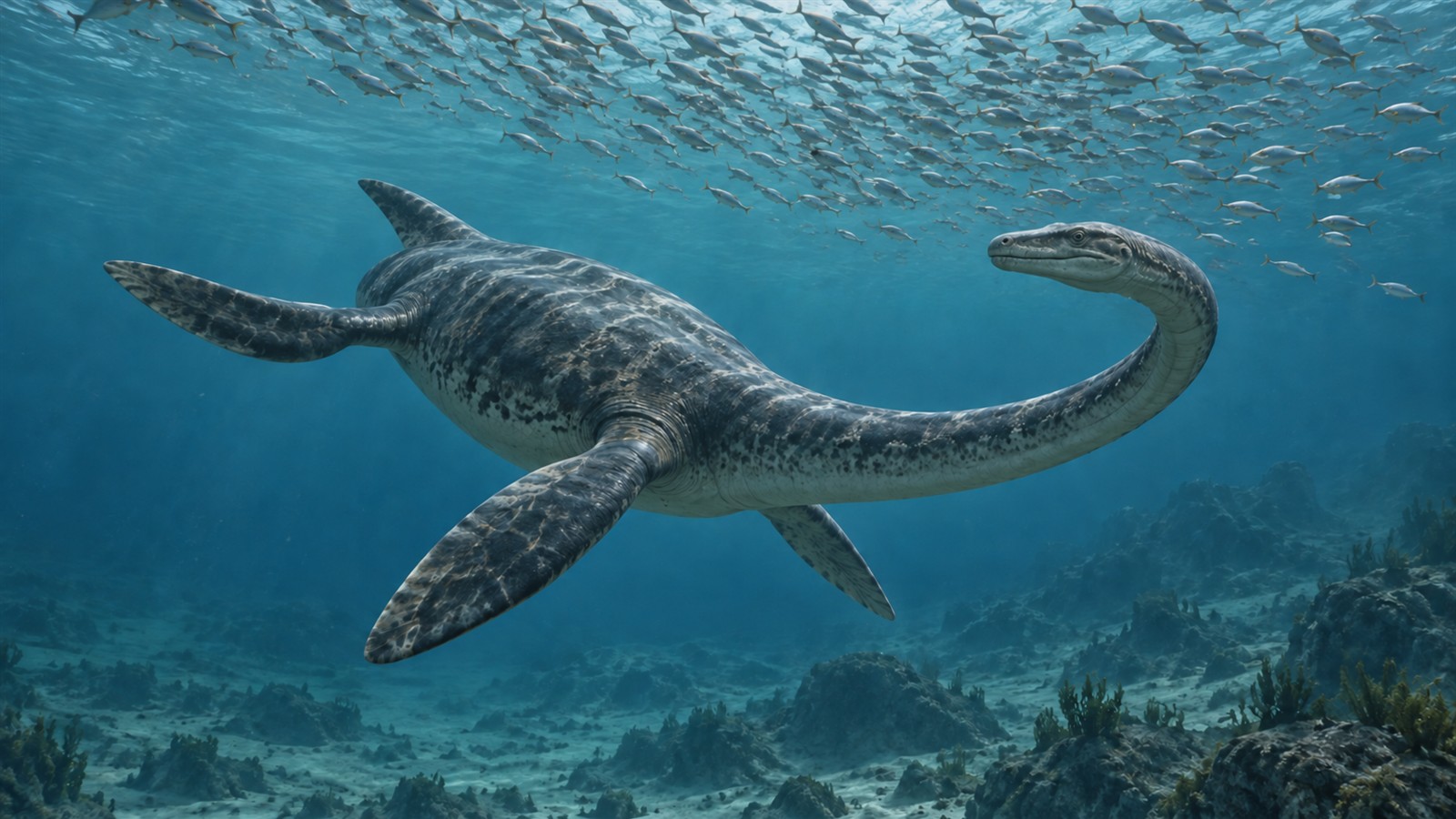
The earliest plesiosaurs appeared near the Triassic-Jurassic boundary and established a body plan that persisted until the end-Cretaceous extinction. Early forms combined moderate necks with four strong flippers. Through the Jurassic, plesiosauroids expanded neck length and pliosaurids enlarged their heads. These categories describe broad tendencies, but evolutionary trees reveal multiple changes in proportion rather than one simple split between harmless long-necks and short-necked monsters.
Jurassic seas favored specialized hunters
European Lower Jurassic rocks preserve Rhomaleosaurus, Microcleidus, and other plesiosaurs alongside abundant ichthyosaurs. The Oxford Clay of England later yielded Cryptoclidus, Muraenosaurus, and the pliosaur Liopleurodon. Historical estimates gave Liopleurodon extraordinary lengths unsupported by known specimens. More conservative reconstructions use skull-to-body ratios from close relatives and keep the famous predator impressive without multiplying missing vertebrae.
Very large pliosaurids also occur in Late Jurassic Arctic deposits. Pliosaurus species carried massive skulls with teeth designed to resist heavy loading. Bite-force models depend on muscle reconstruction and lever arms, while direct evidence such as tooth damage and prey remains tests dietary claims. Long-necked contemporaries occupied different feeding niches, reducing a diverse assemblage to more than predator and victim.
Marine crocodile relatives moved offshore
Teleosauroids often retained elongated snouts, dorsal armor, and limbs compatible with nearshore life. Metriorhynchids changed more radically: forelimbs shortened into paddles, hind limbs flattened, tails developed fins, and bony armor was reduced. Metriorhynchus, Geosaurus, and Dakosaurus represent different cranial and dental designs. Some were narrow-snouted fish hunters, whereas robust skulls and serrated teeth indicate attacks on larger prey.
These crocodylomorphs flourished mainly in Jurassic and Early Cretaceous seas. Their extinction left no fully pelagic crocodilian successor. Modern crocodilians can travel through salt water and possess salt glands, yet they retain walking limbs, dorsal osteoderms, and nesting behavior tied to land. Similar ancestry did not guarantee the same ecological endpoint.
South American and European formations have greatly expanded the known metriorhynchid record. Precise dates reveal evolutionary change across connected basins. Because isolated teeth can resemble those of theropod dinosaurs, marine context and root anatomy matter when assigning fragmentary specimens.
The Cretaceous flooded continental interiors
High sea levels created broad epicontinental waterways, including the Western Interior Seaway across North America. These waters divided the continent and accumulated chalk, shale, and limestone rich in vertebrate fossils. Plesiosaurs, early mosasaurs, turtles, sharks, fish, and diving birds occupied the seaway at different times. Eastern and western margins changed as sea level advanced and retreated, altering habitat area and connections to the open ocean.
In southern continents, formations in Morocco, Angola, Antarctica, Australia, and South America preserve distinct communities. The Tethys Ocean linked tropical regions, while southern high latitudes supplied colder seasonal environments. A genus found on separated landmasses may indicate dispersal through open water, long duration, or taxonomic grouping that needs revision.
Elasmosaurids made neck length extreme
Late Cretaceous elasmosaurids carried dozens of neck vertebrae and relatively small heads. Elasmosaurus became historically important after its first reconstruction placed the skull on the tail, an error corrected when vertebral orientation was reconsidered. The episode remains a useful lesson: an articulated sequence and comparison with related skeletons matter more than an anatomically convenient assumption.
Albertonectes is known for an exceptionally high cervical count, while Styxosaurus and Thalassomedon represent other North American long-necked forms. Outside North America, aristonectines developed broad skulls and numerous fine teeth, suggesting feeding modes unlike the narrow-jawed fish grabber often used for every plesiosaur.
The function of the neck remains debated through hydrodynamics, flexibility studies, and feeding evidence. It could extend reach while the torso stayed distant, permit benthic foraging, or support different prey approaches among species. Extreme length increased drag during turns, so reconstructions should not whip the head through water like a striking snake.
Mosasaurs rapidly occupied predator roles
Early mosasauroids such as Dallasaurus illuminate the transition from small semiaquatic squamates to fully marine forms. Later mosasaurs spread worldwide and diversified into long-snouted fish catchers, robust generalists, shell crushers, and giants. Platecarpus preserves rare soft-tissue evidence for tail shape. Globidens carried rounded teeth suited to crushing. Tylosaurus developed an elongated toothless rostrum ahead of its jaws.
Mosasaurus itself became one of the largest members near the close of the Cretaceous. It did not live with Jurassic ichthyosaurs or Liopleurodon. Prognathodon and related robust-jawed forms broaden the feeding picture, while stomach contents and bite traces link mosasaurs with fish, birds, turtles, ammonites, sharks, and other reptiles. Claims of universal apex status overlook differences in species, size, age, and habitat.
Turtles and birds shared the marine world
Protostegid turtles included Protostega and enormous Archelon, whose broad bodies and long front flippers crossed the Western Interior Seaway. Their shells were reduced in ossification compared with many hard-shelled turtles, producing a framework rather than one uninterrupted bony shield. Turtles nested on land, so coastlines remained essential even for powerful ocean travelers.
Flightless diving birds such as Hesperornis propelled themselves with strong hind limbs. Toothed seabirds captured fish while sharing waters with mosasaurs and plesiosaurs. They were avian dinosaurs, making them a genuine dinosaur presence in Cretaceous seas. Their inclusion helps correct the claim that dinosaurs never became marine while preserving the distinction between birds and the classic marine reptile groups.
Sharks and bony fish were equally important competitors and prey. Giant fish such as Xiphactinus show that dramatic marine predators did not all belong to Reptilia. An ecosystem guide should include these neighbors because reptile evolution responded to the full food web.
Famous fossil regions offer different windows
The Posidonia Shale of Germany is celebrated for Early Jurassic articulated reptiles preserved in dark marine sediment. Lyme Regis and other British coastal exposures helped launch nineteenth-century marine-reptile science through collectors including Mary Anning. The Oxford and Kimmeridge clays document later Jurassic communities. Nevada’s Berlin-Ichthyosaur locality preserves giant Triassic ichthyosaurs whose accumulation has inspired competing burial explanations.
Kansas chalk records the Western Interior Seaway, while Moroccan phosphate deposits contain abundant Late Cretaceous mosasaur teeth and bones. Patagonia, Antarctica, and New Zealand expand southern plesiosaur and mosasaur records. Lagerstätten receive attention because completeness is exceptional, but ordinary fragmentary sites may provide better continuous records of environmental change.
Collections continually rewrite old names
Historical species were sometimes named from isolated vertebrae, teeth, or incomplete skulls. Later discoveries can reveal that a supposed diagnostic feature varies with growth, preservation, or position in the body. Researchers may combine names, separate a broad genus, or declare material too incomplete for confident identification. A changed label is evidence of comparison, not a flaw in science.
CT scans expose internal skull chambers, replacement teeth, and hidden sutures. Photogrammetry allows three-dimensional comparison across museums. Histology tests age, while geochemical screening evaluates whether isotopic signals are original. Quarry records connect specimens to exact layers. Older collections become newly useful when modern methods ask questions their discoverers could not formulate.
Ethical research also depends on legal collection, clear ownership, and collaboration with source countries. A specimen without locality data loses scientific value even if visually spectacular. Repatriation and local capacity building can reconnect fossils with geological expertise and public heritage.
The end-Cretaceous boundary closed an era
Mosasaurs, plesiosaurs, protostegid turtles, ammonites, and many plankton groups disappeared or suffered severe losses around the impact boundary. Darkness and cooling disrupted primary production, while acidification and habitat change compounded the crisis. Large predators could not persist when food webs collapsed beneath them. The event ended dominant lineages that had remained successful until the final interval.
Some turtles, birds, crocodilian relatives, fish, and sharks survived into the Paleogene. New marine mammals later evolved flippers, tail-powered swimming, deep diving, and live birth through yet another set of transformations. Their resemblance to earlier reptiles demonstrates recurring ocean pressures, not direct replacement along one ladder.
Building a reliable worldwide guide
Begin every entry with age, formation, locality, and specimen completeness. Follow with the features that support identification, separating bones actually preserved from proportions restored through relatives. Place size estimates in ranges and identify the comparison behind them. A genus list without geological context invites impossible encounters and treats unequal evidence as equivalent. Then connect the animal to its community. Associated prey, competitors, water depth, climate, and coastline position make anatomy meaningful. Note competing hypotheses when neck use, dive depth, metabolism, or extinction remains unsettled. Maps should distinguish modern political borders from ancient coastlines, because a fossil’s present country may have occupied another latitude and faced a vanished ocean basin when the animal lived. Collection histories deserve equal attention: preparation, trade, wartime movement, and old repairs can change what researchers know about a specimen. The worldwide record is strongest not as a parade of giants but as a changing map of repeated marine invasions. Across that map, each fossil captures one lineage negotiating the same ocean demands with a body inherited from a different past.