Ocean life rewrote the reptile body more than once
Marine reptiles reveal evolution working on a demanding engineering problem from several starting points. Lungs required regular access to the surface, yet feeding opportunities extended into deep or turbulent water. Limbs inherited from walkers had to generate thrust, steer, or disappear into a tail-driven system. Salt entered through prey and seawater. Heat escaped quickly, while pressure increased with every descent. Ichthyosaurs, plesiosaurs, mosasaurs, marine crocodylomorphs, and turtles solved these challenges differently because each lineage began with a different skeleton and history. Explaining them fully means connecting bones to muscles, motion to energy, teeth to food webs, embryos to reproductive freedom, and every reconstruction to the limits of fossil evidence.
A: Active motion, body density, ballast, and lung control all contributed.
A: No. Plesiosaurs relied chiefly on four flippers.
A: They define the stroke directions a living animal could achieve.
A: Anatomy and pathology constrain ranges but rarely yield one depth.
A: Evidence suggests varied and sometimes elevated body temperatures beyond that simple label.
A: Embryos occur within adults in consistent anatomical and developmental relationships.
A: Growth changed size, proportions, prey options, and vulnerability.
A: They confirm particular foods but represent only a final feeding event.
A: Fins, lungs, fat, and muscle strongly affect movement despite limited preservation.
A: Independent anatomical, geological, chemical, and comparative clues point toward the same conclusion.
Independent invasions produced convergent shapes
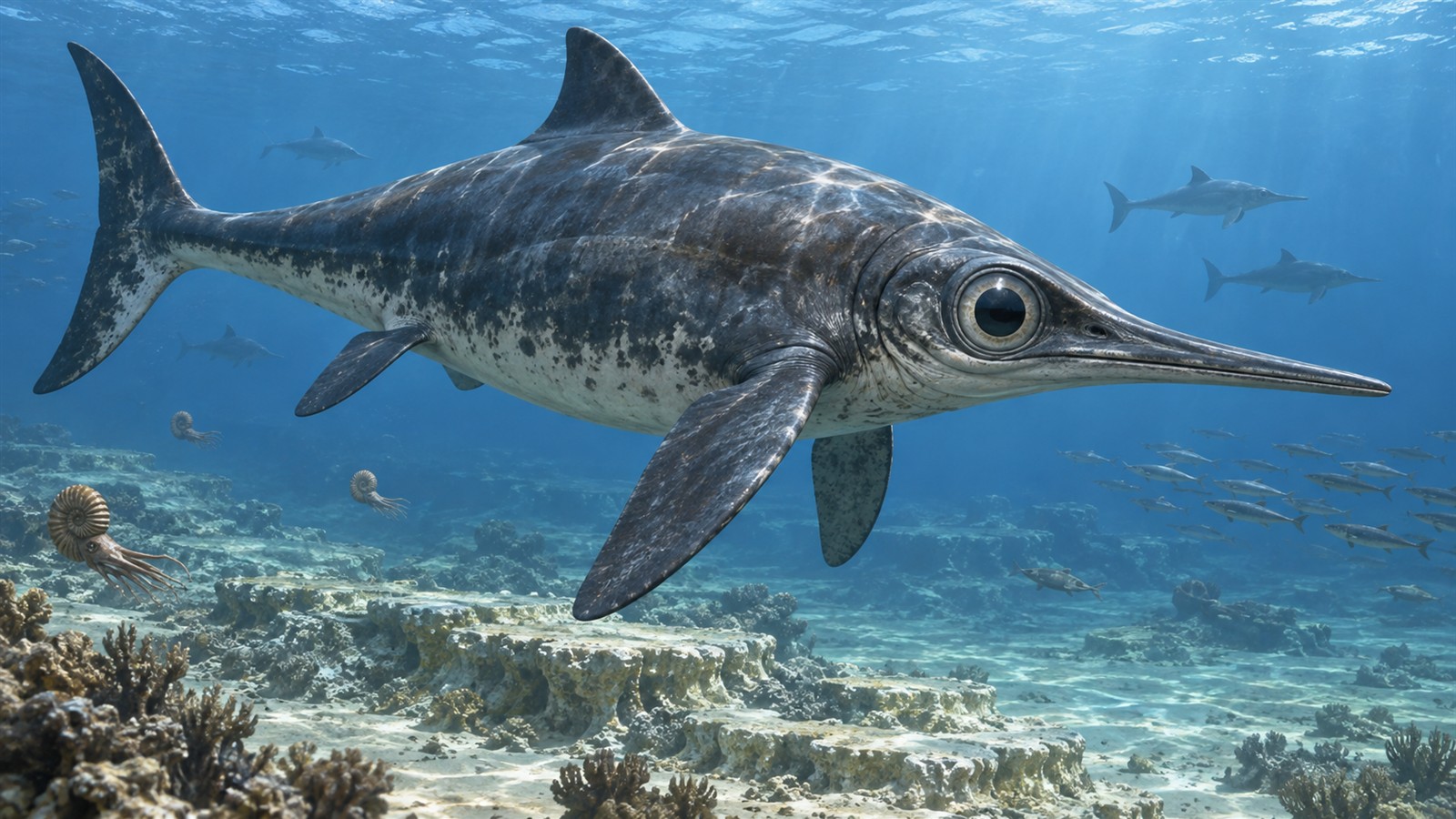
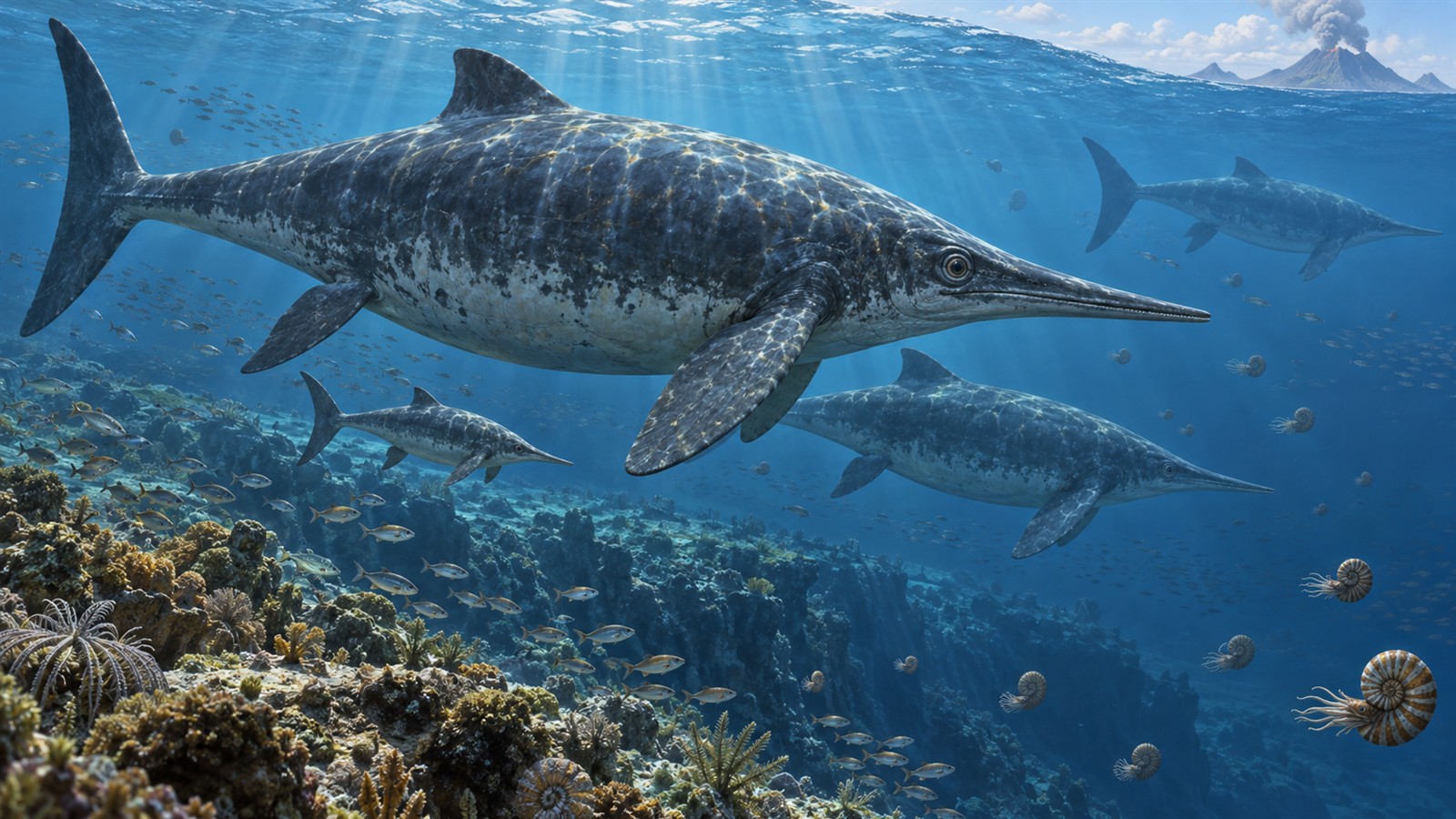
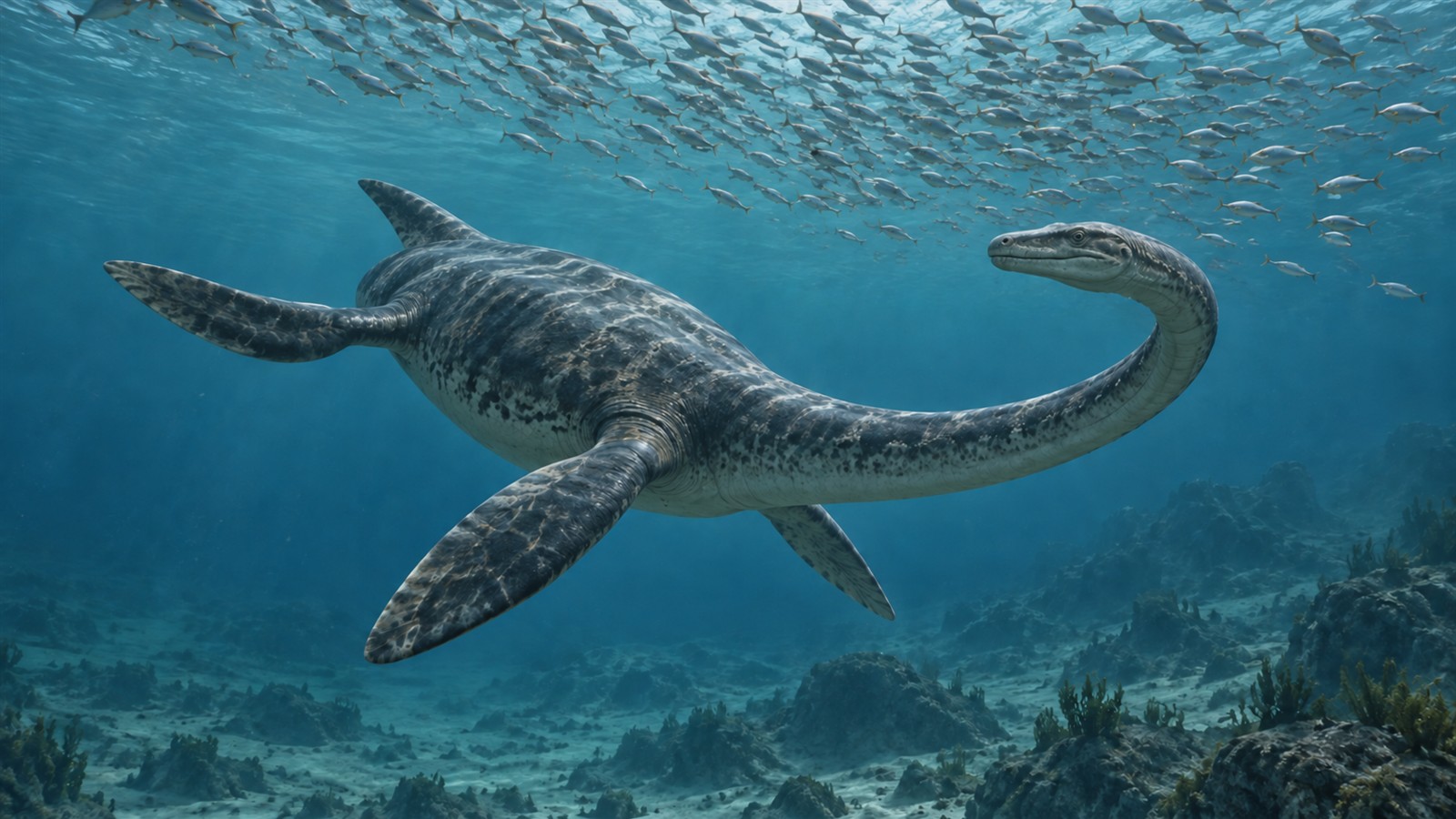
Aquatic adaptation did not pull every reptile toward one perfect design. Fast pursuit favored streamlined bodies and tail propulsion in advanced ichthyosaurs, mosasaurs, and metriorhynchids, yet each supported its fin in a different way. Plesiosaurs retained four dominant limbs and turned them into hydrofoils. Turtles enlarged the front flippers while preserving a shell that imposed its own hydrodynamic constraints. Similar outlines record similar selection pressures, but the underlying bones preserve separate ancestry.
Convergence is strongest when researchers can trace intermediate forms. Early ichthyosauriforms had elongated bodies and less specialized tails. Semiaquatic mosasauroids retained weight-bearing limb features before later species acquired stiff paddles and deeper tail regions. Crocodile relatives moved through shoreline forms before metriorhynchids lost their dorsal armor and transformed all four limbs. These sequences keep streamlined bodies from being mistaken for close relationship.
Buoyancy had to be controlled continuously
An animal with air-filled lungs tends to rise, while dense bone, swallowed stones, body tissues, and downward swimming counter that lift. Nearshore reptiles could use thickened bones as ballast, a condition called pachyostosis when bones become unusually massive. Added weight promotes stability in shallow water but raises the cost of rapid acceleration. Open-ocean hunters generally benefited from lighter, more streamlined frames and active control by flippers or tail.
Lung position also matters because a floating body rotates until centers of buoyancy and mass align. A broad trunk with lungs high in the body can be stable in one orientation but resist rolling during a turn. Plesiosaur gastroliths have been proposed as ballast, yet practical quantities may have been too small to control depth by themselves. The stones could instead aid food processing, supplement minerals, or contribute modestly to stability.
Fossils do not directly record a living animal’s lung volume or fat distribution. Digital models therefore test ranges rather than one answer. Researchers build body shapes around skeletons, assign plausible tissue densities, and alter lung size to see when floating posture matches anatomical expectations. The result is a set of possible behaviors constrained by sensitivity analysis.
Propulsion divided into tails and hydrofoils
Tail-driven swimmers bend the body or tail from side to side, pushing water backward with a broad fin. A narrow connection in front of the fin concentrates motion and reduces drag. Ichthyosaurs evolved a deep crescent tail with vertebrae bending into its lower lobe. Advanced mosasaurs had a hypocercal tail in which the skeletal axis supported the lower region while soft tissue completed the upper lobe. Metriorhynchids developed their own asymmetric support pattern.
Plesiosaurs followed a different route. Their flippers generated lift perpendicular to their movement, much as wings do in air. The front and rear pairs could alter timing, angle, and stroke size to balance thrust against maneuverability. Simulations disagree on the exact phase relationship that delivered the best performance, partly because flexible soft tissues and muscles are reconstructed. Joint limits exclude impossible strokes even when several viable patterns remain.
Flippers retained clues to walking ancestors
Inside a smooth paddle, humerus, radius, ulna, wrist bones, and digits can still be identified. Some lineages increased the number of finger bones, a pattern called hyperphalangy, while others added digits or broadened existing ones. Closely packed polygonal bones stiffened the paddle and spread load. The shoulder and pelvis had to absorb repeated forces, so their articular surfaces help estimate stroke direction. External silhouettes should follow those internal supports; an illustration cannot place a sharp wingtip where the bones end in a rounded fan.
Breathing linked anatomy with behavior
Surfacing frequency depended on oxygen stores, exertion, temperature, and dive depth. Large animals can carry more oxygen in absolute terms and may use it more economically per unit mass, but active pursuit consumes reserves quickly. Flexible lungs can collapse under pressure, reducing nitrogen absorption, while reinforced airways may keep passages open. Fossils rarely settle these details, so living seals, whales, turtles, crocodilians, and diving birds supply comparative boundaries rather than direct copies.
Nostrils positioned away from the snout tip shorten the portion that must clear the surface. Plesiosaur nasal passages are complex and may have contributed to smell or water movement around sensory tissues. Mosasaur nostrils shifted backward during aquatic evolution. Ichthyosaur openings remained on the skull, not as a mammal-like blowhole on top of the head. No known marine reptile breathed through a spout.
Rapid ascent and repeated deep diving raise questions about decompression injury. Some fossil marine reptile bones contain lesions compared with avascular necrosis, which can occur when gas bubbles disrupt blood supply. Trauma, infection, and other processes can resemble it. Patterns across many bones and individuals are needed before a diving explanation becomes persuasive.
Senses operated in a dim and moving world
Vision mattered where suspended sediment, depth, or night reduced light. Ichthyosaur eye size and sclerotic rings suggest strong low-light performance in some taxa, but a large eye does not prove extreme depth by itself. Skull canals and inner ears provide evidence for balance and head movement. A compact vestibular system may suit stable cruising, while greater agility can demand different sensitivity.
Smell underwater works differently from airborne sniffing. Chemical cues can enter nasal spaces during movement, but the route depends on soft tissues rarely preserved. Mechanoreception offers another channel. Living crocodilians detect water disturbance with pressure-sensitive organs, and grooves or foramina on fossil skulls may have supported nerves and blood vessels. Assigning a precise sensory organ requires a close anatomical match rather than surface texture alone.
Teeth partitioned a crowded food supply
Slender interlocking teeth form a cage for small fish. Robust conical crowns resist forces from larger struggling prey. Rounded crushing teeth distribute pressure across shells, and cutting edges can slice flesh. Tooth shape is only the beginning: jaw leverage, replacement rate, crown wear, stomach contents, and prey availability determine what an animal actually ate. Two predators with similar teeth might avoid competition by hunting at different depths, times, or locations.
Microscopic wear records the direction and intensity of repeated tooth contact. Chemical isotopes can distinguish food sources or water habitats when preservation is sound. Embedded teeth and matching bite traces offer dramatic evidence, yet scavenging remains possible unless healing or scene context clarifies the interaction. Food-web reconstruction works best when independent evidence converges.
Predators also became prey. Large plesiosaurs, mosasaurs, sharks, and giant fish occupied overlapping networks, and juveniles faced a different set of dangers from adults. Cannibalism is possible where tooth marks match the same lineage, but identification must be specific. Ocean ecosystems were not ladders with one permanent ruler; they were networks altered by body size, life stage, geography, and time.
Live birth changed the geography of reproduction
Embryos occur in ichthyosaurs, plesiosaurs, mosasaurs, and some other marine reptiles. Their positions inside the body, small size, and matching anatomy distinguish pregnancy from a swallowed meal. Live birth allowed adults with rigid paddles to reproduce far from beaches. It also concentrated investment in fewer, larger young and may have made nursery habitats important.
Birth orientation has attracted attention because many marine mammals deliver tail first, reducing drowning risk. Ichthyosaur fossils preserve both orientations, and embryos can shift after death. One specimen cannot establish a universal birthing rule. Pelvic width, embryo number, developmental stage, and repeated examples offer a more reliable view of reproductive biology.
Growth changed shape, diet, and vulnerability
Bone microstructure records cycles of rapid and slower deposition. Juveniles could have proportionally different heads, eyes, limbs, and tails, complicating species identification. A small skeleton may be a young individual rather than a miniature species. Histology, suture closure, surface texture, and comparison with growth series help distinguish age from taxonomy.
Ecological roles could shift with growth. Young predators may have remained in protected shallows, eaten smaller prey, or accelerated differently from heavy adults. Teeth sometimes change proportions through ontogeny, and muscle leverage grows with the skull. A nursery hypothesis requires repeated young individuals, appropriate sediment, and evidence that currents did not simply sort small carcasses together.
Rapid growth can support an active lifestyle but does not translate directly into a modern metabolic category. Bone tissue responds to nutrition, season, mechanical load, and ancestry. Researchers compare several regions of the skeleton and multiple ages before estimating growth curves. Missing juvenile or old individuals can distort the apparent maximum rate.
Heat balance influenced range and performance
Water removes heat far faster than air. Large bodies retain warmth through low surface-area-to-volume ratios, a phenomenon called gigantothermy, while active muscles generate metabolic heat. Countercurrent blood flow can conserve warmth in limbs, though vessels rarely fossilize clearly enough to demonstrate the arrangement. Elevated oxygen-isotope temperatures in some groups suggest internal conditions above ambient seawater, provided original chemistry has survived burial.
Temperature affected where prey could be followed and how long muscles sustained effort. High-latitude fossils show that several marine reptiles entered seasonally cold waters, but those regions were not identical to today’s polar oceans. Climate models, associated organisms, and sediment chemistry establish the local setting. Migration, seasonal residence, and physiological tolerance can produce similar geographic records.
Disease and repair expose the living animal
Healed fractures reveal that individuals survived collisions, attacks, or repetitive stress. Joint degeneration can indicate age or abnormal loading. Infections leave reactive bone around a wound, while tooth damage may record hard prey. Distinguishing disease from crushing after burial demands CT imaging and close study of bone texture. Patterns across the skeleton can test swimming reconstructions. Repeated shoulder injury might fit heavy forelimb use, whereas widespread vertebral strain could implicate tail propulsion. Such interpretations require sufficient sample sizes and age control. A single injured celebrity specimen should not define normal movement for its species.
Extinction was ecological, not mechanical failure
Marine reptile groups did not disappear because their designs stopped working. Ocean chemistry, temperature, circulation, sea level, and prey communities changed through time. Ichthyosaur decline and extinction preceded the end-Cretaceous impact and involved a different set of transitions from the sudden loss of mosasaurs and plesiosaurs. Diversity estimates must account for uneven rock exposure, collecting effort, and identification practices.
The impact crisis disrupted photosynthesis and food chains from plankton upward. Large specialized predators were especially vulnerable when prey collapsed. Some turtles and crocodilian relatives survived, probably aided by ecological flexibility, freshwater links, lower energy demands, or combinations of factors. Survival was filtered through whole ecosystems rather than awarded to the strongest swimmer.
Evidence should govern every restored detail
A rigorous reconstruction begins with one specimen and labels restored portions. Articulated bones constrain joint order; muscle scars guide body contours; skin outlines establish fins; close relatives fill only the remaining gaps. Hydrodynamic modeling can then test whether the resulting shape produces plausible drag and stability. Color is normally speculative unless pigment structures or ecological comparisons offer unusual evidence. Behavior deserves the same discipline. A group of skeletons may reflect social life, a breeding site, current transport, or one mass-death event. A deep-sea scene must fit the deposit and anatomy. Speed estimates need ranges and assumptions. Marine reptiles become more impressive, not less, when uncertainty is visible: their fossils support multiple complete transformations of the reptile body, and the chain from evidence to explanation lets those transformations be understood rather than merely admired.