A global history of life on pterosaur wings
Pterosaurs crossed every continent and nearly the whole Mesozoic Era, yet their story is preserved unevenly in scattered windows of exceptional rock. Triassic skeletons reveal early long-tailed fliers with no obvious flightless predecessor. Jurassic lagoons capture wing membranes, tail vanes, and changing skull proportions. Cretaceous lakes preserve crests and body coverings, while inland sediments hold isolated bones from towering terrestrial stalkers. The familiar names are only guideposts within a branching history that includes fish catchers, filter feeders, shell crushers, insect hunters, coastal soarers, and giants of open plains. A worldwide guide must connect each animal to its age, formation, specimen quality, and place on a family tree that continues to change as new fossils expose unexpected combinations.
A: Late Triassic sites in Europe and North America preserve early accepted forms.
A: Fine limestone records articulated skeletons, tissues, and growth stages.
A: Several separate early branches shared that ancestral profile.
A: Ctenochasmatids developed dense tooth combs in different arrangements.
A: Its deposits preserve three-dimensional skulls and dramatic soft-tissue crests.
A: Their fossils and proportions strongly support extensive terrestrial foraging.
A: They establish size classes but may not secure genus or wingspan alone.
A: New taxa, rescored anatomy, and incomplete overlap alter the best-supported branches.
A: Both groups coexisted widely until the end-Cretaceous crisis.
A: Age, place, specimen completeness, diagnosis, alternatives, and reconstruction confidence.
Triassic pterosaurs arrived as accomplished fliers
The oldest widely accepted pterosaurs occur in Late Triassic rocks, already equipped with elongated wing fingers, large flight-muscle attachments, and specialized ankles. Eudimorphodon from Italy had multiple tooth shapes, Preondactylus carried a more delicate skull, and Caelestiventus from Utah shows that early pterosaurs occupied desert environments as well as coastal islands. Their geographic spread implies an earlier evolutionary history still poorly sampled.
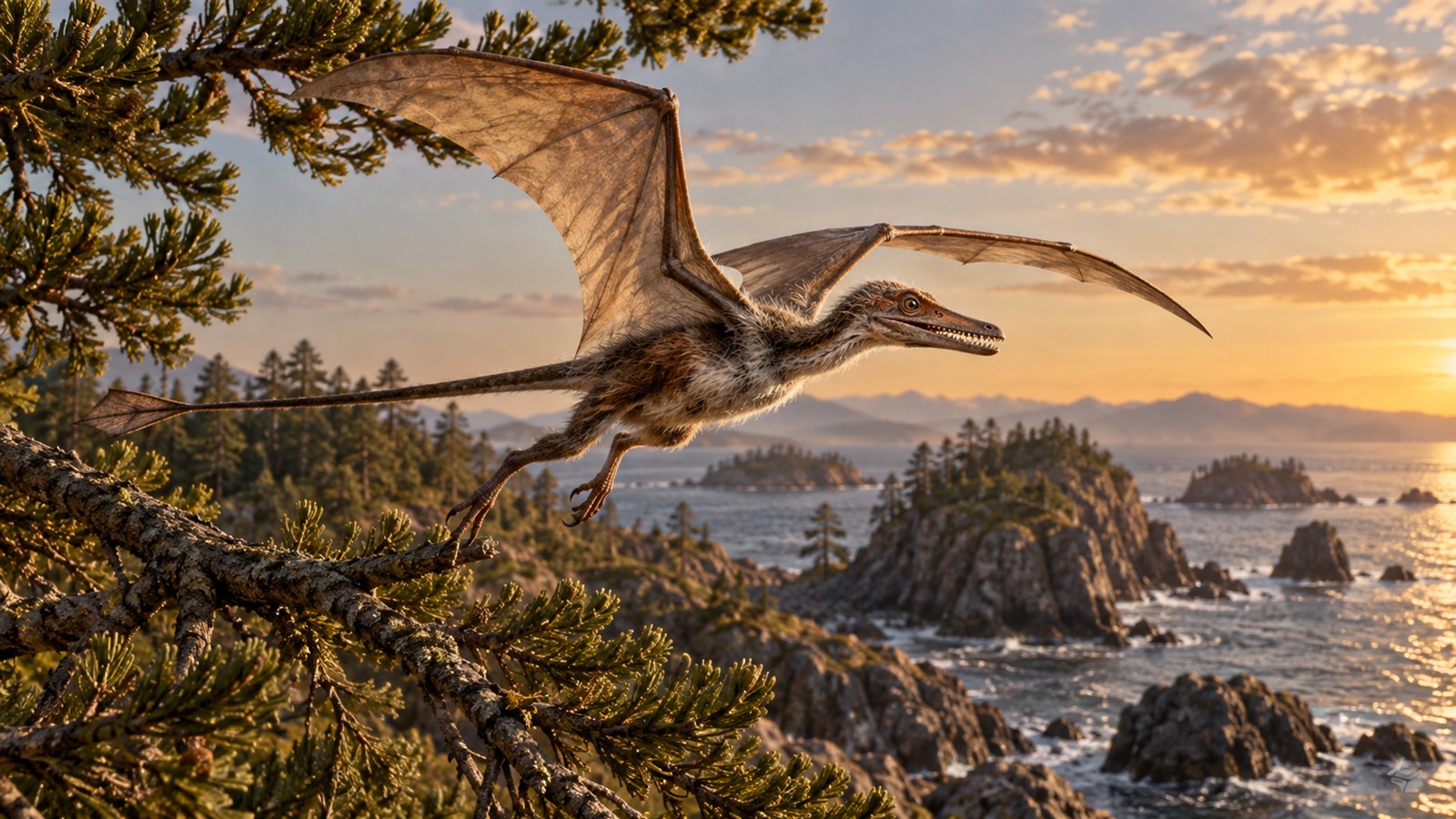
Early species generally retained long bony tails stiffened by rod-like extensions, shorter hand sections, and prominent fifth toes. Those traits once led researchers to bundle them as rhamphorhynchoids, but that term describes a grade rather than one complete natural branch. Modern analyses recover several early lineages whose relationships shift as fragmentary skulls and ankles are rescored.
Jurassic diversification filled contrasting habitats
Early Jurassic Dimorphodon combined a deep skull with robust limbs. Its fossils from southern England became central to early pterosaur science, although traditional cliff-soaring scenes outran the evidence. Anurognathids followed a different plan, with short broad skulls, large eyes, and insect-catching jaws. Their compact bodies and broad wings suggest maneuvering in complex environments.
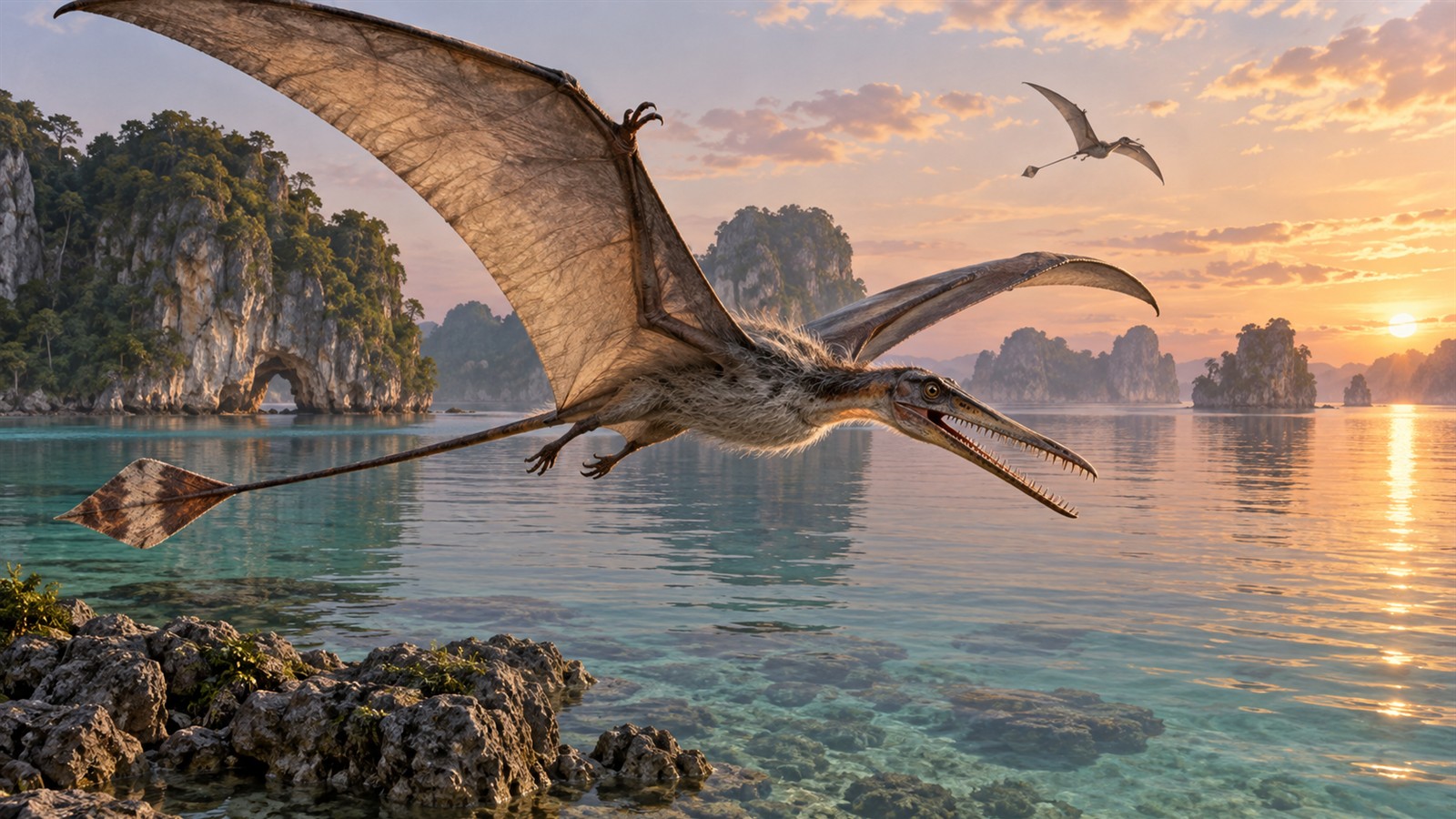
Long-tailed forms such as Rhamphorhynchus flourished around Late Jurassic lagoons. Several specimens preserve fish remains, wing tissues, and diamond-shaped tail vanes. Campylognathoidids had strong jaws and wings suited to powerful flight. Scaphognathines broaden the range of skull forms, reminding readers that long tail does not equal one ecology.
The first pterodactyloids altered the pattern. Longer necks and hands, shorter tails, and changed skulls appear in fossils including Pterodactylus and Germanodactylus. Transitional animals combine traits in ways that make a clean textbook boundary difficult. Evolution reorganized modules at different rates.
Solnhofen limestone became an anatomical archive
Fine lagoonal limestone in Bavaria preserves pterosaurs as articulated skeletons and occasional soft tissues. Historically, differences in size and crest growth produced many names from what later proved to be juvenile and adult stages. Detailed growth series turned the locality into a lesson about ontogeny as well as diversity.
Solnhofen fossils also show feet, wing membranes, and stomach contents that coarser deposits lose. Quarry layer and preparation history matter because specimens entered private and museum collections over centuries. Ultraviolet imaging now exposes repairs and faint tissues invisible under ordinary light.
Ctenochasmatoids exploited shorelines and shallows
Ctenochasmatids developed numerous fine teeth, sometimes arranged as a comb along slender jaws. Ctenochasma and Pterodaustro likely strained small organisms from water, but their tooth arrangements and feeding motions differed. Pterodaustro from Argentina had an extraordinary lower-jaw basket and stones in the body region that may relate to digestion.
Other ctenochasmatoids retained fewer teeth and occupied varied shoreline niches. Trackways often attributed to pterodactyloids record competent walking across wet sediment. Their abundance near water reflects both ecology and the superior preservation offered by quiet deposits.
Filter feeding required more than a comb. Jaw opening, tongue or throat action, water flow, and prey density set its effectiveness. Reconstructions should avoid copying flamingo behavior without anatomical support.
Ornithocheiroids became long-range marine specialists
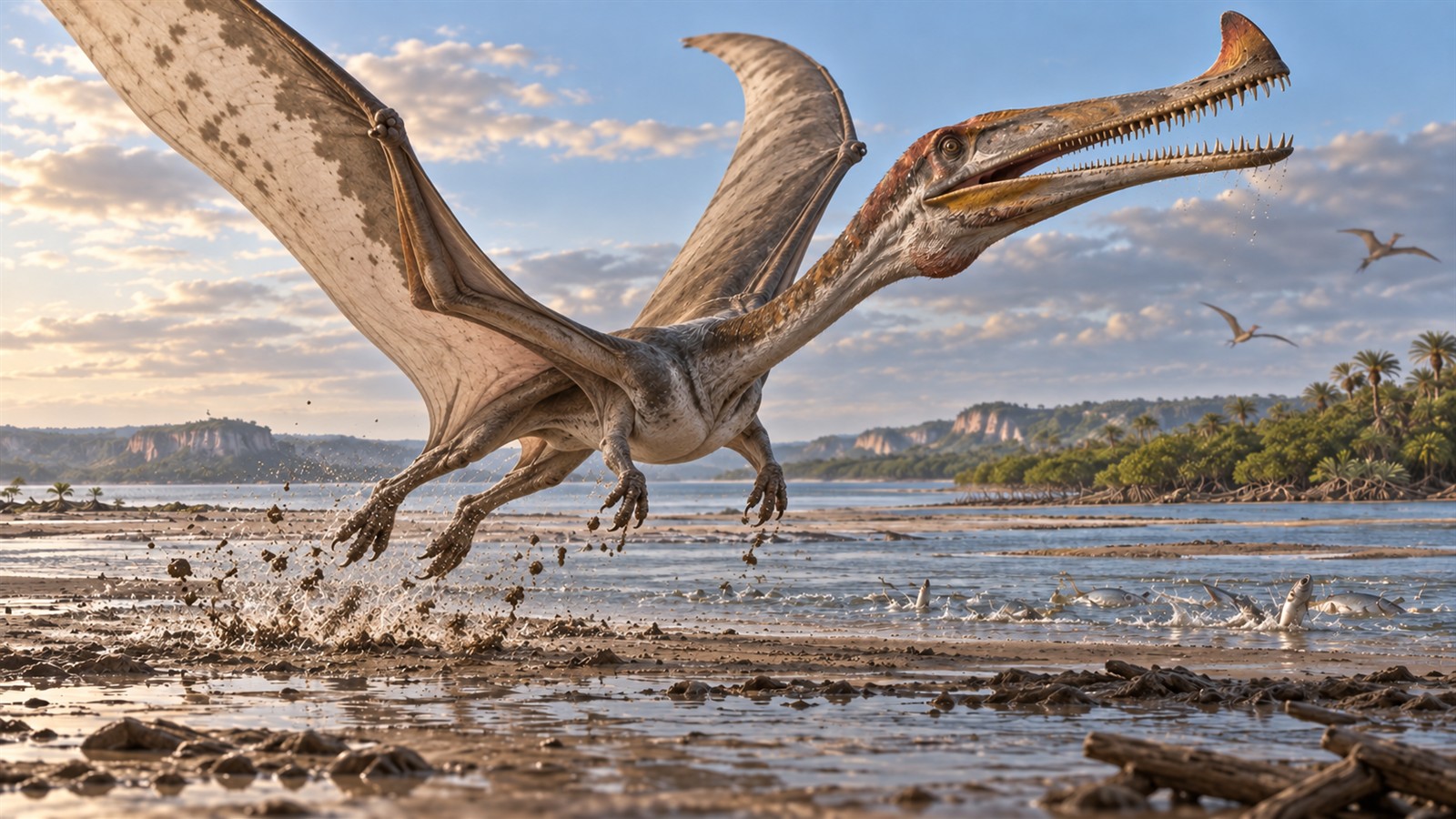
Early Cretaceous forms such as Anhanguera, Coloborhynchus, and related taxa carried elongated jaws with large front teeth. Some bore crests near the jaw tips. Narrow wings and strong shoulders suit sustained travel, while tooth orientation helped contain slippery prey. Their fossils occur in marine and lagoonal deposits across several continents. Later pteranodontids lost teeth and developed large cranial crests. Pteranodon is abundant in rocks of the Western Interior Seaway, but most specimens are incomplete and compressed. Crest size, pelvis form, and body size have fueled discussions of sex and growth. Those hypotheses require populations rather than dramatic single skeletons. Nyctosaurids reduced the free fingers and included species with immense branching crests. The soft-tissue extent of those crests is unknown. Their sparse hands emphasize commitment to flight, but landing and launch still required contact with surfaces. Ocean currents, seasonal winds, and prey migrations probably influenced their travel, yet bones alone cannot assign a fixed annual route.
Dsungaripteroids brought power to the jaws
Dsungaripterus had a reinforced, upturned snout, a bony crest, and rounded rear teeth capable of crushing resistant food. The toothless front of the jaw may have probed or pried prey from substrates. Thick-walled bones and sturdy limbs fit a lifestyle different from delicate marine soarers.
Related species from Asia, Europe, and South America show varied combinations of crests and teeth. Family definitions have changed as skulls once assigned by resemblance were compared character by character. A robust jaw does not alone establish close relationship because hard prey can drive convergence.
Tapejarids turned crests into extraordinary signals
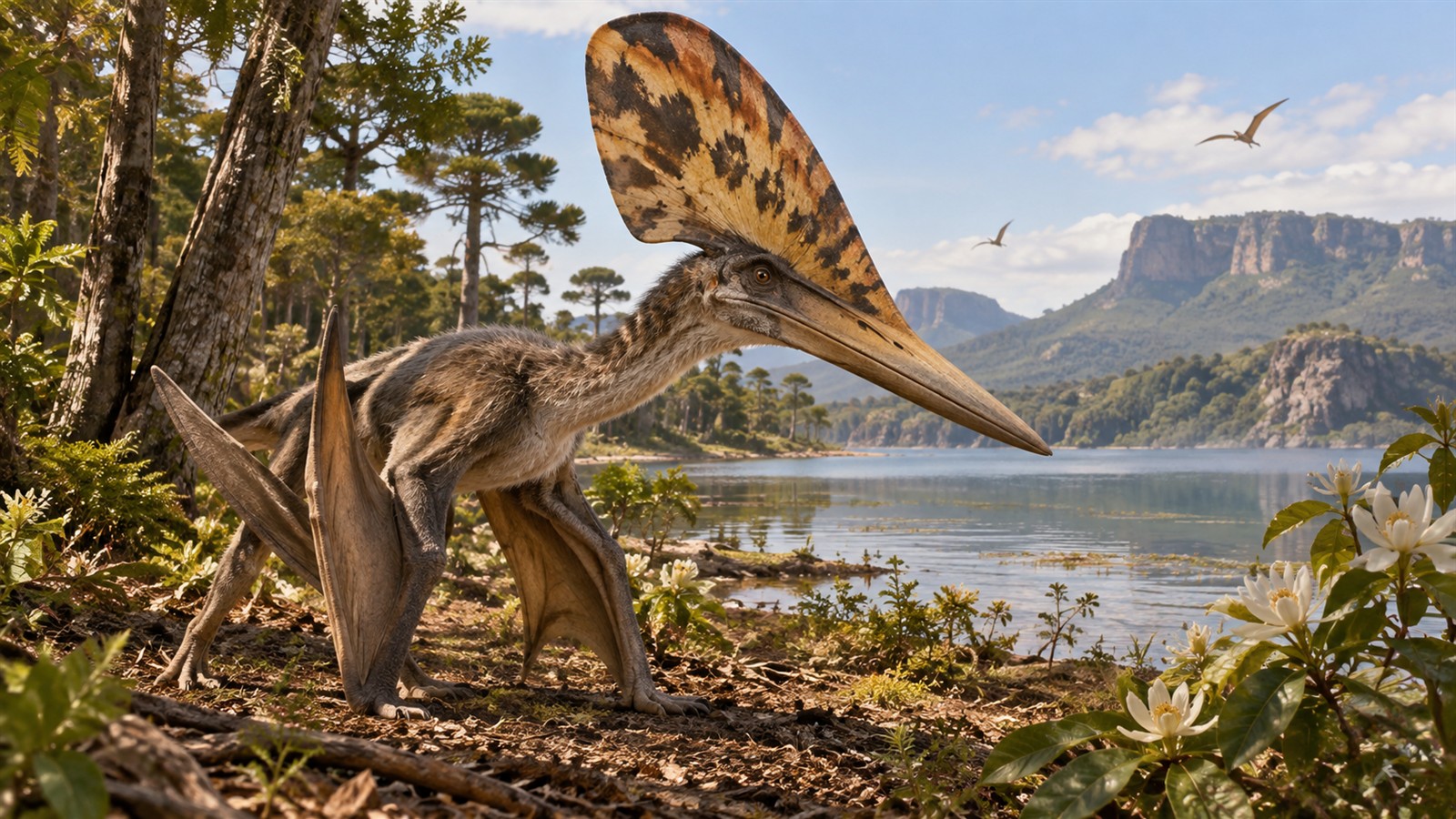
Brazilian deposits preserve tapejarids with deep toothless beaks and tall cranial crests. Tapejara, Tupandactylus, and Thalassodromeus differed in crest architecture and skull proportion. Rare soft tissue shows that bony supports anchored larger sails, making the living profile more dramatic than the skeleton.
Diet remains debated. Strong beaks and terrestrial proportions have inspired fruit-eating models, yet direct plant contents are scarce. Some skulls may suit opportunistic feeding or different resources. Wear, jaw mechanics, and environmental evidence must carry more weight than resemblance to one modern bird.
Crests changed with age and may have served display. Identifying sex is harder because a crest difference can also mark maturity, species, or individual variation. Large samples from the same time and place offer the best test.
China revealed forests, fibers, and hidden branches
Jurassic and Cretaceous deposits in northeastern China preserve small pterosaurs with body coverings, membranes, and stomach remains. Anurognathids, wukongopterids, and early pterodactyloids illuminate stages poorly represented elsewhere. Darwinopterus famously combines a pterodactyloid-like head and neck with a long-tailed body, showing mosaic evolution.
Eggs and embryos from Chinese localities expanded knowledge of reproduction. Specimens associated with eggs require careful taphonomic analysis before being labeled mothers. Soft-shelled eggs could deform, absorb water, and collect in sediments differently from rigid bird eggs.
Azhdarchids ruled late inland skies
Azhdarchids had elongated neck vertebrae, large heads, shortened tails, and limbs suited to ground travel. Quetzalcoatlus from Texas includes both giant and smaller material whose species assignments have been revised. Hatzegopteryx from Romania possessed a particularly robust skull and neck in an island ecosystem with unusual dinosaurs.
Terrestrial stalking models explain their inland occurrence and walking anatomy better than habitual skim feeding. Long stiff necks could lower the head to seize small vertebrates, invertebrates, or carrion. Different sizes and skulls imply ecological variation across the family.
Giant wingspans are often reconstructed near ten meters, with uncertainties from missing tips and proportions. Their masses must satisfy bone strength, launch, and flight models simultaneously. Neither weightless paper giants nor flightless giraffes match the full evidence.
Rare southern fossils widen the map
South America contributes exceptionally preserved Brazilian and Argentine forms, while fragmentary remains from Africa, Australia, Antarctica, and New Zealand show broad distributions. Named species from isolated bones require caution because pterosaur skeletons contain many position-specific shapes. A single neck vertebra can be informative when compared with a well-known sequence but misleading when orientation is wrong.
Continental positions were different, and oceans opened as Pangaea fragmented. Dispersal routes changed with coastlines and climate. Pterosaurs could cross water, so land bridges constrained them less than terrestrial dinosaurs, but nesting and food still tied populations to suitable regions.
Family trees depend on incomplete overlap
Pterosaur analyses score skull openings, teeth, vertebrae, wrists, fingers, pelvises, and feet. Many species preserve only one region, producing missing data. Similar feeding structures can evolve independently, while juvenile proportions imitate ancestral traits. Alternative trees may disagree over early branches or relationships among toothless Cretaceous groups.
A stable claim should identify the specimen and anatomical feature beneath the family label. Researchers can agree that an animal had a long fourth metacarpal and reduced tail even while debating its nearest relative. New matrices improve through direct observation, transparent character definitions, and broad geographic sampling.
Names also shift when type specimens are inadequate. A famous genus may absorb material that later separates by age or anatomy. Revision is most persuasive when it examines overlapping bones and publishes detailed images or scans.
Tracks, eggs, and injuries restore ordinary lives
Body fossils dominate classification, but trace and reproductive evidence show pterosaurs doing things skeletons cannot record. Trackways from Europe, Asia, and the Americas preserve four-limbed walking, changes in pace, foot webbing, and repeated use of wet surfaces. Their handprints reveal how the free fingers accepted weight while the flight digit stayed folded behind the wrist. Egg concentrations from Argentina and China document flexible shells, developing embryos, and repeated breeding at favorable sites, although flood transport can imitate a colony. Histological sections help determine whether nearby animals were hatchlings, growing juveniles, or small adults. Healed fractures and worn joints add another scale of history. A repaired wing bone proves survival after serious injury, while localized arthritis may record age or unusual loading. Tooth damage can reflect resistant prey rather than combat. None of these clues stands alone: track shape changes with mud, eggs move after burial, and disease can be confused with crushing. Together they replace a catalog of skulls with populations that walked, launched, nested, grew, failed, recovered, and returned to landscapes across generations. That ordinary-life record is also geographically important because traces can reveal pterosaurs where fragile skeletons never survived.
Mass extinction ended a long aerial experiment
Pterosaurs survived earlier crises and remained diverse through much of the Cretaceous. Their latest record is dominated by larger pterodactyloids, but small species may be missing because inland sediments preserve fragile bodies poorly. Birds occupied many small-flyer niches without necessarily driving pterosaurs into extinction.
The end-Cretaceous impact disrupted plants, insects, aquatic productivity, and terrestrial food chains. Specialized large-bodied lineages faced collapsing resources and slow recovery. No pterosaur is known to cross the boundary, while several bird lineages survived and radiated afterward.
How to assemble an ultimate pterosaur guide
Organize taxa by time, lineage, and locality rather than wingspan rankings. Record whether each reconstruction comes from one skeleton, a composite, or relatives. Separate preserved crest bone from restored soft tissue and adult characters from juvenile states. Put disputed diets beside the evidence and competing alternatives. Then read the map dynamically. A Triassic desert flier, Jurassic lagoon hunter, Cretaceous filter feeder, and inland azhdarchid represent different evolutionary experiments, not steps toward one final giant. Pterosaurs succeeded because their basic wing system supported repeated changes in skull, neck, feet, covering, and behavior. The best guide preserves that variety while keeping every vivid animal attached to a specimen and every certainty proportionate to the fossil beneath it.