Flight emerged from an unfamiliar anatomical machine
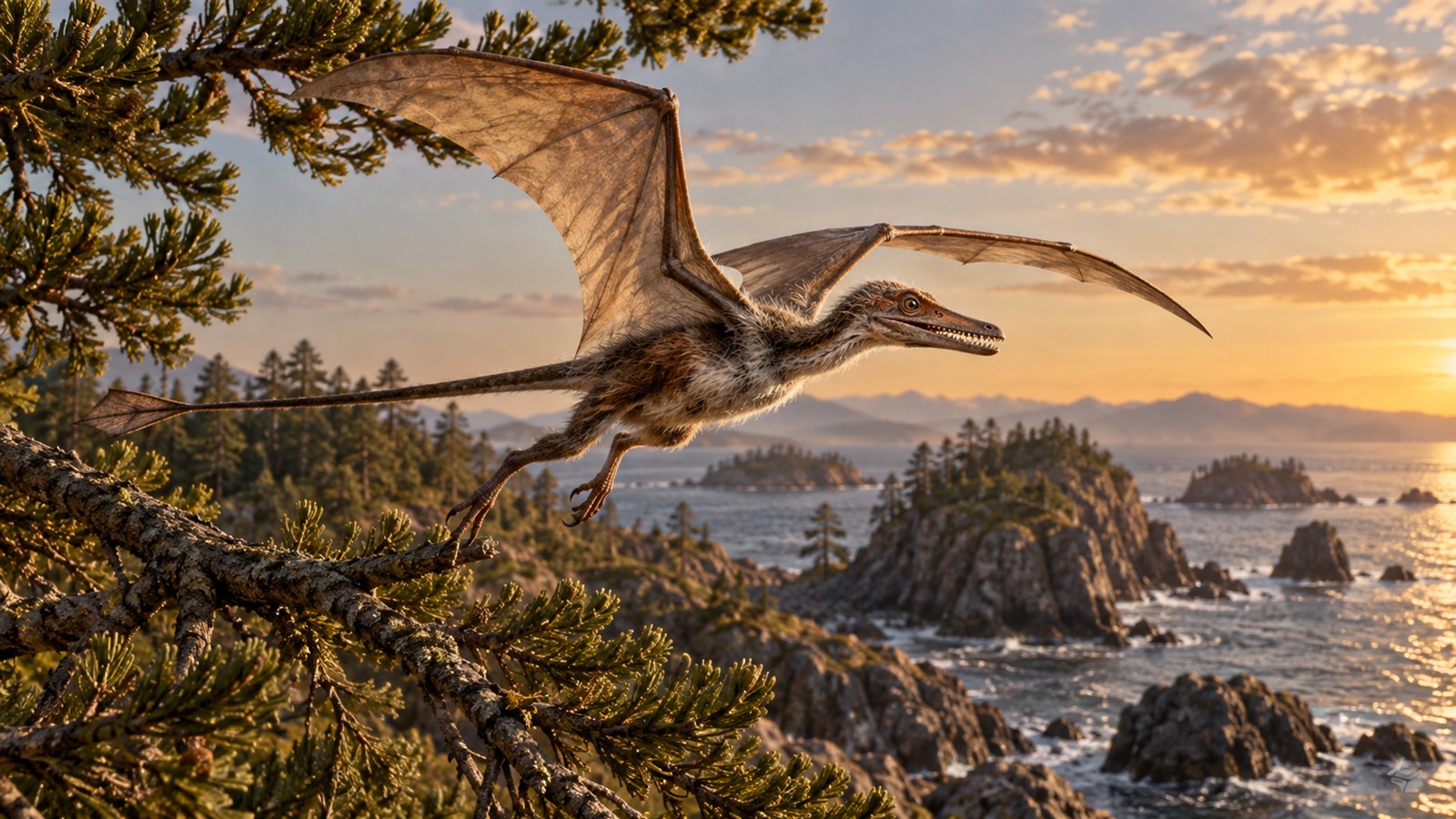
Pterosaur flight cannot be explained by stretching a bat or bird around a different skeleton. Its main spar was one giant finger, its leading edge included a unique pteroid-supported membrane, and its powerful forelimbs served both flight and terrestrial launch. Air-filled bones reduced weight while internal struts carried stress. A fiber-reinforced wing membrane changed tension, sensed airflow, and probably adjusted its camber during each stroke. Below the surface, an efficient respiratory system and rapid growth supported active lives. Above it, crests, jaws, tails, and wing shapes diversified for contrasting habitats. Understanding this machine requires several kinds of evidence at once: articulated joints, soft-tissue fossils, trackways, bone microstructure, aerodynamic models, and comparisons chosen for a specific function rather than superficial resemblance.
A: It contained reinforcing fibers, muscles, nerves, and blood vessels.
A: Their shape and internal struts placed material where loads demanded it.
A: It helped support and control the leading-edge membrane.
A: Quadrupedal-vault models support that ability on suitable substrates.
A: Muscles and joints demonstrate active flapping capability.
A: Pneumatic bones support an air-sac system related to efficient archosaur breathing.
A: Preserved nerves and membrane complexity make sensory feedback strongly plausible.
A: Developed embryonic wings support early flight, although timing remains debated.
A: Hollow bones often survived in fine sediment that later compressed them.
A: Anatomy, tracks, stress, aerodynamics, and environmental context must agree.
The wing was a layered, active structure
Exceptional fossils reveal pterosaur membranes as organized tissues. Actinofibrils ran in changing directions across the wing, reinforcing it against flutter while allowing controlled deformation. Blood vessels supplied living tissue, nerves carried sensory information, and small muscles could adjust local stiffness or tension. These components make a modern sailcloth analogy incomplete: the surface did not merely catch air but participated in maintaining its aerodynamic form.
The principal membrane extended behind the arm and elongated fourth digit. Debate over its rear attachment affects reconstructed area and performance. A broad attachment toward the ankle creates more surface and couples leg position with wing shape; a narrow attachment near the hip reduces area but conflicts with several soft-tissue specimens. Species variation remains possible, so one outline should not be imposed across Pterosauria.
Bone geometry managed flight loads
The humerus often had a large deltopectoral crest for attachment of powerful muscles. Its shaft resisted bending and twisting through a combination of shape, thin walls, and internal trabeculae. The forearm became long, while wrist bones transferred force into the metacarpal and wing finger. Joints restricted motion in directions that would destabilize the spar.
Large pterodactyloids fused several trunk vertebrae into a notarium, stiffening the shoulder region. The shoulder socket faced in a way that supported elevated wings and broad movement without requiring bird anatomy. A fused synsacrum linked the spine and pelvis. These rigid zones gave muscles a stable base while distal joints shaped the stroke.
Stress estimates are highly sensitive to mass and wingspan. Engineers model cross-sections from CT scans, assign material properties based on living bone, and apply forces expected during launch, flapping, or soaring. Crushing must be digitally corrected before a flattened fossil becomes a reliable beam.
The pteroid refined the leading edge
The pteroid was a rod-like bone projecting from the wrist and associated with the propatagium. Its exact orientation has been debated because articulation is rarely preserved without distortion. Pointed forward and inward within realistic joint limits, it could control a curved leading-edge membrane that smoothed airflow and resisted stall. It did not support the entire wing or project straight ahead like an extra finger.
Flapping converted muscle work into thrust
During a downstroke, the wing generated lift and forward force by moving through air at an angle. Rotation near the shoulder and wrist altered the local angle of attack along the span. The upstroke reduced resistance and repositioned the wing. Flexible membranes may have passively twisted in useful ways, while active tension prevented excessive billowing.
Flight speed influenced every force. At low speed, high angles and strong flapping were needed to remain aloft. At faster speed, narrow-winged species could cruise efficiently but required wider turns. Broad wings favored maneuvering and lower-speed lift. Aspect ratio and wing loading provide comparisons, yet both depend on reconstructed area and body mass.
Modern wind tunnels, robotic models, and computational fluid dynamics explore these relationships. A model becomes informative when its joints, membrane elasticity, and mass fall within fossil-supported bounds. A beautiful animation using arbitrary inputs demonstrates software rather than pterosaur performance.
Four-limbed launch changed the size limit
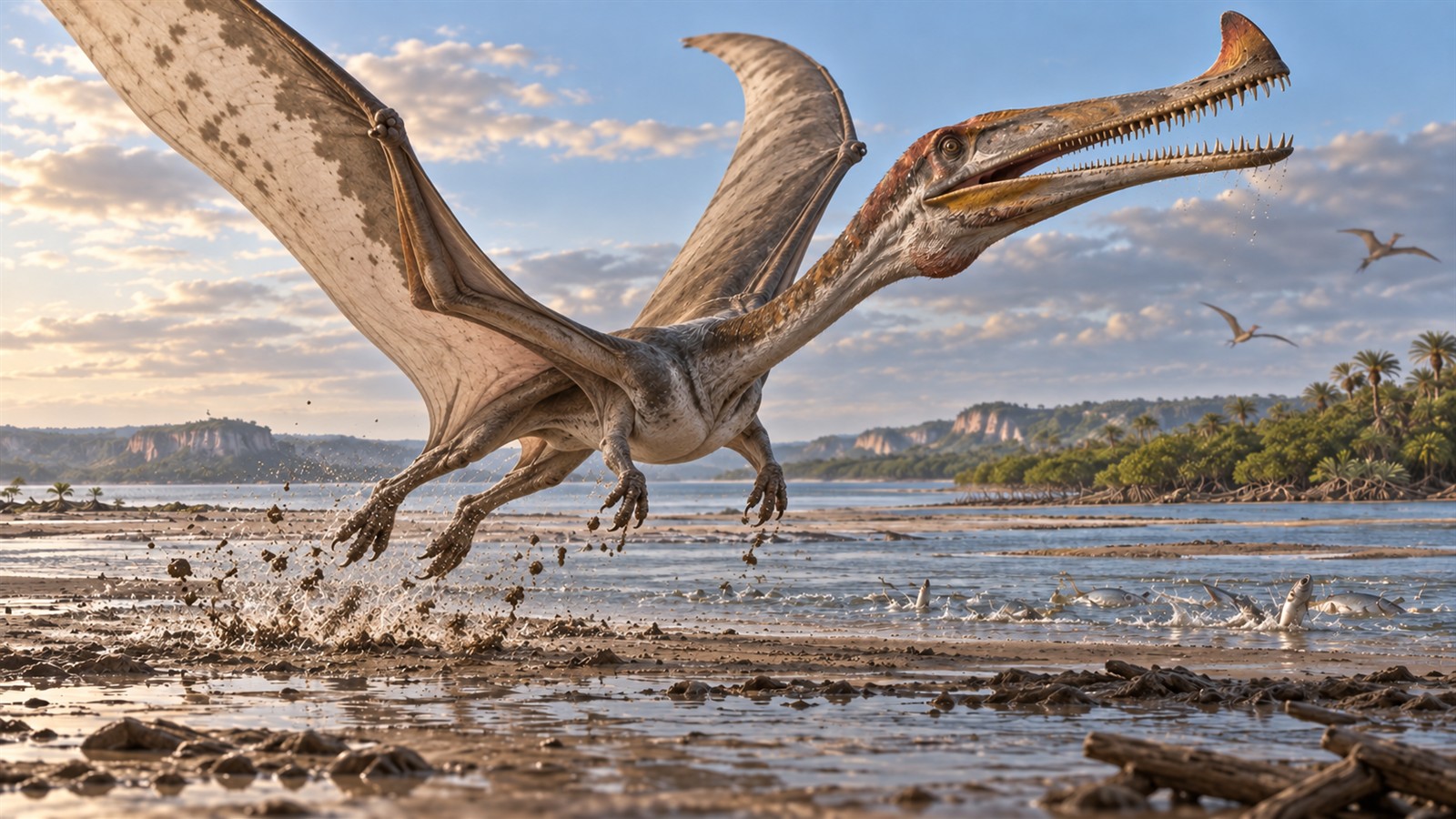
Pterosaurs placed their hands on the ground while walking, keeping major flight muscles available before takeoff. In quadrupedal-launch models, the hind limbs began a leap and the forelimbs delivered a forceful vault. The folded wing finger then opened after ground clearance. This sequence distributes acceleration across all limbs and lets the stronger flight apparatus contribute directly.
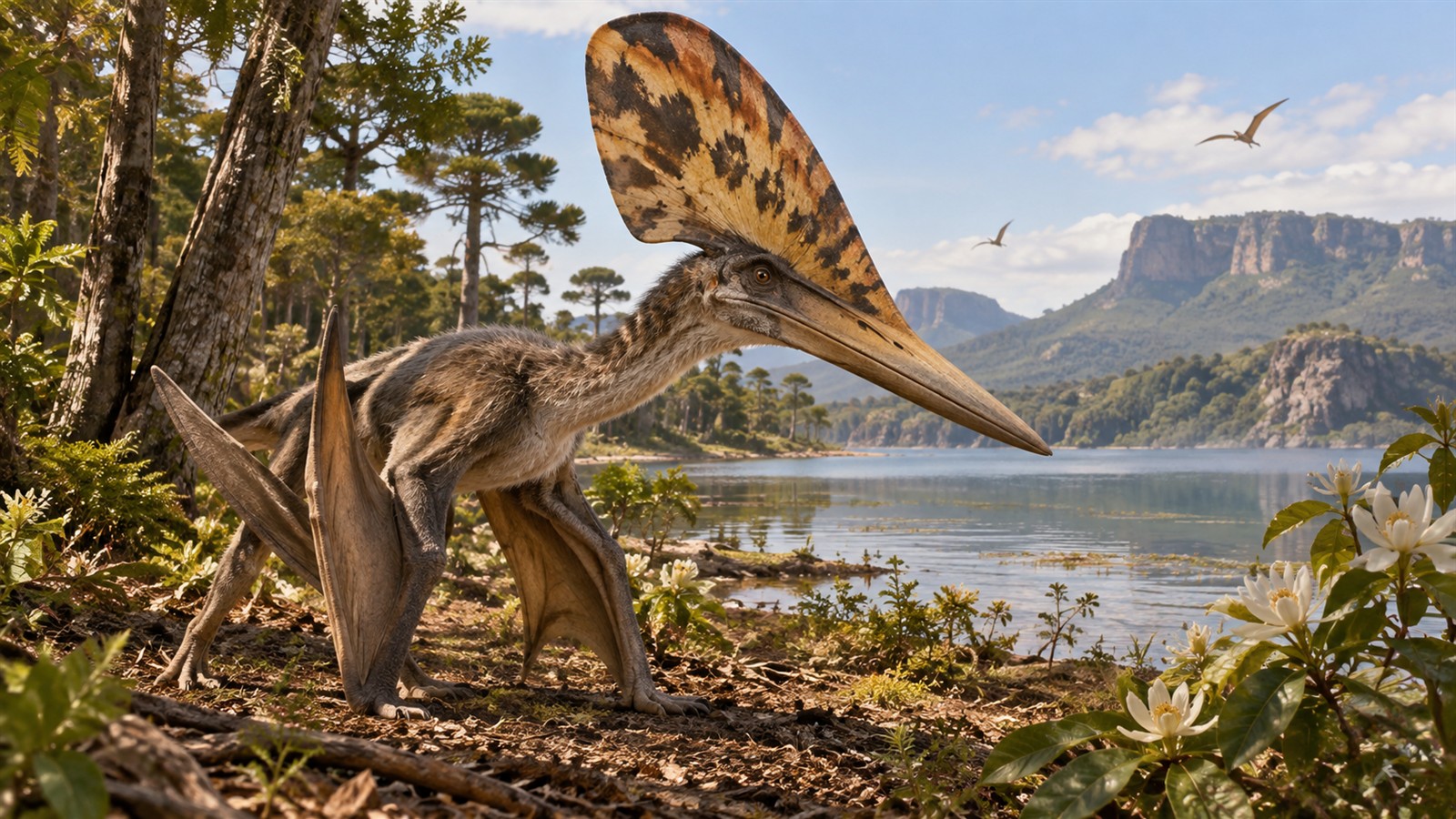
Giant azhdarchids are central to the debate because a purely bipedal run places great demand on comparatively lighter hind limbs. Forelimb bone strength and joint range support vaulting, but substrate, wind, and species proportions affected practical performance. A muddy flat and a firm dry plain would not offer the same purchase.
Soaring strategies reflected habitat
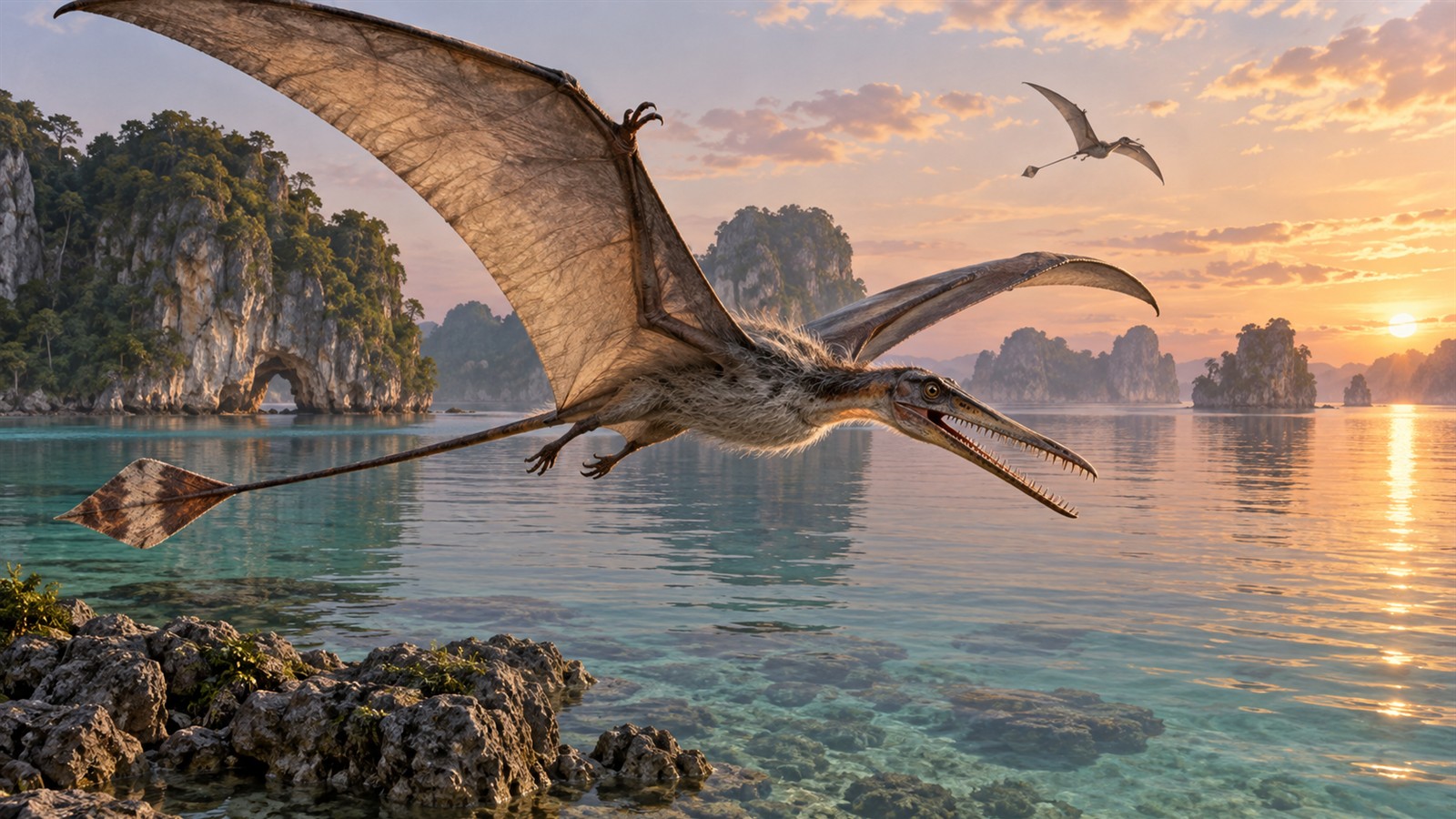
Long narrow wings suit efficient travel through steady air and appear in several marine pterosaurs. Dynamic soaring, which extracts energy from wind gradients above waves, has been proposed for some forms by comparison with albatrosses. Thermal soaring uses rising warm air and may suit broad-winged inland giants. Fossils provide wing proportions, while climate and habitat models determine whether the necessary air movements were likely.
Soaring did not eliminate flapping. Every animal had to launch, climb, correct course, and cross calm regions. Muscle mass and attachment areas show powered capability even in specialists. The balance between flapping and gliding could shift with age, weather, load, and destination.
Wingtip shape influences induced drag and maneuvering. Soft tissue extended beyond the last bone and could change under tension. Restoring every pterosaur with sharp pointed tips overstates skeletal certainty. Some specimens support rounded ends, and damaged digits can create false proportions.
Air sacs may have linked lungs and skeleton
Openings in vertebrae and limb bones indicate invasion by air-filled diverticula, resembling the skeletal pneumaticity associated with bird respiratory systems. Air sacs can ventilate rigid lungs efficiently and spread through the body without serving as simple balloons. Their distribution lightened large bones and may have helped manage heat.
Pneumaticity varied with size, age, and skeletal region. An opening must connect internally in a characteristic way before being identified as pneumatic; vascular canals and damage can mimic it. Researchers map cavities with CT scans and compare them across related taxa. The evidence supports an active respiratory system but does not preserve breathing rate.
Heat, fibers, and growth indicate active biology
Pycnofibers reduced heat loss from the torso and neck. Insulation is especially useful for a flier whose muscles generate substantial metabolic heat and whose body experiences moving air. Some specimens preserve branched fibers that resemble feather architectures, raising evolutionary questions about coverings near the common origin of dinosaurs and pterosaurs. Homology remains an anatomical and developmental question, not one settled by using the same informal word.
Bone histology often shows rapid juvenile growth, rich blood supply, and later slowing near adult size. Growth rates differed among lineages and individuals. A fast-growing bone does not prove an exact body temperature, but it contributes to a larger case involving insulation, respiratory anatomy, and flight demands.
Gigantism adds thermal complexity. Large pterosaurs retained heat more easily but risked overheating during launch. Air sacs, blood flow through membranes, behavior, and flight altitude may have helped, although direct tests are limited. Images of permanently cold, sluggish reptiles do not fit their locomotor system.
Vision and balance guided rapid movement
Pterosaur brains had enlarged regions associated with vision and processing information from the inner ear. The floccular region was once interpreted as exceptionally large for controlling wing sensation, though newer digital reconstructions refine its boundaries. Semicircular canals record head orientation and sensitivity to rotation. Their arrangement can be compared with habitual head posture but should not be converted into a single behavior mechanically.
Large eyes in some species supported visual hunting, while skull and neck form set the field of view. Crests could affect aerodynamics around the head without blocking sight. The wing’s sensory network may have reported tension and airflow, allowing adjustments during gusts. That feedback is inferred from preserved innervation and living membrane-wing fliers, not observed directly.
Feeding mechanics began at the whole body
A jaw cannot be interpreted apart from neck, feet, and habitat. Long conical teeth and narrow jaws grip slippery prey, but capturing fish could occur from the surface, in shallow plunges, or after landing on water. Continuous skim feeding is mechanically expensive because a submerged jaw experiences strong drag and impact. Only specialized anatomy would make it routine, and most proposed pterosaur skimmers lack the full package of living skimmers.
Filter-feeding ctenochasmatids used rows of fine teeth, perhaps sweeping or pumping water in shallow settings. Robust dsungaripterid skulls transferred forces from hard prey. Azhdarchid proportions support walking and reaching down to collect terrestrial items. Coprolites, pellets, gut contents, tooth wear, and associated prey can move these models beyond beak analogy.
Feeding style also influenced takeoff. An animal sitting low on water faced different resistance from one standing on firm ground. Webbed feet do not prove prolonged floating, and inland fossils do not exclude occasional aquatic feeding. Behavioral repertoires were broader than single-scene labels suggest.
Growth could alter flight performance
Young pterosaurs often had proportionally different wings, skulls, and crests. If hatchlings flew, their lower mass and broad relative wing area may have favored maneuverability. Adults of the same species could become efficient travelers or soarers. This ontogenetic niche shift would reduce competition between age groups, but it must be tested with reliably associated growth series.
Histology distinguishes rapidly growing juveniles from small-bodied adults. Fusion of wrist, shoulder, and pelvic elements provides additional maturity clues, although timing differs by species. A small unfused skeleton should not automatically receive a new genus. Conversely, genuine small taxa existed and cannot all be reassigned as babies.
Tracks test posture better than isolated skeletons
Trackways preserve hands, feet, stride, direction, and sometimes speed changes. Their handprints point outward while feet track closer to the midline in many pterodactyloids. No tail drag accompanies most trails. Repeated patterns across sites confirm a competent quadrupedal gait.
Substrate can distort prints as mud collapses or a foot slips. Undertracks form in layers beneath the actual surface and appear larger or less detailed. Matching a trackmaker to one genus is rarely possible without exceptional skeletal association. Tracks instead reveal functional categories such as foot proportions and gait.
Landing and takeoff traces are unusual but potentially transformative. A series with increasing spacing, deep hand impressions, and sudden disappearance might record launch, yet erosion can remove later steps. Experimental track formation helps separate behavior from preservation.
Preservation controls what we think was common
Fragile hollow bones survive best where burial is rapid and scavenging limited. Fine-grained lagoons in Germany and lake deposits in China preserve articulated skeletons and soft tissues, producing an apparent abundance of small species. Large isolated bones dominate many inland deposits because sturdy fragments survive transport. Sampling creates a record weighted by environment and body part.
Compression can reverse joint surfaces, overlap fingers, and displace wing membranes. Preparation may expose one side while removing impressions above it. Ultraviolet photography reveals subtle tissue films and restoration boundaries. Digital scans preserve geometry before further preparation.
A sound flight reconstruction makes its assumptions visible
Start with specimen-specific wingspan, joint mobility, and body volume. Reconstruct muscles from scars and comparisons on both sides of the archosaur family tree. Use preserved membranes to set attachment and test more than one plausible elasticity. State atmospheric density, speed, and mass before reporting performance. Results should be ranges showing which assumptions change the conclusion. Then compare the model with independent evidence. Can the animal launch under the proposed conditions? Does the posture agree with tracks? Do stress levels fit bone structure? Does the feeding scenario match locality and wear? Pterosaurs need no exaggerated abilities to remain extraordinary. A transparent model shows how an animal built from one giant finger, a responsive membrane, powerful forelimbs, and a highly pneumatic body became the first vertebrate to turn sustained powered flight into a worldwide way of life.