Velociraptor’s exact top speed has never been measured
Velociraptor could move actively on two legs, but no fossil supplies the equivalent of a timed sprint. Confident-looking speed figures often combine anatomical assumptions, comparisons with living animals, and models whose uncertainties disappear when a number is repeated online. The more revealing picture comes from asking how the animal moved: how its hind limbs supported it, how a long tail affected balance, what its specialized feet could do, and how it might have controlled an encounter with prey. The real Velociraptor was a relatively small, feathered dinosaur, not the oversized screen animal familiar from films. Its movement needs to be reconstructed around that body. Fossils support a capable terrestrial predator with a distinctive locomotor and prey-handling system, while leaving its precise maximum speed and many details of its hunting behavior unresolved.
A: No. Available claims depend on inference and modeling rather than direct timing of the extinct animal.
A: No. Velociraptor had a much smaller body, and its long tail contributed greatly to its total length.
A: Feather evidence establishes plumage, not a measured increase in running speed.
A: The specialized second digit could be held raised during ordinary locomotion.
A: No. Specialized stiffening constrained motion without turning the entire tail into a fixed artificial rod.
A: It preserves an extraordinary interaction, but not a timed sequence of the preceding movement.
A: No. Grasping and restraint are among the hypotheses evaluated from dromaeosaur anatomy.
A: Traction, body balance, foot placement, speed, and mass distribution also matter.
A: The specific cooperative tactics familiar from films are not securely demonstrated for Velociraptor.
A: Balance and handling anatomy can be investigated even when an exact performance limit cannot be calculated securely.
Begin with the real animal rather than the screen silhouette
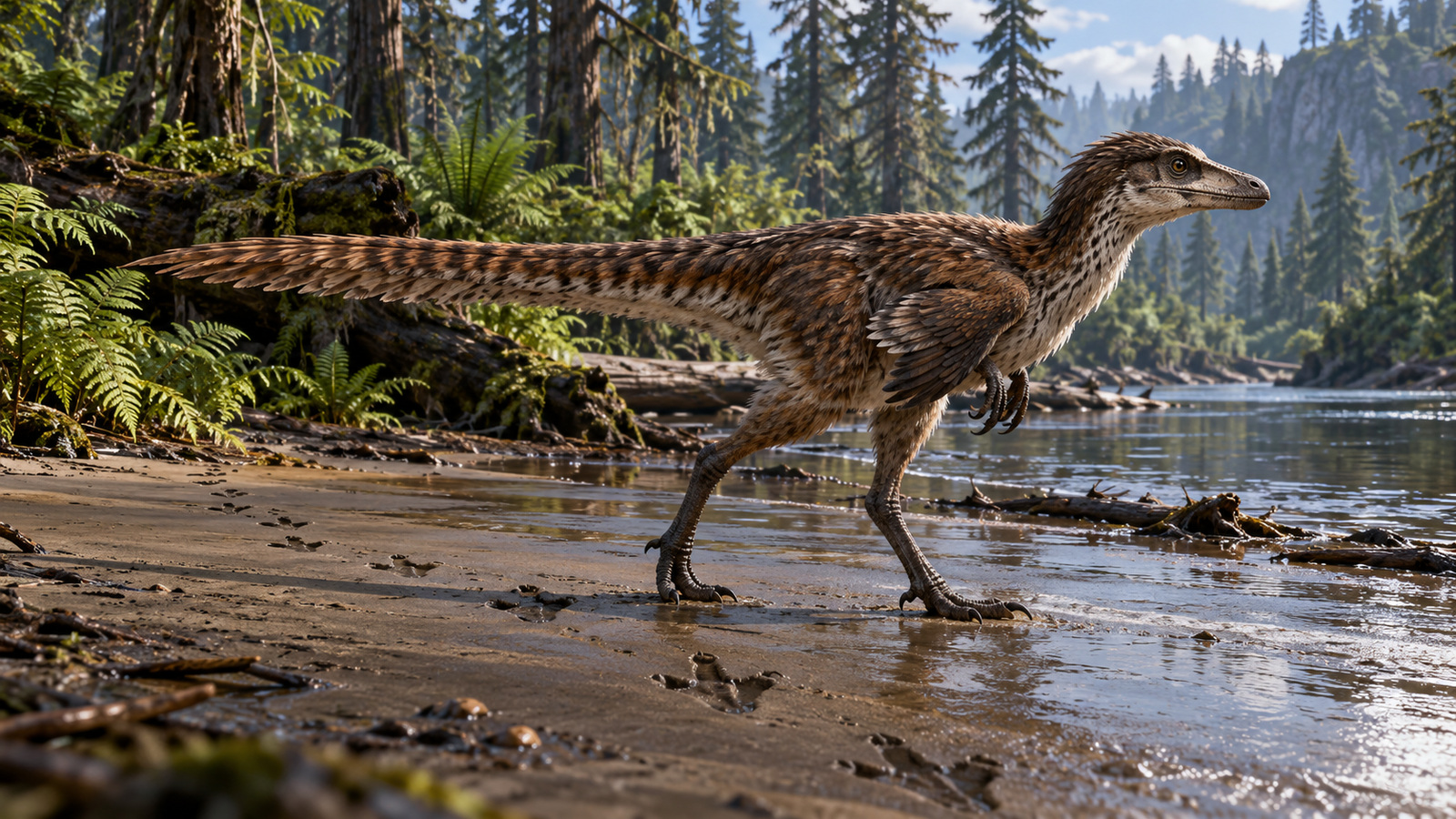
Velociraptor was a dromaeosaur theropod from Late Cretaceous Asia. Much of its total length came from the tail, so a length measurement alone can exaggerate the apparent size of its torso. It had a relatively low, horizontally oriented body supported on the hind limbs. The forelimbs were available for functions other than ordinary walking support.
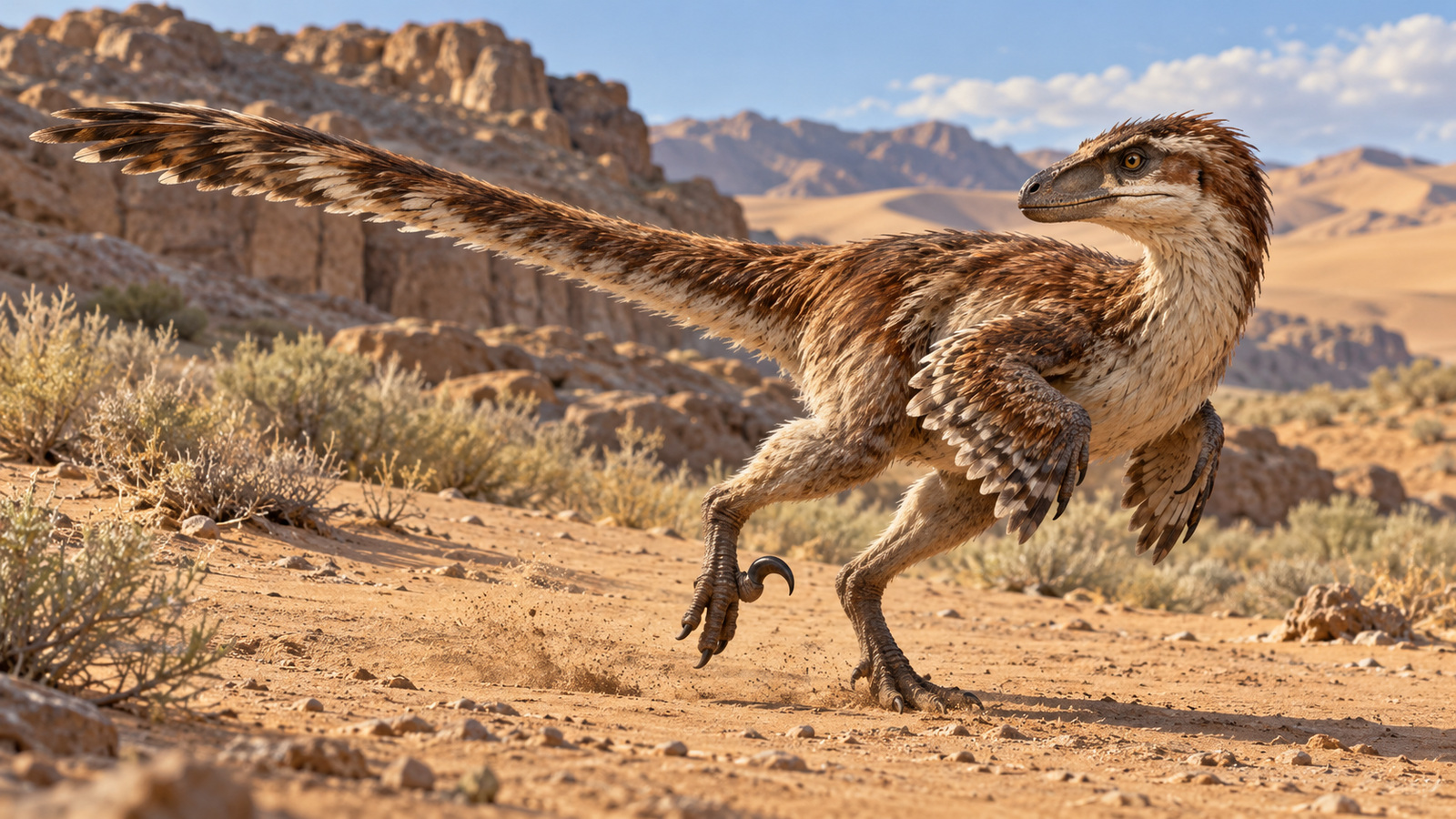
Feathers belong in this reconstruction. Quill knobs on a Velociraptor forearm provide direct evidence of attachment for substantial feathers, supporting a body very different from the naked-armed movie image. Feathers did not make the animal a powered flier. Their presence nevertheless changes its living outline and raises plausible roles in display, insulation, or other behavior that must be distinguished from demonstrated locomotor effects.
Its legs allowed movement, but proportions do not act as a stopwatch
The femur, lower leg, ankle, and foot together formed a system for supporting and propelling the body. Their proportions help researchers compare locomotor possibilities with other theropods. Joint geometry and likely muscle paths add further constraints. A long lower limb may be relevant to running, but no single bone ratio supplies a reliable top speed by itself.
Muscle capacity matters because movement requires force, especially during acceleration, support, and rapid changes of direction. The bones preserve clues about attachments, while missing soft tissues must be reconstructed. Different assumptions about muscle volume and body mass can yield different performance estimates. A precise result is only as secure as the anatomy and mechanical relationships underlying it.
Comparison with specialized running dinosaurs is therefore informative without producing a universal ranking. Dromaeosaur feet combined locomotion with unusual grasping features, and not every part of the animal was optimized for an extended straight-line sprint. Functional tradeoffs are normal in evolution. A predator can be effective without being the fastest animal in its environment.
Four speed ideas are often mistaken for one
A comfortable travel pace describes routine movement, acceleration describes how quickly speed increases, a brief maximum describes peak performance, and endurance concerns how long activity can be sustained. These properties need not rise together. Accelerating requires extra force to increase the body’s forward motion; maintaining a steady pace presents a different demand. A sharp turn adds a sideways demand even if the numerical speed stays unchanged. A published estimate must therefore specify which performance it models, its anatomical assumptions, and its uncertainty. Velociraptor has no securely measured set of values for all four, so a single popular running number cannot stand for its complete ability to move.
A long tail helped organize a moving body
The tail contributed mass behind the pelvis, helping balance the trunk and head positioned farther forward. Dromaeosaur tails also possessed specialized bony structures that stiffened substantial portions of their length. That anatomy matters when reconstructing how the animal could position its tail during travel. It should not be animated as either a completely limp rope or an unchanging metal rod.
Mass distribution influences turning as well as balance. A long tail can affect how the body responds when its direction changes, but specifying an exact turning radius requires more information about speed, posture, traction, and active control. Fossil anatomy supports mechanical questions about the tail’s role; it does not preserve a measured cornering demonstration.
The tail also moved with the rest of the animal rather than balancing a stationary trunk. When the torso changed direction, mass behind the hips had to change direction too. Muscles and joints governed that relationship. A reconstruction must therefore coordinate the tail with the turning body, instead of attaching a decorative sweep to an independently animated pair of running legs.
Agility depended on the feet meeting the ground
Turning requires the animal to redirect its motion through forces applied at the ground. Foot placement and traction therefore matter alongside balance and muscle power. A small body can have different mechanical advantages and limitations from a massive theropod, but size alone cannot establish its maneuverability. The substrate and the intended movement remain part of the problem.
On firm ground a planted foot might support a controlled change of direction, whereas loose sand could shift beneath it. A turn attempted at high speed demands different forces from a slow pivot. Calling Velociraptor agile is most useful when it refers to plausible control and coordinated movement, rather than an unsupported claim that it could change direction instantaneously under any conditions.
The famous claw was more than a running accessory
Velociraptor carried an enlarged curved claw on the second toe of each hind foot. The digit could be held raised during ordinary locomotion, unlike the main weight-bearing toes. This specialization means the foot combined travel with another potential function. Its interpretation belongs within the mechanics of the whole limb rather than a simple image of a knife swinging from the ankle.
Denver Fowler and colleagues’ 2011 prey-restraint hypothesis compared Deinonychus feet with those of living birds of prey. Grasping toes and an enlarged claw could help hold prey beneath the predator while body weight contributed to restraint. This offers a functional model for related dromaeosaurs, including Velociraptor, rather than direct evidence that each used an identical sequence. The comparison concerns how feet control a struggling body, not a claim that the whole animal behaved like an eagle.
The older image of routine disemboweling with a slashing claw is likewise not established merely by the claw’s dramatic shape. Curvature, tip geometry, joint motion, and resistance to loading all affect what a claw can do. Multiple behaviors may have been possible. The evidence supports evaluating them as competing or complementary hypotheses rather than treating one cinematic action as a fact.
During an encounter, balance could have mattered as much as a powerful strike. Contact with moving prey introduces forces that ordinary walking does not. The animal would need to remain controlled while using its jaws, feet, and potentially forelimbs. This integrated challenge helps explain why hunting movement cannot be reduced to a straight sprint followed by one isolated claw action.
A remarkable fossil captures contact rather than a chase
The celebrated Fighting Dinosaurs fossil preserves Velociraptor and Protoceratops in close physical association, with their limbs and jaws positioned in an extraordinary interaction. It is powerful evidence that these animals could engage directly. Yet it does not preserve the full sequence leading to the contact, a measured pursuit speed, or the normal frequency of such encounters. The specimen must also be interpreted through its burial history. Its importance comes from constraining possible interactions more directly than separate skeletons do, while still leaving questions about how the struggle began and ended. One exceptional event cannot become a complete account of a species’ usual hunting routine.
Forelimbs and feathers belonged to the control problem
Velociraptor’s forelimbs were not miniature human arms with freely rotating palms. Joint structure constrained their movement, and feathered surfaces formed part of the living anatomy. Any reconstruction of grasping or prey contact must respect those limits. A pose that looks dramatic but requires impossible wrist rotation is weak evidence for behavior.
Feathers have sometimes been proposed to assist balance or stability during certain activities in nonflying feathered dinosaurs. Such possibilities are worth testing, especially through comparison and modeling. However, evidence that feathers existed is stronger than evidence for every particular aerodynamic function proposed for them. A possible stabilizing role does not demonstrate that feathers increased its maximum running speed.
Hunting success did not require a race-winning top speed
Prey encounters can depend on approach, distance, terrain, surprise, vulnerability, and control after contact. A predator need not exceed every potential victim’s maximum speed under ideal conditions. Nor is the fastest prey necessarily the most frequently pursued. These ecological principles help explain why locomotor tradeoffs can be compatible with an effective feeding strategy.
For Velociraptor, exact methods and prey preferences remain incompletely known. Its anatomy supports hypotheses about grasping and close handling, while specific fossil associations add limited behavioral information. Scavenging could also provide food without a chase. The available evidence is more consistent with evaluating several possible opportunities than assigning every individual a standardized hunting sequence.
Group behavior introduces another layer of uncertainty. A visually coordinated pack in a film supplies no evidence that Velociraptor routinely hunted in the same way. Fossil association alone can have several causes, and cooperation requires stronger support than simply finding similar animals together. A speed discussion should not quietly add elaborate social tactics to fill gaps in the locomotor record.
Habitat shaped the movements that were useful
Velociraptor fossils occur in environments reconstructed in part from dune and other arid-region deposits, but an ancient habitat was not a single uniform field of loose sand. Local vegetation, firm surfaces, slopes, and water availability could vary. Geological context matters because the surface influences traction and the landscape influences encounter distances.
It is equally important not to derive every behavior from the modern appearance of a fossil locality. Present deserts have their own later geological history. Sedimentary evidence and associated fossils are the appropriate guides to ancient conditions. A credible scene reconstructs the environment occupied by the living dinosaur, rather than simply placing it where its bones happen to be exposed today.
Follow the transition from travel to close contact
A straight approach and a struggle over prey place different demands on the same body. During forward travel, successive foot placements support the animal while the body passes over them. Before a turn or stop, the feet must redirect or reduce that motion. The pelvis, trunk, and tail then have to remain coordinated through the change, rather than continuing along incompatible paths. This explains why a reconstruction can look energetic yet fail as a model of controlled movement.
Contact introduces another transition. Under the prey-restraint hypothesis, a foot is not merely landing beneath the animal’s own weight; it is helping control a moving body below it. A struggling target can shift the point of support and pull the predator away from a balanced position. The enlarged claw, grasping toes, jaws, and any assisting forelimb movements must work within that changing arrangement.
The distinction gives the Fighting Dinosaurs specimen its locomotor interest without turning it into a speed record. Closely associated bodies constrain a contact pose that would be difficult to infer from two isolated skeletons. Reconstructing the approach remains a separate task. The preserved encounter is most useful when it directs attention toward support, reach, and control at the point where a pursuit would already have ended.
Picture movement rather than a performance ranking
Velociraptor was a feathered biped with a long specialized tail, grasping feet, and forelimbs available for more than ordinary weight support. Those parts belonged to one moving system. Its legs carried it across the ground, its feet transmitted forces at each contact, and its body had to remain balanced as direction or activity changed. The exact maximum running speed remains unresolved, but the animal’s movement is still understandable in substantial detail. Following a step, a turn, and a possible prey contact gives its agility a physical meaning. It replaces the image of an unlimited sprinter with a small predator whose distinctive anatomy shaped how it could travel and handle an encounter.