A baby dinosaur was often more than a miniature adult
Give a hatchling dinosaur the outline of its adult parent, reduce every dimension equally, and the result may be biologically wrong. Growing dinosaurs could change the proportions of their heads, necks, limbs, and tails; develop more prominent ornaments; and encounter very different opportunities for food and movement. Some juveniles looked different enough from adults to complicate the identification of isolated fossils. Their transformation was therefore not simply an increase in scale. It was a sequence of anatomical changes unfolding within a living animal’s history. Fossil embryos, small skeletons, growth series, and microscopic bone tissues help reconstruct that sequence, although the available stages remain unevenly sampled. Understanding how babies became adults reveals why the same species could occupy different roles in an ecosystem at different ages.
A: Often not; proportions and structures could change substantially during growth.
A: The scales must be accounted for. Matching page size can conceal the actual size difference and confuse the comparison.
A: No. Developmental support patterns varied among dinosaur lineages.
A: Their ornaments developed and could change shape as they matured.
A: Proximity alone is weaker evidence than a secure association or identifiable embryo.
A: The extent and form of care are uncertain and likely varied.
A: Yes, but specific dietary changes require anatomical and preferably direct evidence.
A: Such patterns are usually reconstructions unless supported by appropriate fossil evidence.
A: No. Individual development and evolution across generations are different processes.
A: Secure identification, multiple stages, careful measurements, and independent maturity indicators.
Life began inside an egg with its own constraints
Dinosaur eggs limited the starting size of animals that could later become enormous. An embryo developed within a shell that exchanged gases with its surroundings, and the hatchling entered the world with a body far removed from adult dimensions. The adult’s eventual mass cannot simply be read backward into an oversized egg. Growth after hatching accounted for much of the increase.
Eggs and embryos also require careful identification. Shell shape alone rarely establishes a precise parent species, and a nearby adult does not always prove ownership. An identifiable embryo or a secure nesting association provides stronger evidence. These distinctions matter because a developmental reconstruction can go wrong at its starting point if unrelated eggs and adults are combined.
Different body parts followed different schedules
Allometry describes changes in proportion as overall size changes. A head may become relatively smaller or deeper, limbs may lengthen at different rates, and a neck or tail may contribute a changing share of total length. These differences alter the animal’s appearance and mechanics. They also mean that a single bone cannot always predict the whole body through a simple fixed ratio.
Researchers study those patterns by comparing multiple individuals across growth stages. Measurements need to come from securely identified specimens, with deformation and incompleteness considered. A size series becomes more informative when age evidence from bone tissue supports the ordering. Otherwise, small adults, large juveniles, and neighboring species can be mistaken for steps in one animal’s development.
Not every difference between two specimens is an age difference. Individual variation, sex-related variation, preservation, and species diversity can also influence anatomy. A convincing growth interpretation must outperform those alternatives. That makes a well-sampled series much stronger than an appealing narrative built from one tiny skeleton and one giant mount.
Faces and ornaments could transform visibly
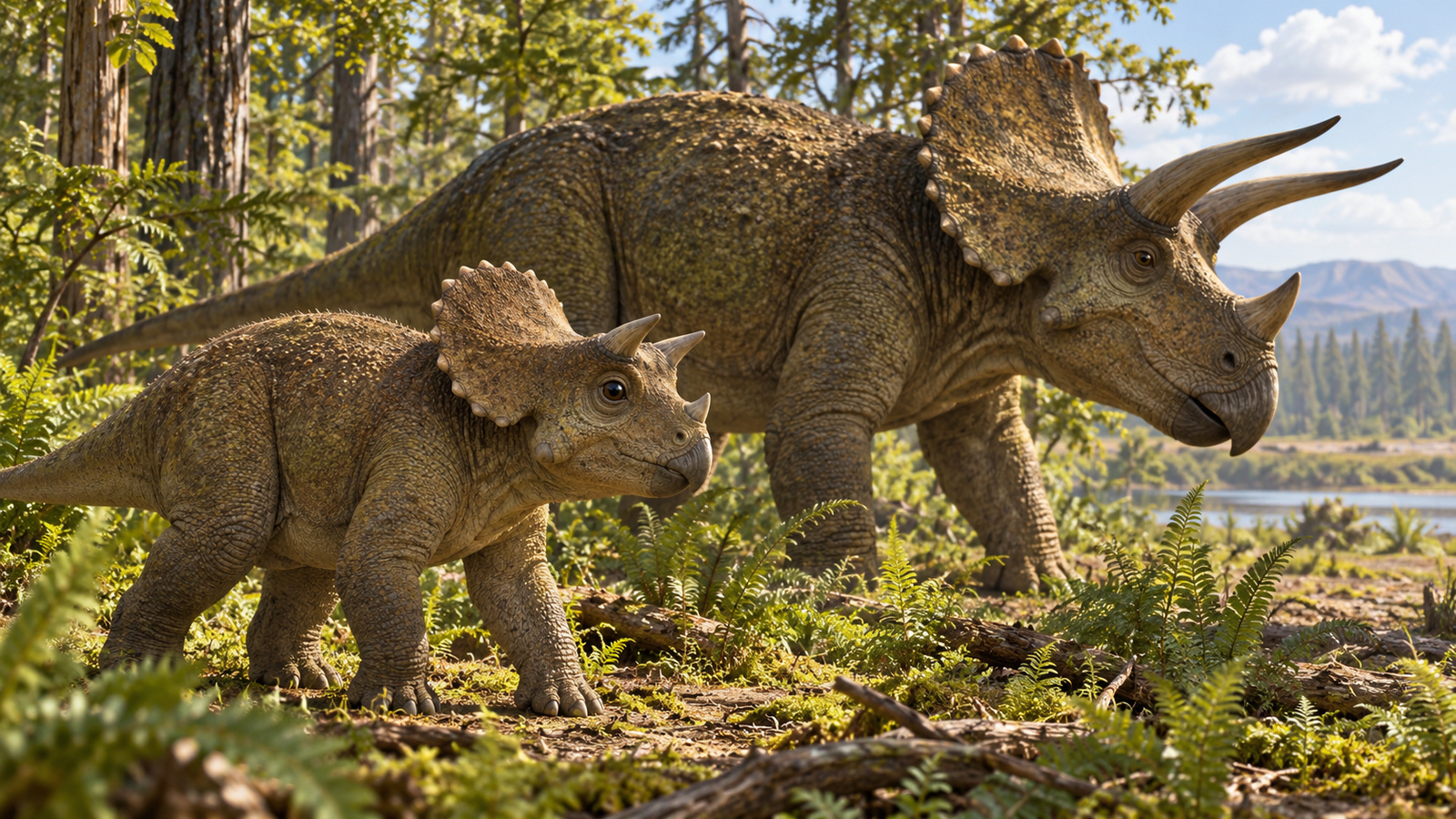
Triceratops did not simply enlarge its three horns. Horner and Goodwin’s 2006 study described brow horns beginning as straight stubs, curving backward in juveniles, straightening in subadults, and curving forward in adults. The rear edge of the frill also changed from a strongly scalloped outline toward a smoother adult margin. The bony ornaments along that edge became flatter and more elongated as they matured. A juvenile therefore needed a different silhouette, not just shorter adult horns. Those changes were documented in a skull series ranging from a baby about thirty-eight centimeters long to adults about two meters long.
Changing limbs could change contact with the ground
A dinosaur’s balance depended on how its mass was distributed around the supporting limbs. If the head, trunk, or hind limbs changed disproportionately, the best support pattern could change as well. Some growth series have been interpreted as documenting shifts between greater forelimb support and stronger reliance on the hind limbs. That is a substantial mechanical transition, not just a longer stride.
Work on Psittacosaurus limb proportions and histology linked developmental change with a shift toward bipedality. Other dinosaurs need not have followed that direction or timetable. Differences among lineages are part of the evidence. A reconstruction should identify the relevant growth series before assigning all hatchlings either a four-legged crawl or an adult-like walk.
Food-handling ability developed with the feeding apparatus
A small mouth could not detach or process every resource available to a large adult. Bite size, reach, tooth dimensions, and muscular capacity changed as the animal grew. These physical differences create reasons to investigate age-related diet. They do not, on their own, identify exactly what each juvenile ate.
For a herbivore, lower reach and smaller feeding tools could alter which plant parts were practical to collect. Softer growth might present different handling demands from a resistant stem, but a favored juvenile food needs evidence. The local vegetation and the developing mouth must both fit the hypothesis. Imagining a universal nursery menu of tender leaves goes beyond what size alone establishes.
Carnivores faced comparable constraints. Small prey or accessible carcass portions could differ in value across life stages, while growth altered the feeding forces an individual could apply. In some groups, dietary separation between ages is an active research topic. Specimen identity remains crucial: an apparent juvenile predator may instead belong to a distinct small species.
Direct dietary clues from identifiable young individuals are therefore especially valuable. Gut contents, feeding traces, or other secure associations can test hypotheses suggested by anatomy. Their rarity should not be filled with a detailed invented feeding schedule. The strongest account combines what a developing animal could handle with evidence for what it actually consumed.
Defenses did not arrive fully formed
Adult size itself could reduce vulnerability to some attackers, while armor, horns, and other structures offered additional possible protections. A young dinosaur might lack the dimensions or mature form of those features. It consequently faced a different set of risks even within the same habitat. Survival strategies could involve movement, concealment, grouping, or other behavior, but the balance among them is usually difficult to reconstruct. Developmental anatomy can establish a smaller horn or less imposing body more securely than it can establish a parent’s protective response. Keeping those levels separate helps explain vulnerability without inventing a universal dinosaur childhood.
A feathered or scaly coat needs evidence at each stage
Similicaudipteryx supplies an unusually revealing comparison of feathered youngsters. Two juvenile specimens described in 2010 preserve strikingly different wing and tail feathers: the younger animal had ribbon-like portions, while the older juvenile carried more extensively vaned feathers. A vane is the broad feather surface on either side of its shaft. The authors interpreted the difference as evidence of developmental transformation, although two individuals do not provide every intermediate stage.
That example does not justify giving every baby dinosaur a distinctive downy coat. Skin and feather evidence remain uneven among species and body regions. Color changes are harder still: a spotted hatchling in an illustration may be an artist’s proposal rather than a measured fossil result. The useful distinction is between a specific observed transformation, such as these preserved feather shapes, and a possible change inferred only from living animals.
Behavior cannot be scaled up or down mechanically
A nest of young animals provides evidence about a breeding site, but it does not necessarily reveal the length or form of parental care. An adult near a nest may have several possible relationships to the eggs or juveniles. Posture, association, sedimentary context, and repeated discoveries all affect the interpretation. Strong behavioral claims need more than proximity.
Likewise, a group of small skeletons does not automatically demonstrate an organized nursery supervised by adults. Individuals could aggregate for several reasons, or their remains could be concentrated after death. Age composition can help evaluate the alternatives, especially when burial context is well understood. A developmental series and a social group are different kinds of evidence even when some fossils contribute to both.
Growing individuals probably changed their interactions as their size and capabilities changed, but exact family structures remain uncertain for many dinosaurs. Comparisons with birds and crocodilians provide hypotheses rather than a universal answer. Living archosaurs themselves display varied care and social systems. The extinct record should determine which parts of that diversity are plausible for a particular lineage.
Age groups could divide an ecosystem within one species
If juveniles and adults differed in size, reach, speed, or feeding mechanics, they might use resources differently. This is called ontogenetic niche change: ecological roles shift during an individual’s development. It can influence competition between ages and the arrangement of a wider community. The principle is biologically reasonable, but its magnitude in a particular dinosaur population requires evidence.
One potential consequence is reduced direct overlap in some foods or feeding spaces. Another is a succession of vulnerabilities and competitors as the animal becomes larger. These are testable ecological proposals, not automatic outcomes of growing. They become stronger when anatomical change agrees with direct feeding evidence, environmental reconstruction, or other independent observations.
Building a growth series takes more than lining up sizes
A growth series becomes especially persuasive when several structures change together. In Triceratops, brow horns, frill edges, and the nasal region contribute overlapping developmental clues. This makes the sequence more informative than lining skulls up by length alone. An unusually small adult or a distorted fossil would otherwise be easy to place in the wrong position.
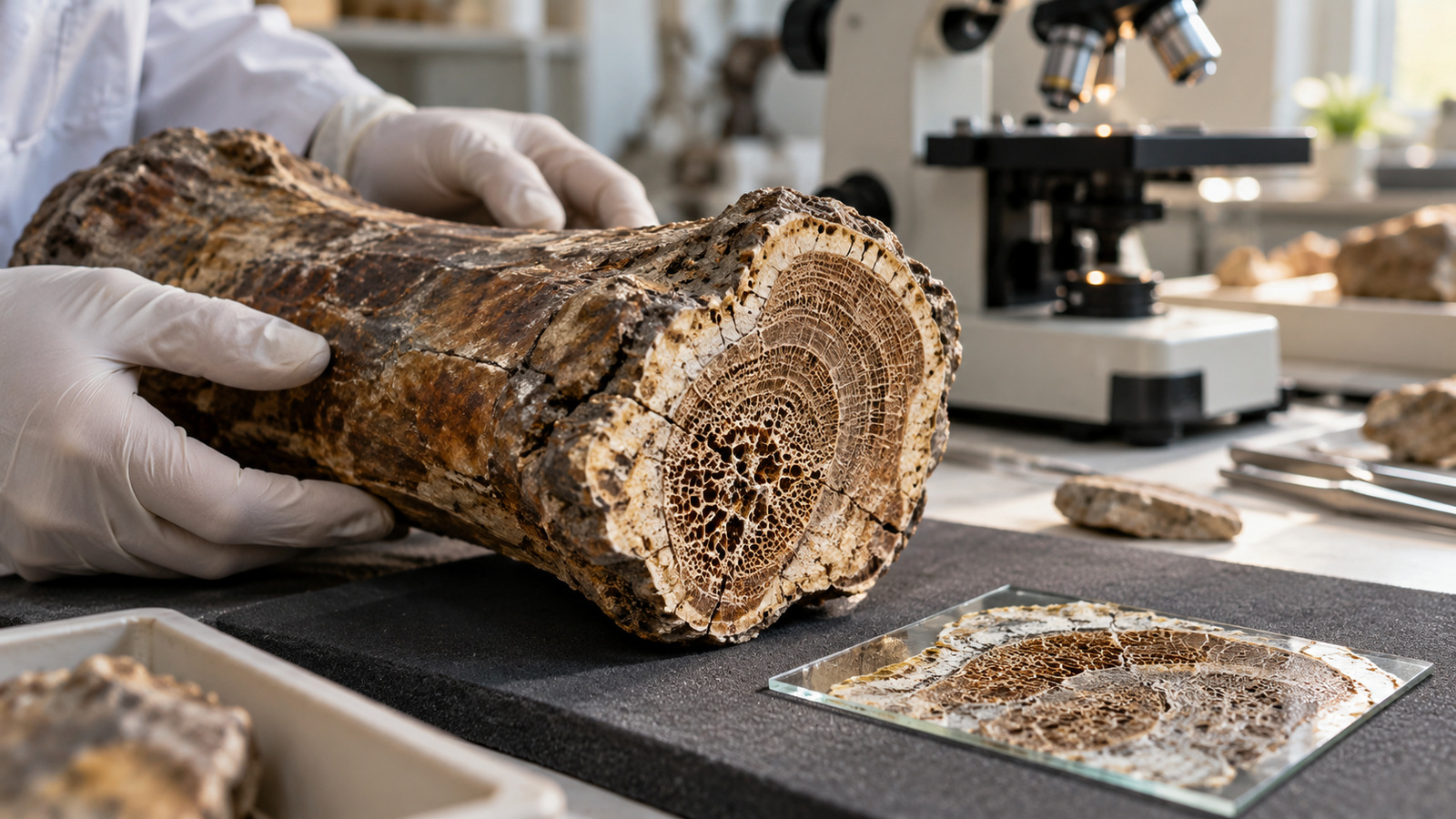
The smallest stages remain difficult to recover. Tiny bones can be destroyed or lose identifying features, and an embryo folded inside an egg differs from a walking hatchling. Discovering one of those missing stages can change a reconstruction more than adding another large adult. Its value lies in connecting a previously unknown body to the rest of the sequence.
For viewers, a good comparison therefore shows both scale and shape. The baby Triceratops skull is not the same size as the adult image merely because both fill a page. Once their actual dimensions are restored, changes in horn direction and frill outline become visible alongside the enormous overall increase. Growth then appears as a documented transformation rather than a guess made between two endpoints.
Age evidence from bone tissue remains a useful independent check, particularly where size and maturity do not agree. It supports a proposed ordering instead of replacing anatomy. Together, the different clues allow a series to explain what changed, which stages are represented, and where the fossil record still has a gap.
Development and evolution operate on different timescales
A juvenile becoming adult is not reenacting a complete sequence of ancestral species. Its body follows its own developmental program, shaped by evolutionary history but not equivalent to a moving family tree. Changes in the timing or rate of development can themselves influence evolution over generations. Understanding that distinction prevents a hatchling’s proportions from being described as a literal preserved ancestor. It also explains why comparing juvenile and adult anatomy can illuminate relationships without making individual growth and species evolution the same process.
A dinosaur lifetime was a succession of workable bodies
Each developmental stage had to function with the anatomy available at that time. A hatchling needed to breathe, move, and obtain resources before adult proportions or defenses existed. Growth therefore produced a sequence of living solutions, not merely an unfinished animal waiting to become useful. Fossils make some of those solutions visible while leaving others uncertain.
Baby dinosaurs could differ from adults in skull shape, limb proportions, feeding limits, defenses, and ecological roles. The details varied among lineages and remain better known for some groups than others. Reconstructing those differences adds an entire life history to the familiar adult skeleton. It reveals a prehistoric world populated by animals changing as they lived, rather than a landscape occupied only by full-sized giants.