A colorful feather and a color-seeing eye are two different discoveries
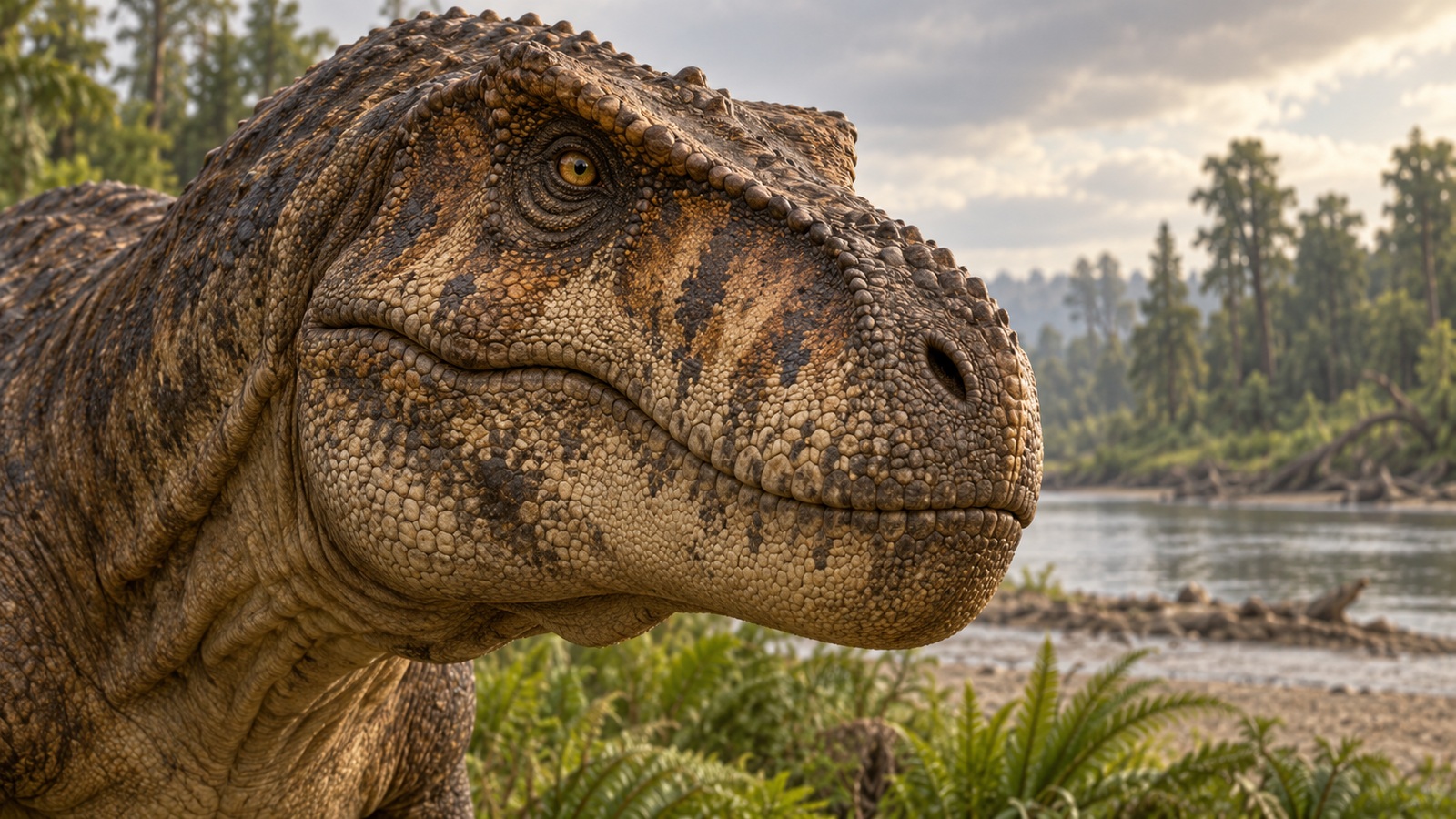
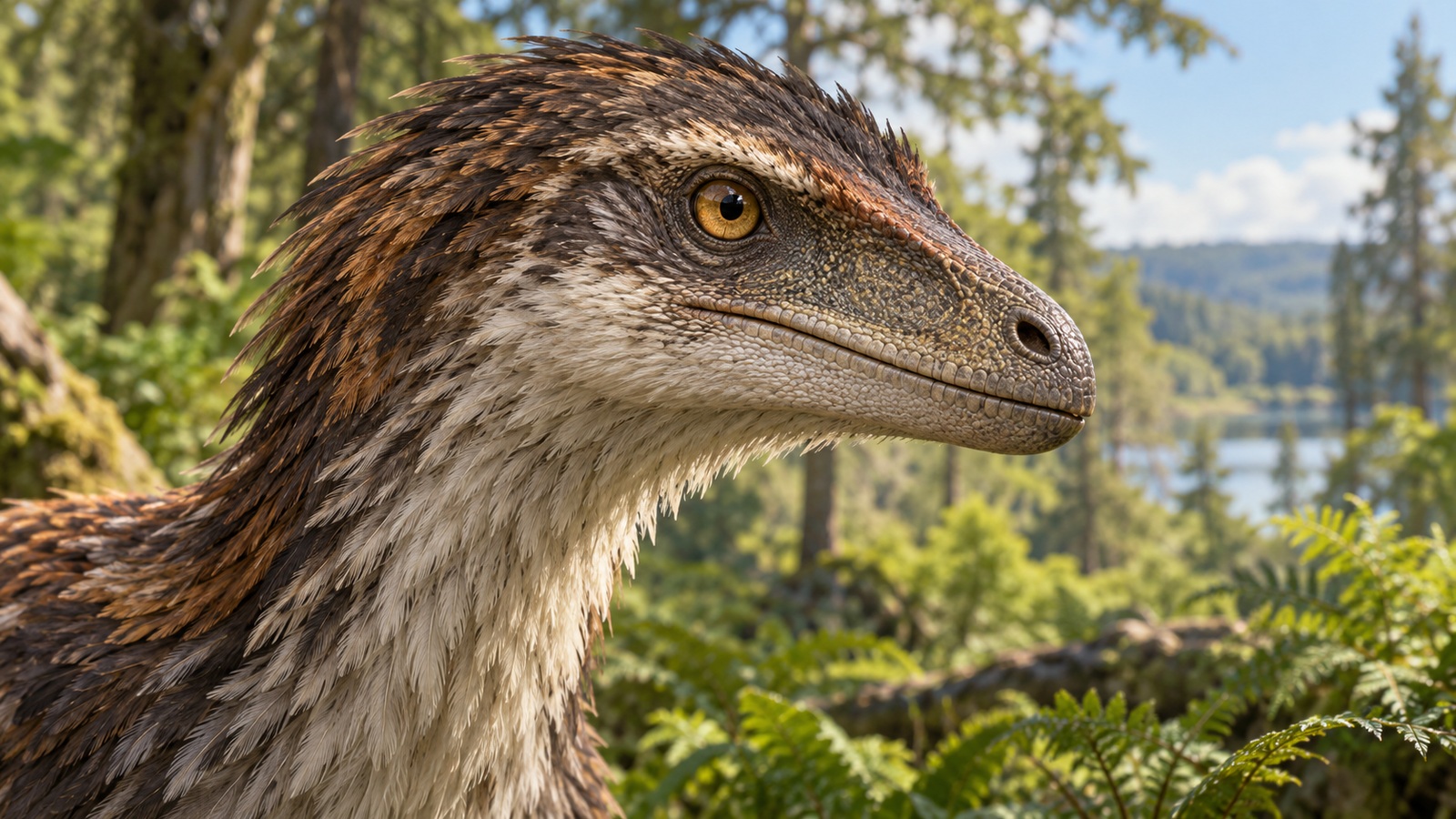
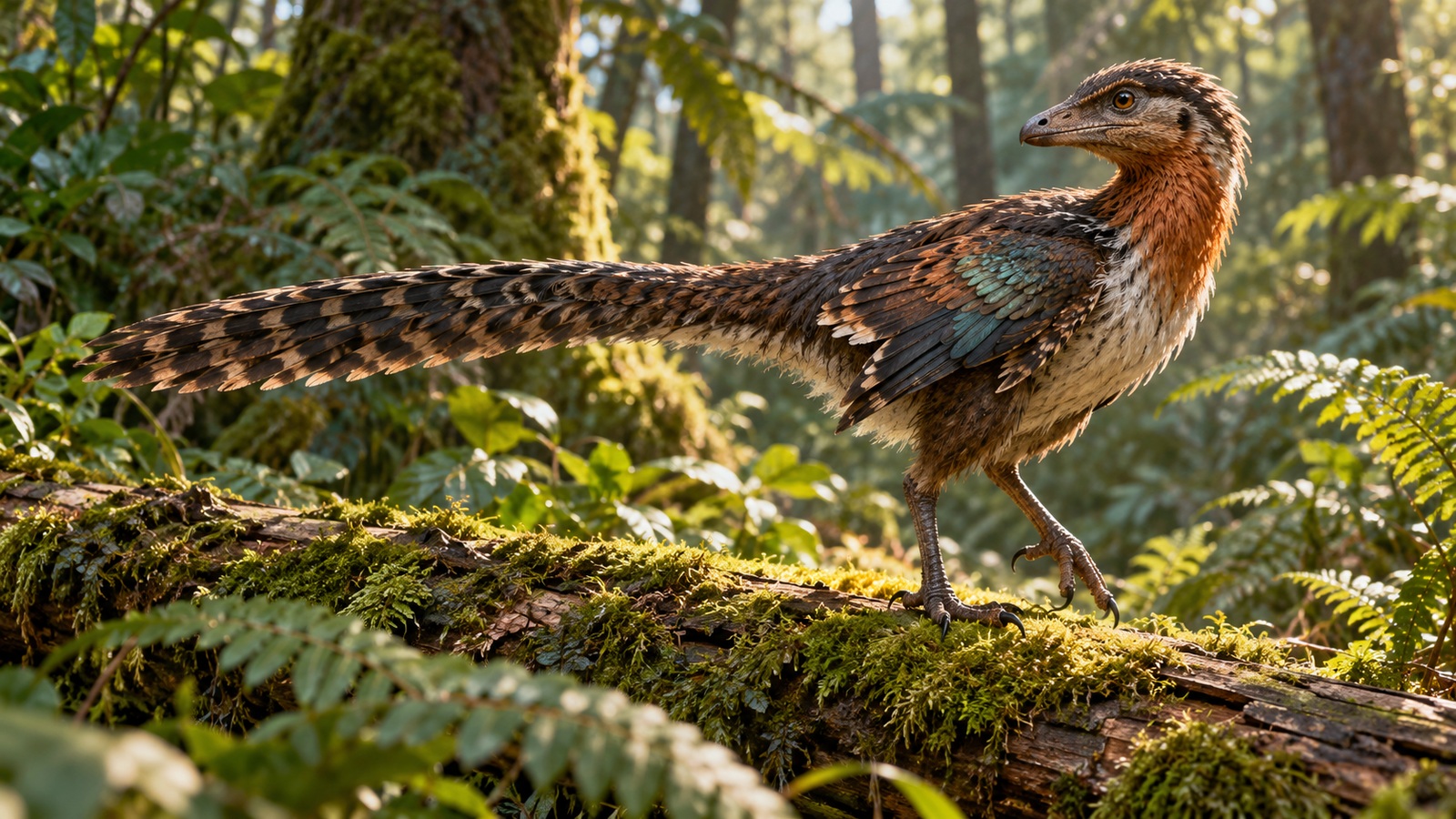
Imagine a small feathered dinosaur turning a chestnut shoulder toward another animal in a sunlit forest. The scene raises two questions that are easy to merge: what colors covered the dinosaur, and what colors could the other animal distinguish? Fossils sometimes preserve evidence relevant to the first question, while the second relies much more heavily on evolutionary comparisons and knowledge of living eyes. Scientists have good reasons to infer color vision in nonavian dinosaurs, including evidence concerning the ancestry of cone pigments and retinal structures. That does not mean every species saw an identical rainbow or experienced color exactly as humans do. Understanding the difference lets us appreciate a visually rich prehistoric world without claiming that an ancient feather is a complete record of the mind looking at it.
A: No. Evolutionary comparisons and research on visual-system history provide biological evidence independent of artwork.
A: The feather concerns body coloration, while the owner's visual abilities need separate evidence.
A: No. Living birds themselves vary, and extinct lineages had their own evolutionary histories.
A: A different receptor system changes possible discriminations rather than simply adding one named category.
A: No. Exact receptor tuning and the wavelengths transmitted by the eye also matter.
A: Their evolutionary history informs plausible ancestral retinal structures and how cone signals could be filtered.
A: Its biological effect depends on the relevant animal viewer and environmental conditions.
A: A visual capacity and an activity schedule are different traits, and their use can change with lighting.
A: It cannot reproduce all signals of a different receptor system or establish the animal's subjective experience.
A: Species-specific tuning, many optical details, and the exact experience produced by their nervous systems remain difficult to recover.
Color vision begins with comparing signals inside the eye
Light reaching an eye contains a distribution of wavelengths. Photoreceptors convert part of that incoming light into biological signals, and comparisons among differently sensitive receptors can support color discrimination. Brightness alone is not enough to determine color. Two surfaces can deliver similar overall light levels while differing in which wavelengths they reflect.
In familiar human vision, three cone classes contribute to ordinary color discrimination. Other animals possess different arrangements, and their visual worlds need not match ours. Describing a dinosaur’s likely color vision therefore means investigating its probable receptor system and evolutionary inheritance. It is not simply a choice between a modern human rainbow and a black-and-white film.
A useful everyday comparison is the difference between describing a light source and describing the instrument that records it. The same source can produce different signals in different detectors. Likewise, a colored feather reflects light whether the observer is human, bird, or another animal, but each observer samples that reflected information through its own sensory equipment. The physical surface and its perceived appearance are connected without being identical.
Living birds provide direct access to a dinosaur visual system
Birds are living dinosaurs, and their eyes can be studied in ways no extinct species permits. Researchers can examine retinal cells, measure light sensitivity, investigate visual pigments, and test behavior. Many birds have four single-cone classes relevant to color vision, although their spectral sensitivities and other details vary. This makes them powerful comparative evidence, not interchangeable samples of one universal bird eye. A sparrow, owl, and seabird differ in ecology and evolutionary history, and modern specializations should not be copied wholesale onto an extinct relative. The key question is which visual features probably existed before the lineages diverged and which changed afterward.
Evolutionary bracketing puts the inference on a family tree
Researchers use the distribution of traits among living and extinct relatives to infer ancestral states. Birds and crocodilians help bracket extinct nonavian dinosaurs within archosaurs, while more distant relatives can add information about deeper history. If a relevant visual feature is widespread in appropriate relatives, an inherited origin can be more plausible than repeatedly inventing it from nothing. The method works through explicit evolutionary relationships. This is why resemblance alone is insufficient. Two animals can occupy similar environments while arriving there through different evolutionary histories, and their eyes may retain different inherited components. A carefully built comparison explains which relationship supports the inference and which living traits might be specialized departures. That structure makes a hypothesis testable as additional comparative evidence becomes available.
It is not a simple rule that every living relative has exactly the same retina. Lineages can lose, modify, or specialize components, particularly when their environments and activity patterns change. A comparison needs to consider those changes rather than count relatives as identical votes. Reconstructing ancestry is a biological analysis, not an exercise in averaging two modern animals. This approach supports color vision as a reasonable expectation for nonavian dinosaurs even where eye tissues are absent. Its strength concerns the likely presence and broad architecture of a capacity. Predicting a particular species’ cone sensitivity requires more specific evidence. The inference becomes weaker when stretched from an ancestral system to an exact account of every dinosaur’s perception.
Visual pigments and oil droplets offer complementary clues
Cone sensitivity depends partly on visual pigments that include opsin proteins, while other eye structures influence which wavelengths reach those pigments. In many birds and turtles, colored oil droplets within cone cells act as filters. Their contribution helps explain why receptor number alone does not describe an animal’s entire color system. Optical filtering and neural comparisons also matter. A study of the conserved mechanism behind red cone oil droplets in birds and turtles inferred a deep evolutionary origin for relevant retinal features. The authors connected that history with evidence supporting dinosaur color vision, including a likely four-cone system. This is an inference from comparative genetics and evolutionary distribution, rather than a direct measurement of a living nonavian dinosaur retina. Its value comes from connecting independent biological clues.
Four cone classes would not mean merely seeing one extra named color
Human color words divide a perceptual experience using language and convention. An animal with a different set of receptor sensitivities need not organize its experience into those same categories with one additional label attached. It may distinguish reflectance differences that humans find similar, depending on light and the properties of the surfaces involved.
Conversely, a numerical count of cone classes does not by itself provide a catalogue of every discrimination the animal can make. The brain’s comparisons, optical filters, receptor noise, and illumination all affect performance. Tetrachromacy is therefore a useful description of a sensory arrangement, not a license to describe an extinct animal’s private experience in exact human terms.
Ultraviolet sensitivity requires its own evidence
Some living birds have visual systems sensitive to ultraviolet wavelengths, while others have a short-wavelength cone tuned differently. That variation matters when people claim that all dinosaurs saw ultraviolet light. A bird-like ancestry provides a starting hypothesis, but the exact spectral tuning of an extinct lineage is a more specific issue. One cannot simply attach every modern bird specialization to every dinosaur.
Transmission through the eye’s optical media also matters. A receptor can only respond usefully to wavelengths that reach it, so its pigment is part of a larger system. Soft tissues and biochemical details are usually unavailable in nonavian dinosaurs. Strong wording about precise ultraviolet abilities should therefore carry equally specific supporting evidence.
Research on living birds demonstrates the practical consequences of these distinctions. A study of avian ultraviolet vision in forest environments examined contrasts involving leaf surfaces. It helps explain why a different spectral system could reveal different information in a natural scene. It does not establish that every extinct dinosaur saw leaves in the same way as the tested living birds.
Fossil color reconstructions concern the surface being viewed
Some exceptionally preserved feathers contain microscopic structures associated with pigment-bearing organelles called melanosomes. By comparing these with suitable modern material, researchers can investigate aspects of an extinct animal’s coloration. Preservation, chemical alteration, and the available comparative samples affect the interpretation. Color reconstruction is a careful analysis rather than a direct color photograph extracted from stone.
Research on fossil melanosomes in Cretaceous dinosaurs and birds helped establish empirical approaches to reconstructing pigment-related patterns. Such findings concern what an animal may have looked like. They do not directly preserve the retinal cells or visual processing of another animal looking at it. Keeping the surface and the observer separate is essential, even when both questions involve color.
Camouflage depends on the viewer as well as the wearer
A pattern that blends into foliage for one visual system may be more conspicuous to another. Illumination, viewing distance, background, and movement also change the information available. A dinosaur’s reconstructed colors therefore cannot be assigned a camouflage function solely by asking whether a human finds a painting hard to see. Researchers need an explicit viewing model and a plausible environment. Even then, a pattern can have several consequences rather than a single exclusive function. It might reduce contrast in one setting while being visible at close range, or serve differently when the body changes posture. Appearance, perception, and behavior work together.
Color could have mattered beyond hiding from predators
Living animals use visual information when recognizing food, attending to others, and navigating complex environments. These comparisons make several uses of color biologically plausible for dinosaurs. A colored body region might have contributed to display or recognition, and plant surfaces might have provided useful contrasts. Each proposed behavior still needs its own evidence.
Bright colors alone do not prove courtship, just as a muted pattern alone does not prove a camouflage adaptation. Age, sex, season, and body region can influence living coloration, but their exact roles in a fossil species may remain unknown. A careful reconstruction can present several reasonable functions rather than converting an attractive illustration into a behavioral fact. The ability to discriminate color establishes possibilities, not a complete social script.
Dim light changed the usefulness of color information
At low light levels, fewer photons are available to support reliable comparisons among cone signals. Many living vertebrates rely more heavily on rod-mediated vision under such conditions, with tradeoffs that differ among species. This makes lighting central to any discussion of prehistoric perception. A forest at noon and the same forest at night were different visual problems.
Possible nocturnal activity in some dinosaurs does not imply that the entire group lacked color vision. Nor does likely color vision prove that an animal was active only in daylight. A species could use different information under different conditions, and activity might include dawn, dusk, or shaded environments. Behavioral categories and receptor capacities should not be collapsed into one trait.
Fossil orbits and scleral rings can contribute to investigations of light gathering and activity patterns, but they do not supply every component of a color system. A large eye is not direct evidence for a specific cone count. Combining optical possibilities with evolutionary evidence is more informative than treating one visible bone feature as a complete retinal diagnosis. Different lines of evidence answer different parts of the question.
An illustration cannot show exactly what a dinosaur saw
A modern screen is designed to stimulate human vision using a limited set of display channels. It cannot reproduce every distinction available to an animal with different receptors, especially where ultraviolet wavelengths are involved. A false-color visualization can map otherwise invisible information into human-visible colors, but that mapping is an explanatory convention rather than the animal’s actual view. The same caution applies to vivid museum art. A plausible scene can communicate a colorful ecosystem while using speculative details to fill gaps in the record. Clear captions should identify those details so viewers can appreciate the image without mistaking every hue for a fossil measurement.
The strongest answer combines a clear conclusion with a careful boundary
Nonavian dinosaurs very likely included animals with substantial color-discrimination abilities, supported by evolutionary relationships and evidence about the history of visual systems. Birds show directly that the dinosaur lineage contains sophisticated color vision today. Comparative work provides reasons to infer an ancient capacity rather than imagine a universally gray prehistoric world. This is a meaningful scientific conclusion even though the evidence is indirect for most extinct species.
The boundary lies in precision. We cannot confidently assign identical receptor tuning, ultraviolet sensitivity, or subjective color experiences to every dinosaur. Nor can a recovered pigment pattern answer those questions on its own. When looking at a colorful reconstruction, ask separately what supports the body’s appearance and what supports the eye’s capacity. That distinction keeps the prehistoric world vivid while allowing each kind of evidence to make the claim it can actually support.