Standing still would not switch off a tyrannosaur’s sight
A dinosaur freezes in the rain while a huge predator searches inches away: it is a memorable movie scene built around an unreliable biological premise. There is no fossil evidence that Tyrannosaurus rex could see an animal only when it moved. Its skull instead suggests a capable visual system, with eyes positioned to share a substantial view of the space ahead. That arrangement could help a giant animal judge distances, negotiate obstacles, and direct its head toward a target. Exactly how sharply it saw, how its retinas handled dim light, and how its brain combined visual signals remain harder to establish. Understanding T. rex eyesight means separating the geometry preserved in bone from the performance inferred through comparisons. The result is an impressive predator whose vision deserves more credit than the motion myth allows, without turning every attractive estimate into a measured fact.
A: There is no evidence for that movie premise; stationary objects still provide visual cues.
A: It is the area both eyes can view at the same time.
A: Its shape allowed useful frontal sight while restricting some directions.
A: They can model possibilities, but cannot perform a direct test or recover every retinal detail.
A: Movement could be informative, although its exact behavioral response is unknown.
A: Different species and growth stages had different head proportions.
A: No; useful sensory systems can complement one another.
A: It lacks several optical and retinal variables needed for that certainty.
A: Calculations can yield precise values even when their biological inputs remain uncertain.
A: The skull supports effective forward-directed vision with substantial binocular overlap.
The broad rear skull gave the eyes a useful vantage
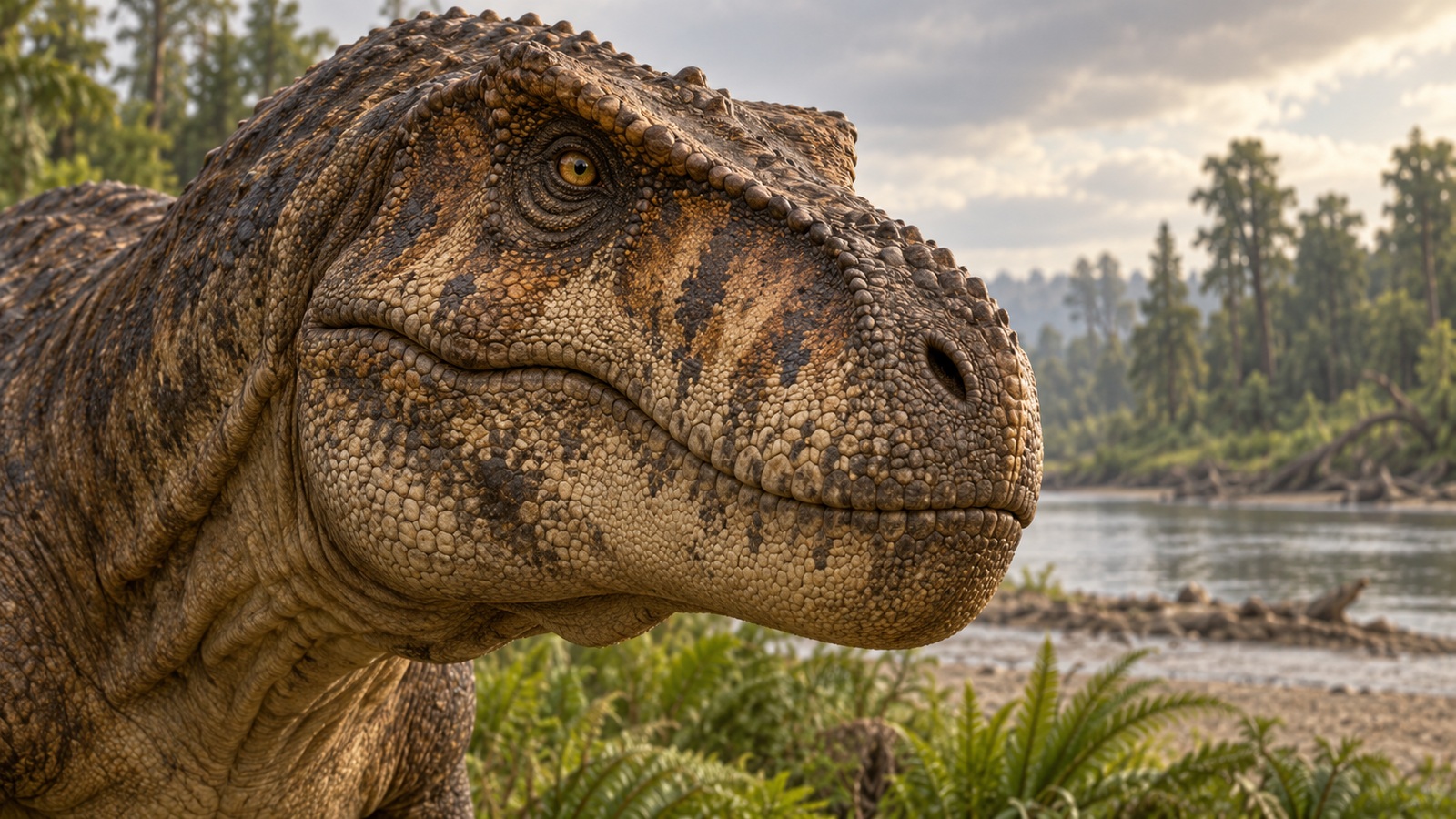
The head of an adult Tyrannosaurus was broad toward the back and narrower toward the front. Its eye sockets occupied positions that allowed the eyes to look partly forward rather than only outward. A useful way to appreciate this geometry is to view an accurate skull from above. The snout still blocks some directions, but it does not form the same obstacle that it would if the eyes sat much closer together behind a uniformly broad muzzle.
Bone establishes the general arrangement more securely than it establishes the complete living eye. Eyeball size, placement within the socket, surrounding soft tissues, and posture all affect a reconstruction. A museum skeleton therefore supplies constraints rather than a finished field-of-view measurement. Researchers need to reconstruct the living head before calculating which lines of sight would remain clear.
Two overlapping views could support judgments of depth
Binocular overlap is the region visible to both eyes at once. Within that region, slightly different images can provide information about distance, a process called stereopsis when the nervous system uses their disparity. An animal can also judge depth through other cues, including motion, relative size, texture, and the way nearer objects obscure farther ones. Forward-facing eyes are consequently one part of a visual system rather than a guarantee that every aspect of depth perception matches a human’s. For T. rex, a broad overlap would have been useful across ordinary activities as well as feeding. Moving a large head past branches or approaching uneven ground creates distance problems even when no prey is nearby.
A reconstruction can map visibility without testing a living animal
In Kent Stevens’s research on theropod binocular fields, reconstructed heads were used to investigate how the snout and surrounding anatomy restricted sight lines. This approach turned a visibility problem around: if an observer could see the modeled pupil from a particular direction, that direction could lie within the eye’s unobstructed field. Mapping many directions produced a proposed field rather than a behavioral eye test.
The published 2006 comparison placed the reconstructed coelurosaur fields, including Tyrannosaurus, at roughly forty-five to sixty degrees wide. The modeled Allosaurus and Carcharodontosaurus fields were only about twenty degrees across. These figures describe the shared viewing region, not an acuity score. Their useful result is the anatomical contrast: a tall, narrow snout obstructed sight lines differently from the broad-backed Tyrannosaurus head.
The result still depends on the model. Change the pupil’s position, the shape of soft tissues, or the head’s angle, and some boundaries may shift. Such uncertainty does not erase the evidence for forward-directed vision. It means that a precise angle should be presented with its reconstruction assumptions rather than treated as an angle directly read from a fossil retina.
Sharpness and overlapping fields answer different problems
Visual acuity describes the ability to distinguish fine detail. Binocular overlap describes how much of a scene both eyes can see simultaneously. An animal can have a broad shared field without extraordinary acuity, or sharp vision with a differently arranged field. Confusing these measurements turns a supported anatomical observation into a much stronger performance claim.
Estimating acuity requires assumptions about the eye’s optical properties and the sampling capacity of the retina. Larger eyes can create opportunities for useful optical performance, but size alone does not determine the density of light-sensitive cells or their neural connections. The fossil skull cannot show every component needed to calculate a definitive resolution limit. Claims that T. rex saw a fixed number of times better than a human should therefore be understood as model-based possibilities.
The retina is the missing part of many confident claims
A living retina contains specialized cells whose arrangements influence detail, color sensitivity, and performance at different light levels. An ordinary tyrannosaur skull does not preserve that map, so it cannot show how finely the eye sampled an image or how the information was processed. This leaves an important distinction in the reconstruction: researchers can investigate the space visible around the snout more directly than the detail resolved within that space. The published field diagrams remain useful even when the retinal variables are unresolved. An illustration of overlapping sight lines should therefore be read as a geometric result, while a claim about exceptionally fine detail requires additional assumptions about the missing eye. Living relatives help frame those assumptions without supplying a recovered Tyrannosaurus retina.
Movement could attract attention without creating visibility
Motion often makes an object easier for animals to detect. A moving shape can stand out against a complex background, and its changing position can reveal boundaries that camouflage otherwise conceals. That useful sensitivity is very different from being unable to perceive stationary objects. The movie rule makes the stronger claim without evidence.
A stationary animal still reflects light and can present contrasts, edges, shadows, and an outline. Whether a predator detects it depends on lighting, distance, concealment, attention, and the observer’s abilities. An exposed body does not become optically absent when it stops moving. Freezing might reduce one cue while leaving several others available.
Tyrannosaurus also lived in an environment full of stationary obstacles. It needed to move through vegetation, approach ground surfaces, and orient around other physical features. A system limited to moving targets would create problems beyond hunting. Nothing in the fossil anatomy requires such an extraordinary restriction, so it should not be treated as a scientific survival strategy.
Long-distance sight depended on the landscape as well as the eye
A large animal’s head can provide a useful view across some surroundings, but height does not remove every visual barrier. Trees, terrain, weather, and the curvature of local ground limit sight lines. Looking over low vegetation differs from looking through a dense stand of trees. Any claim about seeing prey at a particular distance needs a scene as well as an eye model.
Detecting that something is present also differs from recognizing what it is or estimating its exact distance. A distant patch of movement may become visible before individual body features can be resolved. These are separate performance thresholds. Treating them as interchangeable produces dramatic claims that the available fossil evidence cannot support precisely.
Vision worked alongside the rest of a sensory animal
The Natural History Museum’s Tyrannosaurus profile highlights the importance of smell in this animal. That sensory investment does not make good vision unnecessary. Different sources of information can operate at different ranges or remain useful under different conditions. An odor can direct attention before an object becomes visible, while sight can help locate its immediate position.
Hearing, head movement, balance, and touch also belong in a reconstruction of behavior. A hunting animal does not need to choose one sense permanently and abandon the others. Integrating information can be more effective than depending on an isolated channel. Reconstructing the whole animal therefore gives a more realistic picture than describing T. rex as either a walking nose or a pair of superhuman eyes.
Sensory anatomy should also be separated from a guaranteed behavioral outcome. A strong ability to detect food does not establish whether a particular meal was hunted, scavenged, or taken from another animal. Eyesight can inform the range of feasible activities without deciding every feeding encounter. Fossil feeding traces and ecological evidence must carry their own part of that argument.
A growing tyrannosaur did not keep one unchanging head shape
Young tyrannosaurs had different proportions from large adults, including changes in the skull as they grew. Those differences caution against assigning every life stage an identical visual reconstruction. Eye orientation, snout interference, and habitual head carriage need to be considered in the specimen being studied. A measurement based on one adult skull cannot simply become a universal value for every juvenile and adult. Growth does not imply that juveniles lacked useful vision; it means the relevant geometry developed alongside the rest of the animal. The same care applies when comparing different tyrannosaur species with distinct skull shapes.
Color and darkness remain less certain than eye direction
Living birds and crocodilians supply evolutionary context for investigating dinosaur visual systems. Their eyes demonstrate capacities that can help researchers form hypotheses about extinct archosaurs. Yet those lineages have their own histories and specializations. A feature shared by living relatives can support an inference without fixing every detail of Tyrannosaurus color perception.
Night vision is similarly difficult to reduce to a confident label. Light collection, pupil behavior, retinal composition, and visual processing all influence performance in darkness. Skull anatomy alone does not reveal every variable. Describing T. rex as exclusively a daytime or nighttime visual specialist on the basis of a dramatic illustration would go beyond the evidence considered here.
Hunting involved more than seeing a target clearly
Good sight could assist with approaching prey, directing a bite, maintaining orientation, and avoiding collisions. Those benefits make functional sense without demanding cinematic perfection. A successful attack also depended on body mechanics, the prey’s defenses, terrain, experience, and the circumstances of an encounter. Vision cannot independently establish an infallible hunting technique.
Nor would a broad binocular field mean that every direction around the head was visible at once. Areas outside the overlap could be seen by one eye, while others might require turning the head or body. Animals routinely change posture to gather information. A static diagram is therefore a map of a particular arrangement, not a complete account of active looking.
Predators can also make errors despite effective sensory systems. Concealment, distraction, poor contrast, and rapidly changing scenes challenge living hunters. There is no reason to turn an extinct animal’s useful anatomy into omniscience. Keeping those ordinary limits in view makes Tyrannosaurus more biologically convincing while leaving its powerful sensory capabilities intact.
Separate the tyrannosaur’s forward view from an imagined eye test
T. rex probably possessed effective vision, and its broad rear skull supports substantial overlap in the view ahead. That is a firmer conclusion than any exact multiplier comparing its acuity with a human’s. Reconstructed fields, inferred optical performance, and imagined behavior belong on different evidentiary levels.
When evaluating a striking claim, look for the specimen, the reconstruction method, and the assumptions about the living eye. Then ask whether the claim concerns detection, detail, distance, color, or darkness. Those distinctions explain why the motion-only myth fails while several more precise aspects of tyrannosaur sight remain open to investigation. The real animal emerges as a capable observer whose abilities can be studied without pretending its eyes survived for a modern examination.