Survival depended on more than winning a fight
Stegosaurus carried spikes at the dangerous end of its tail; a young Psittacosaurus could become food for a mammal; and a duck-billed dinosaur survived a tyrannosaur bite with a broken tooth embedded in its tail. These different discoveries show why dinosaur predators and prey need more than a cast of invincible hunters and helpless victims. Size, defenses, growth, and circumstances changed the balance of an encounter. Hunters also faced consequences: an injured limb or failed attack could make the next meal harder to obtain. Fossils preserve only scattered contacts within that larger ecological relationship. By connecting actual specimens with the anatomy of feeding and defense, we can see how prehistoric animals obtained food, resisted danger, and sometimes survived long enough to leave a record of recovery.
A: No. Injury, food shortages, competition, and vulnerability during growth still mattered.
A: Sometimes tooth shape, spacing, and local candidates support an identification, but uncertainty can remain.
A: Many possessed size, armor, weapons, or escape options that complicated attacks.
A: It records a particular event rather than a lifetime's hunting routine.
A: Avoiding an expensive or dangerous opportunity is ecologically plausible, although individual decisions rarely fossilize.
A: Its enlarged bony knob worked with a handle of stiffened, interlocking tail vertebrae; both components matter when reconstructing the structure.
A: No. Burial processes and environmental concentrations can produce other explanations.
A: Injuries in the predator's own body provide another record of physical hazards, although attributing a particular lesion to prey still requires evidence.
A: No. Clubless forms such as Nodosaurus carried armor without the distinctive terminal club, so armor alone does not identify that weapon.
A: They recycled remains and linked dramatic encounters to the wider ecosystem.
Predator and prey describe relationships, not permanent ranks
A carnivorous dinosaur could threaten another animal while remaining vulnerable to injury, competition, and hunger itself. Its position in a food web did not make every encounter worth pursuing. Likewise, a herbivore’s defenses changed the risks of an attack without guaranteeing its escape. The relevant comparison is between two bodies in particular circumstances, rather than a permanent ranking of strong hunters above weak victims.
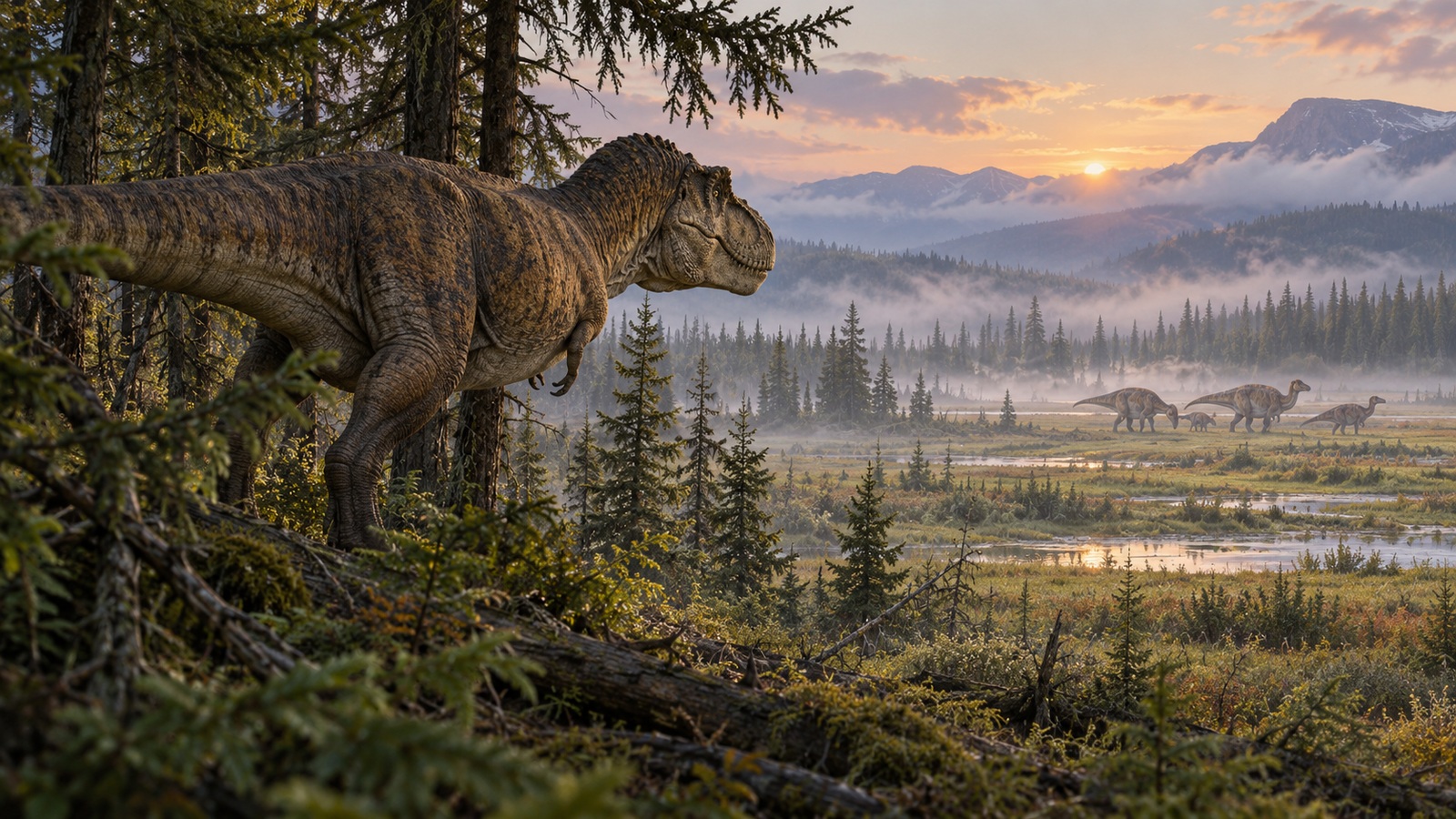
Begin with the point of contact: a mouth approaching a flank, a tail weapon reaching an attacker, or a foot gaining purchase during escape. Each creates a different mechanical problem. The positions of head, limbs, and defenses matter alongside body size, because force is useful only where it can be delivered. The examples below connect those physical relationships with actual damage and preserved food. Later, a mammal’s dinosaur meal reveals why the same comparison also changes across growth stages.
A fossil bite can reveal a meal without revealing a kill
Tooth impressions, gouges, broken bones, and embedded teeth are physical evidence, but their meanings depend on context. A bite on an animal that was already dead documents feeding without proving that the biter caused its death. Healing around an injury establishes that the victim survived for a time, making the sequence much more informative. Researchers also compare the dimensions and shapes of traces with the teeth of plausible local animals, while considering trampling, breakage, and other sources of damage. Several independent observations are stronger than a dramatic mark interpreted in isolation. The most useful account distinguishes what the specimen records directly from the behavior inferred to explain it.
Finding a target was a problem of information
A hunter first needed to detect something worth pursuing. Smell could identify carrion or nearby animals, while vision could register movement and outline. Hearing might help locate activity before its source became visible. These channels would have operated together, and their usefulness changed with wind, vegetation, distance, and background noise.
Prey had access to information too. Eye position, posture, and attention could help an animal monitor its surroundings while feeding, although fossils rarely reveal an individual’s exact scanning behavior. A movement detected early might allow withdrawal before close contact became necessary. Dense cover could conceal a hunter but also obstruct its own view and movement.
The Australian Museum’s overview of dinosaur senses explains the anatomical clues behind sensory reconstructions. Those clues do not supply a universal detection distance for dinosaurs. A fossil skull can help establish plausible sensory capabilities without showing precisely what an animal noticed on a windy afternoon. Environmental context is part of the encounter, not just background scenery.
A potential meal had to be worth the risk
The Stegosaurus–Allosaurus comparison makes risk concrete. Both inhabited Late Jurassic ecosystems of western North America, but the herbivore’s four tail spikes placed sharp weapons behind its feeding head. A predator approaching from the rear did not encounter an undefended end. The animal’s reach and ability to turn its tail mattered alongside the attacker’s jaws.
Kenneth Carpenter’s illustrated account shows a punctured Allosaurus tail vertebra interpreted as contact with a Stegosaurus spike. Such an attribution is a reconstruction from the damaged anatomy, not a complete film of the attack. Even with that limit, it offers a more informative survival problem than asking which dinosaur was stronger overall. Close contact could expose the carnivore itself to serious injury, and escaping that contact could matter as much as overpowering the herbivore.
Armor and weapons changed the terms of an approach
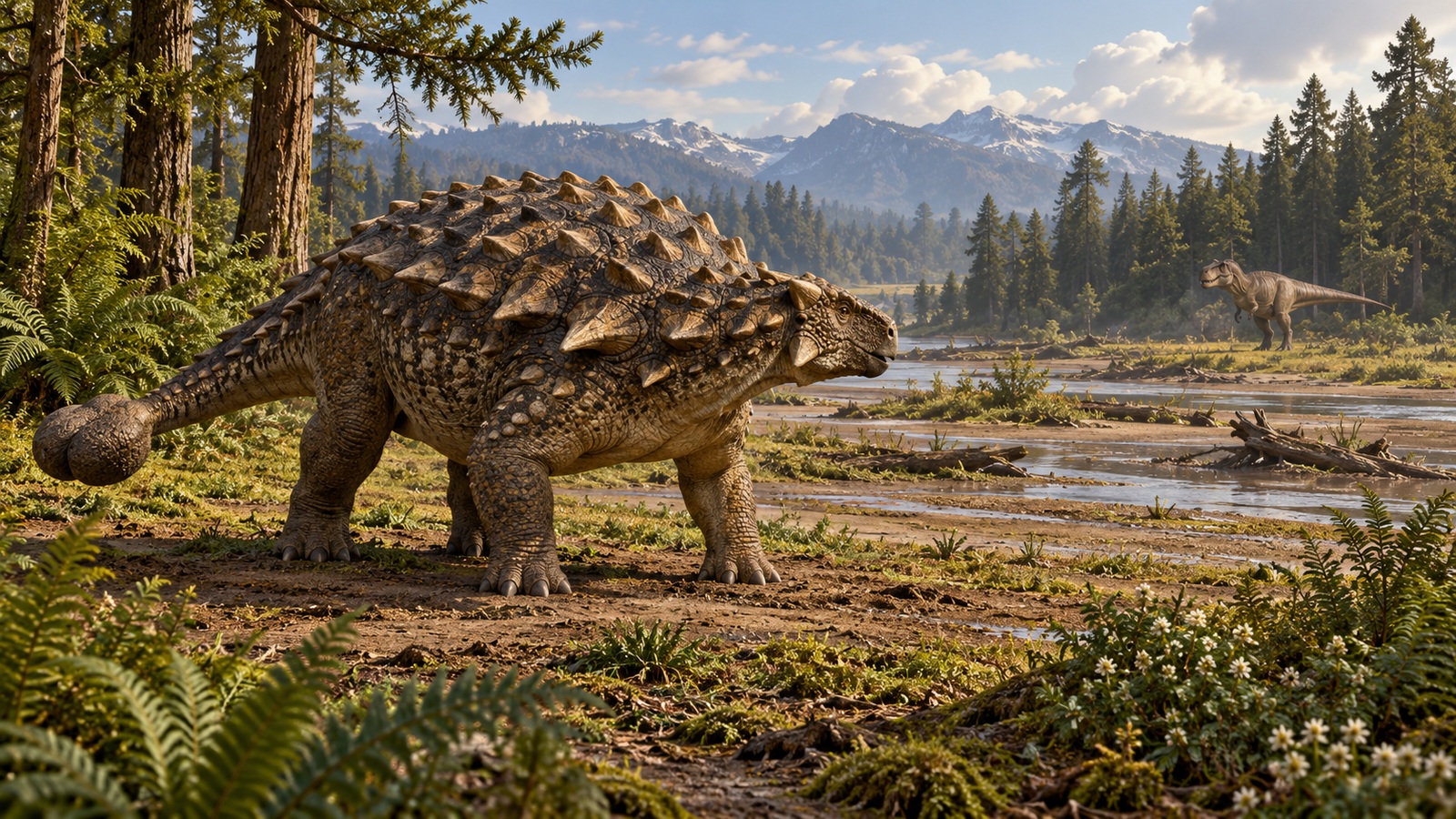
Ankylosaurids used a different defensive arrangement. Bony plates and other armor covered parts of the body, while some species carried a stiffened tail ending in a heavy knob. The armor presented a barrier and the club extended the consequences of approaching too closely. Neither made every body region invulnerable.
Victoria Arbour’s 2009 tail-club models found that large clubs could potentially deliver bone-breaking impacts, whereas smaller clubs did not produce the same result. This is a size-dependent mechanical estimate. It does not show how often the weapons struck predators in life.
The physical contrast with Stegosaurus is revealing. A stegosaur spike concentrates contact at a pointed tip, while an ankylosaurid knob delivers an impact through a broader terminal structure. Both depend on moving and positioning the tail effectively. An inventory of weapons cannot substitute for understanding how the body used them.
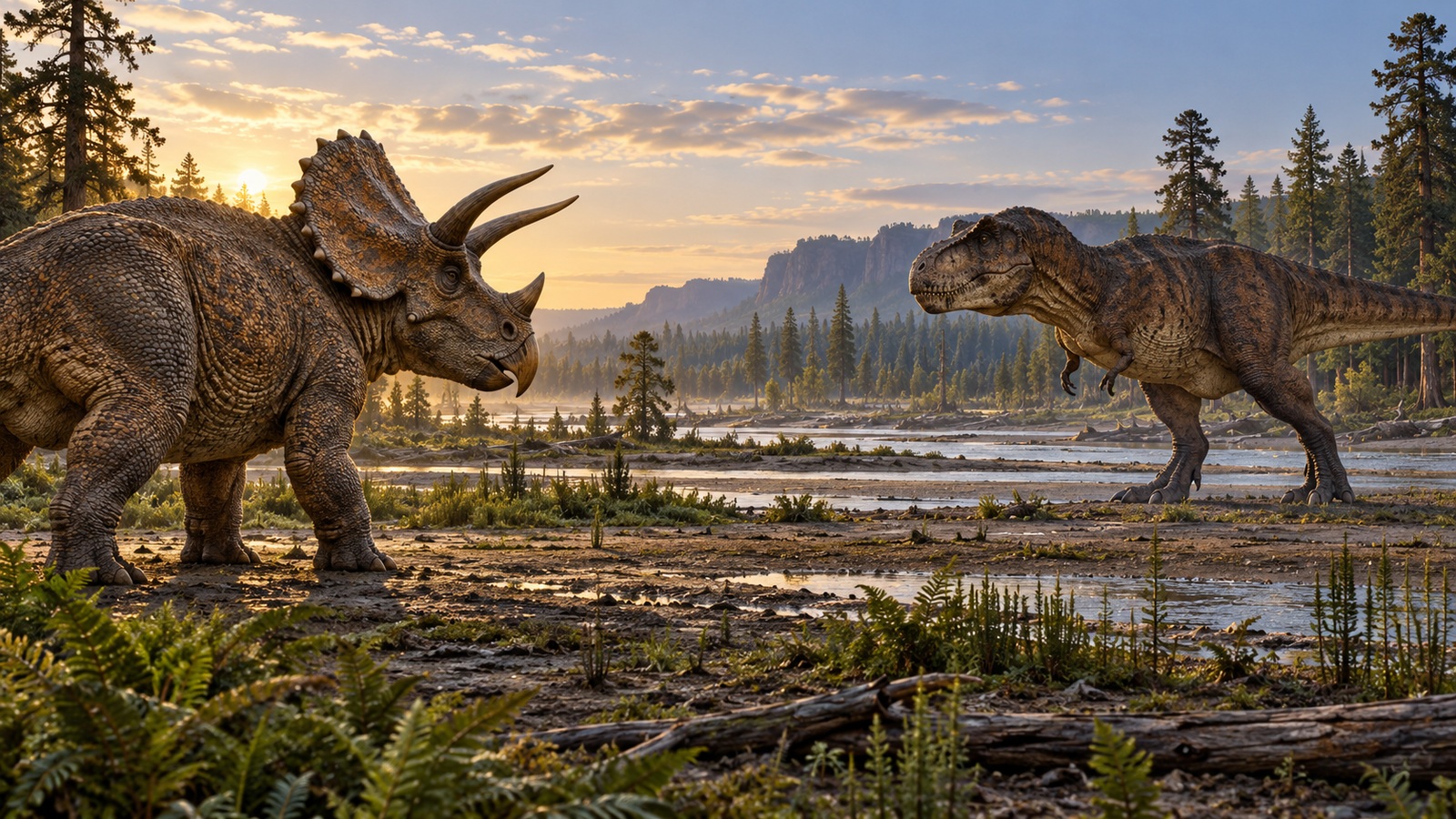
Horns added another arrangement in ceratopsians such as Triceratops. A predator facing the head confronted a different obstacle from one contacting the flank. Those horns could also participate in interactions within the species, so their existence should not be reduced to one evolutionary purpose. For survival during an actual encounter, however, orientation and reach were immediate physical constraints.
Movement offered choices before it offered a race
Escape did not always require a long sprint. Early detection, a short movement into cover, or a change in direction could prevent an encounter from developing. The options depended on body size, terrain, and how close the hunter had already come. Even an animal capable of rapid movement might avoid spending energy unnecessarily.
Trackways preserve actual passages, but most do not document predator-prey pursuit. Two kinds of footprints on one surface can have been made at different times, and similar directions do not establish a chase. Interpreting pursuit requires a stronger case connecting timing, movement, and track relationships. Surface deformation can further complicate apparent stride and speed.
Living animals show why maximum speed alone is a poor survival score. Turning, footing, acceleration, endurance, and the starting distance can all change an outcome. Fossil anatomy and mechanical models can investigate some of these variables, with uncertainty about muscles and body mass carried into the conclusions. They cannot convert every pair of species into a reliable winner.
Growing up meant moving through different danger zones
Small dinosaurs could be food for animals far below the size of a giant theropod. A Repenomamus robustus specimen described in 2005 preserves juvenile Psittacosaurus remains in its stomach region. This mammal consumed a young dinosaur, reversing the familiar image of mammals existing only as dinosaur prey. The contents establish consumption even though they do not preserve the complete acquisition sequence.
For Psittacosaurus, becoming larger would change which animals could physically handle it. Its juvenile stage belonged to a smaller-scale food web that an adult skeleton alone does not convey. Eggs and recently hatched animals similarly offered resources to consumers unable to challenge mature herbivores. Growth did not eliminate danger, but it changed the set of possible encounters and the usefulness of different shelters.
Living near others could change who noticed danger
A group could place more animals near an approaching threat, but the fossil record seldom reveals exactly how they responded. Age-organized Mussaurus associations demonstrate that some dinosaurs gathered in structured ways; they do not preserve a ring of guarding adults or assigned sentries. The survival connection is therefore a bounded possibility. Neighbors might alter detection or individual exposure, while crowding could also create competition. Establishing the association is a first step toward understanding its consequences, not evidence for one universal defensive formation.
A healed injury records survival rather than a flawless defense
Bone repair gives an encounter a timeline. The animal lived long enough after damage for its body to respond, which separates that injury from a bite delivered only after death. Identifying the cause can remain difficult, especially when healing obscures the original trace. An injury may demonstrate survival without revealing how the victim escaped.
A study of a tyrannosaur tooth embedded in healed hadrosaur vertebrae offers an unusually direct example of a living dinosaur surviving a bite. It supports active predation in that case, while also recording an unsuccessful outcome for the attacker. One specimen cannot establish how often that happened across an entire community. Its strength lies in the physical sequence it preserves, not in supplying a complete hunting biography.
Dead animals kept connecting the food web
A carcass could feed animals that had played no role in the original death. Large pieces might be consumed first, with smaller remains available later to other vertebrates and invertebrates. Microorganisms completed much of the recycling that rarely appears in dramatic reconstructions. A landscape’s predators, scavengers, and decomposers were linked through these transfers.
Tooth marks on dinosaur bones sometimes document feeding within a species. Research on cannibalistic feeding in Tyrannosaurus illustrates how remains can reveal consumption without establishing that the eater killed a living member of its own kind. Opportunistic use of a carcass is compatible with an animal also being an active hunter. The evidence should determine the narrow claim before a broader behavioral label is applied.
This perspective also changes how a predator’s success is imagined. Access to food involved competition, discovery, handling, and the ability to keep feeding, not just delivering a fatal bite. Other consumers could remove resources, and environmental exposure could alter the carcass. A kill was one possible beginning of a meal rather than the end of every ecological problem.
Changing landscapes changed the balance of opportunities
Rivers shifted, floodplains flooded, vegetation changed, and local conditions could become wetter or drier. These changes affected visibility, travel routes, available plants, and where animals gathered. A place that offered shelter during one interval could become difficult ground during another. Dinosaurs therefore encountered a moving set of circumstances rather than a fixed arena. Deposits preserve pieces of those environments, but the fossil record combines events over time and often across an area larger than a single encounter. Reading the surrounding sediment and associated fossils helps keep a behavioral interpretation tied to a plausible landscape instead of an imagined permanent backdrop.
The strongest survival story leaves room for uneventful days
Most individual acts of avoidance never marked a bone. This creates a preservation bias toward feeding traces, serious injuries, and unusual burial events. Reconstructing ordinary survival requires acknowledging that invisible majority while grounding specific claims in the evidence that does remain. A skeleton with horns or armor tells us something about physical possibilities, but not how frequently those defenses were tested.
When viewing a prehistoric scene, ask what establishes the encounter, which traits affect its mechanics, and which actions are artistic interpretation. Then consider the alternatives: the hunter withdraws, the prey notices early, or the animals simply pass at a distance. These outcomes are biologically meaningful even when they lack a dramatic finish. Dinosaur survival was sustained by successful decisions over time, and many of those decisions prevented a battle from happening at all.