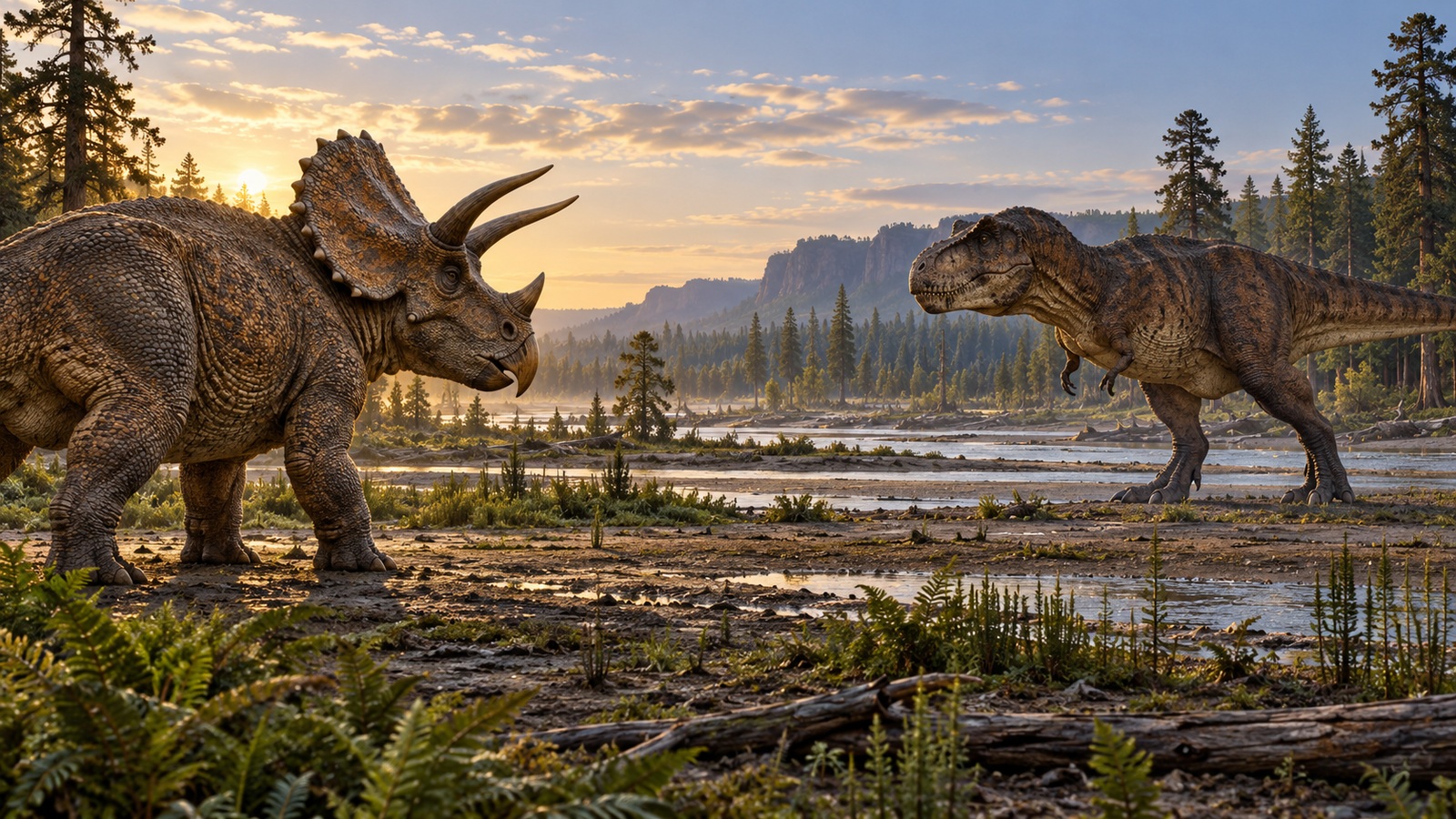
The famous face-off asks a larger question than who would win
Place a Tyrannosaurus skull opposite a Triceratops skull in a museum, and a battle almost stages itself in the imagination. One animal carried a powerful mouth; the other brought a large body, a bony frill, and prominent facial horns. Unlike many popular dinosaur pairings, these animals really did share late Cretaceous environments in western North America. Their fossils also preserve evidence of feeding interactions, making the connection more than a plausible illustration. Yet a real encounter would have involved particular individuals on particular ground, with different reasons to approach, resist, or retreat. The useful question is what the evidence reveals about those possibilities. Understanding the matchup means examining injuries and traces while resisting the urge to turn every damaged bone into a complete, predetermined fight.
A: They overlapped in late Cretaceous western North America, making encounters geographically and temporally plausible.
A: No. Feeding on an already dead animal can also leave such damage.
A: Triceratops also possessed a beak and jaws; proposing a defensive bite is a different behavioral hypothesis from a horn strike and would need appropriate supporting evidence.
A: No. Interactions within the species, accidents, and disease also require evaluation.
A: That single-purpose explanation overlooks other possible roles and specimen-specific evidence.
A: Access, orientation, footing, and the target's response also shaped any encounter.
A: Its options depended on movement and terrain; fossils do not document an infallible maneuver.
A: Association requires additional evidence before it can establish interaction.
A: The incomplete and selective fossil record does not provide an unbiased tournament sample.
A: An approach ending in withdrawal or early avoidance is biologically plausible.
A shared landscape makes this meeting possible
Tyrannosaurus rex and Triceratops lived in western North America near the end of the Cretaceous, making this pairing possible in a way that many film matchups were not. Their surroundings included rivers, floodplains, vegetation, and other animals. A carnivore seeking food and a herbivore managing danger could meet there without either seeking a contest. Shared deposits establish the opportunity for contact; the damaged horn and frill below supply the more revealing evidence. They bring the discussion down to one animal, particular surfaces, and an injury that can be examined.
Tooth-marked bones establish feeding before they establish combat
Triceratops remains bearing marks attributed to Tyrannosaurus document a meaningful feeding relationship. A carnivore could leave grooves, punctures, or broken surfaces while removing flesh from an animal that was already dead. Those marks do not inherently identify the cause of death, the direction of an attack, or the health of the prey beforehand.
The museum account of Triceratops specimen VMNH 120763 identifies a left brow horn from the Hell Creek Formation of Montana. Its tip is missing, and two deep rounded depressions occur near the remaining end. An associated frill fragment carries a line of marks as well. These are particular physical observations behind the famous pairing, rather than damage added to an imagined fight. The specimen is held by the Virginia Museum of Natural History.
Healing can connect an injury to a living animal
If damaged bone shows biological repair, the injury happened while the animal was alive and it survived for some interval afterward. This helps separate a living encounter from feeding that occurred only after death. Attribution is a second issue: researchers still need to determine what caused the damage. An injury with healing is not automatically a predator bite.
In this horn-and-frill case, X-rays showed denser tissue around the frill marks, interpreted as repair while the animal was alive. John Happ attributed the damage to a tyrannosaur encounter using its arrangement and tooth comparisons. The 2013 review of tyrannosaur predation evidence also notes an alternative crocodilian attribution considered for the horn depressions. Thus the observed repair supports survival after injury, while the identity of the attacker requires an additional anatomical argument. This is why the case is discussed as evidence rather than treated as a complete record of a fight.
Even a well-supported survived bite would tell us only part of the sequence. The victim may have escaped, the attacker may have withdrawn, or another circumstance may have interrupted contact. Healing demonstrates survival beyond the injury, not the precise defensive maneuver responsible. Keeping the conclusion at that level makes the fossil more informative rather than less impressive.
Triceratops had to place its defenses where they mattered
The paired brow horns, nasal horn, large head, and robust body created a difficult problem for an approaching predator. Their effectiveness depended on orientation and distance: weapons presented toward the front could not cover the entire body simultaneously. The neck, shoulders, and feet supported the head, so a turn involved more than rotating a skull. A predator circling that defense likewise had to move its own mass and maintain balance. Distance changed the problem too: beyond the horn tips there was room to withdraw, whereas closing the gap exposed a larger part of the attacker to the head’s movement. The useful comparison concerns how the bodies could reach and respond to one another, rather than which animal carried the more impressive weapon in isolation.
Not every injured frill records an attack by Tyrannosaurus
Horned dinosaurs could interact physically with members of their own kind. A comparative study of injuries in Triceratops and Centrosaurus evaluated patterns consistent with differences in combat behavior. Such work makes a crucial distinction: an injury can reflect competition within a species rather than predation. The frill belongs in that wider context. Its location affected the geometry of a predator encounter, but its presence does not establish an exclusively defensive function. Display, recognition, and interactions within the species remain relevant possibilities.
Accidents, infection, and later damage also need consideration depending on the specimen. A mark’s location and biological response can help compare explanations, but resemblance to an imagined horn wound or bite is not enough by itself. The safest interpretation weighs multiple causes before assigning a familiar opponent.
Tyrannosaurus brought a powerful mouth and a vulnerable body
A large skull and robust teeth provided formidable feeding equipment, but the rest of the animal still had to survive an encounter. Tyrannosaurus supported itself on two hind limbs, so serious injury to a leg could have consequences beyond a single failed attempt. A resisting target could create dangerous loads and unpredictable movement. Predatory capability did not remove these costs.
Approaching a horned animal’s front would expose the attacker to a concentrated defensive region. An approach elsewhere might reduce some hazards while creating others, including the need to reach and hold a moving target. Anatomy can identify these possibilities without revealing a standardized hunting routine. No fossil warrants the assumption that every Tyrannosaurus used one choreography against every adult Triceratops.
Jaw strength is therefore relevant but insufficient. A predator must first obtain an effective position, and a bite that can damage bone does not guarantee safe access. Balance, timing, and the prey’s response influence whether contact occurs at all. A single performance measure cannot substitute for the mechanics of two living animals moving around one another.
The age and condition of both individuals changed the encounter
A mature Triceratops and a small juvenile did not present the same defensive reach or handling challenge. Likewise, a young Tyrannosaurus had different proportions and less mass than a fully grown animal. Comparing the largest possible adult of one species with an unspecified individual of the other hides these differences. Real populations contained many body sizes.
Health could matter as much as size. Injury, illness, fatigue, or poor footing might change a particular animal’s options without characterizing the whole species. Fossils sometimes preserve pathology, but connecting a condition directly to an attack requires a careful sequence of evidence. A plausible vulnerability should not be asserted as the cause of a death merely because it makes the story convenient.
A predator did not need to accept every challenge
A potential meal carried benefits and costs. A healthy adult horned dinosaur might offer abundant food while posing a serious risk, and an available carcass might offer a different balance. Tyrannosaurus could hunt and scavenge under different circumstances rather than being confined to one category. Withdrawal from a risky opportunity would be compatible with effective feeding over a lifetime. The same applies to Triceratops: moving away early could prevent a close encounter without testing its horns. Survival did not require every meeting to become a fight. Decisions that ended contact were part of the biology even though they usually left no recognizable trace.
Ground and visibility belonged to the mechanics
Firm open ground and a slippery river margin created different problems for large animals. Vegetation could conceal movement, interrupt sight lines, or restrict an approach. A bank, obstacle, or narrow passage could limit how either animal turned. Environmental reconstruction therefore contributes directly to the plausibility of an encounter.
Sediment and associated fossils can help describe the broader habitat, but rarely preserve every detail of the moment of contact. A skeleton found in river deposits was not necessarily attacked in water; remains can be transported after death. Distinguishing the place of interaction from the place of burial avoids a common storytelling shortcut. The ground beneath a reconstruction should follow evidence rather than provide scenery chosen only for drama.
Where detail is missing, showing a broad plausible habitat is preferable to claiming a particular trap or obstacle caused the outcome. A narrow bank might make an interesting illustration, but it remains an artistic choice unless the specimen supports it. Separating those choices from observations lets a viewer understand both the scientific reconstruction and the space left for interpretation.
A carcass could attract contact that looked violent afterward
Removing flesh from a heavy skull or body could require force, and the resulting traces might appear dramatic even without a live struggle. Bites on a horn or frill can reflect access during feeding rather than an attempt to disable the same structure during combat. Researchers examine anatomical placement, repeated contact, breakage, and other clues to evaluate such possibilities. Feeding behavior is itself a substantial subject of study.
Later disturbance can further complicate an assemblage. Other animals may visit the remains, sediment can move bones, and geological processes can alter surfaces. A tidy skeleton in a display is often a scientific reconstruction assembled from material with a much messier history. Understanding that history helps separate traces of animal behavior from traces of burial and exposure. The horn-and-frill example is more informative than simple proximity because it contains actual injury traces. Its interpretation can therefore be tested against the surfaces and repaired tissue, without inventing an associated second skeleton.
There is no fossil tournament table of winners
A collection of injured specimens cannot provide a universal victory percentage for either species. The record is incomplete, and preservation favors some kinds of event over others. Successful escapes may leave no trace, fatal attacks may leave few identifiable marks, and scavenging can add damage long after the original death. Museum collections introduce further filters through discovery and collection. Even if more interactions are identified, their interpretation must account for these biases. The aim is to reconstruct how encounters could work and which actually occurred, rather than rank species as if equal adults repeatedly met under identical conditions.
A realistic scene can end with both animals walking away
Imagine a horned dinosaur turning toward an approaching carnivore, leaving enough space for neither to commit. The predator changes direction, and the herbivore eventually returns to feeding. This is a plausible kind of outcome, although no particular imagined exchange should be presented as a fossil observation. Its value is to restore the alternatives that a staged fight excludes.
The evidence supports a real ecological connection between Tyrannosaurus and Triceratops, including feeding on Triceratops remains and debated traces relevant to living encounters. Anatomy explains why contact could be dangerous for both. What it does not supply is a guaranteed winner or a script followed every time. The most compelling reconstruction lets each specimen establish its own claim and allows ordinary caution to stand beside the famous weapons.