Duck-billed dinosaurs provide the clearest direct hunting evidence
A duck-billed dinosaur comparable to Edmontosaurus annectens survived a T. rex attack with part of the attacker’s tooth lodged in its tail. That is the strongest starting point for asking what Tyrannosaurus hunted: an identifiable living target, rather than merely another species on the same landscape. Triceratops supplies additional feeding evidence and a reported healed skull injury, although the interpretation of particular encounters remains more debated. Ankylosaurus was a contemporary armored candidate, not a demonstrated routine victim. These distinctions allow a useful prey account without inventing a long catalogue of confirmed kills. The animals approached also had their own size, defenses, and opportunities to escape. Hunting involved a difficult transition from detecting a possible meal to catching a resisting body, and the most revealing fossil records a target that survived.
A: A tyrannosaur tooth embedded in healed hadrosaur tail vertebrae links a bite with survival afterward.
A: Yes. Preserved bone damage does not establish whether skin and muscle still covered the area when the tooth contacted it.
A: Their size and movement could make them difficult and risky to capture.
A: Feeding evidence alone does not establish the approach or whether the animal was killed by the feeder.
A: The healed tail specimen connects a tyrannosaur bite with a living hadrosaur; shared rocks alone establish only an opportunity for contact.
A: Its forward-pointing horns made the direction of contact important, while a predator feeding on an already dead body faced a different handling problem.
A: It was a plausible contemporary, but the evidence discussed here does not demonstrate that T. rex routinely hunted it. Armor and a tail club complicate the proposed encounter.
A: They demonstrate feeding on the species, while the cause of death can remain unknown.
A: The incomplete and biased feeding record cannot support such a universal tally.
A: Small prey may leave few identifiable feeding marks, so a search centered on damaged large bones can miss part of the diet.
Start with the community that actually shared its world
Edmontosaurus, Triceratops, and Ankylosaurus are meaningful names to consider because these kinds of large herbivores inhabited the late Cretaceous world of western North American tyrannosaurs. They are not equally supported as hunted prey. Edmontosaurus-like hadrosaur evidence includes an embedded tooth with healing; Triceratops includes feeding traces and debated live-contact evidence; Ankylosaurus remains a plausible contemporary whose defenses make assumptions about routine capture especially questionable.
This distinction turns a list into a useful comparison. A fossil can establish that a tyrannosaur fed on a body without establishing that it killed the owner. A healed wound can demonstrate attack during life without demonstrating a successful kill. Merely sharing a formation provides neither kind of contact, even though it establishes the ecological possibility.
The relevant setting was the final part of the Cretaceous, roughly 68 to 66 million years ago, rather than the complete dinosaur cast assembled in films. Jurassic sauropods and African Spinosaurus were not ordinary targets available to T. rex. Local rivers, forested floodplains, and habitat differences further shaped which animals a particular hunter could meet. The candidates must fit that real landscape before a hunting scenario becomes worth evaluating.
A tooth inside healing tail bones anchors the hunting case
The 2013 description by DePalma and colleagues concerns two joined tail vertebrae from a hadrosaur compared with Edmontosaurus annectens, discovered in the Hell Creek Formation of South Dakota. A broken tyrannosaur tooth remained between them, partly enclosed by bone grown during healing. The anatomy links an attacker with a living target more securely than a loose tooth beside a skeleton. Because the animal repaired the injury, the bite cannot be explained solely as feeding after its death. This particular attempt failed to secure the whole intended meal, although the fossil does not reveal the escape maneuver.
Hadrosaurs were substantial targets with their own advantages
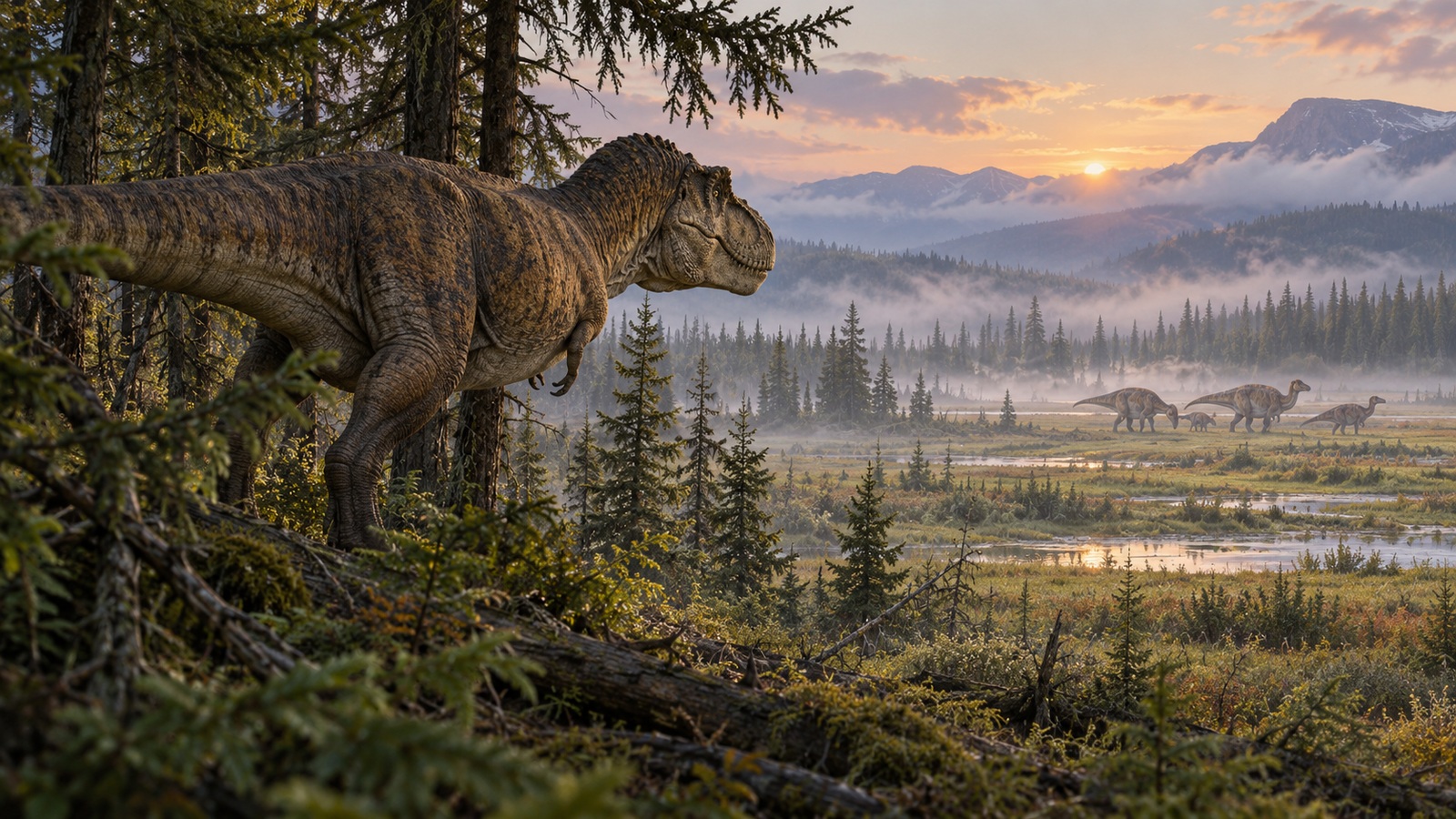
An Edmontosaurus-like animal presented a large body that still had to be brought under control. Unlike a carcass, it could move as the attacker approached and resist after contact. A tail bite placed the tyrannosaur behind part of that body, but it does not reveal whether this position was the original plan or arose during a struggle. The evidence is strongest at the point where the tooth entered and the victim subsequently healed.
Large duck-bills lacked the facial horns of Triceratops, yet that absence did not make them effortless prey. Their mass and ability to move remained important obstacles. A juvenile would pose a different handling problem from a mature animal, so the species name alone cannot describe every encounter. The healed specimen gives a direct attack case; it does not establish that hadrosaurs of one age were always preferred or usually captured.
Horned dinosaurs offered food behind a dangerous front end
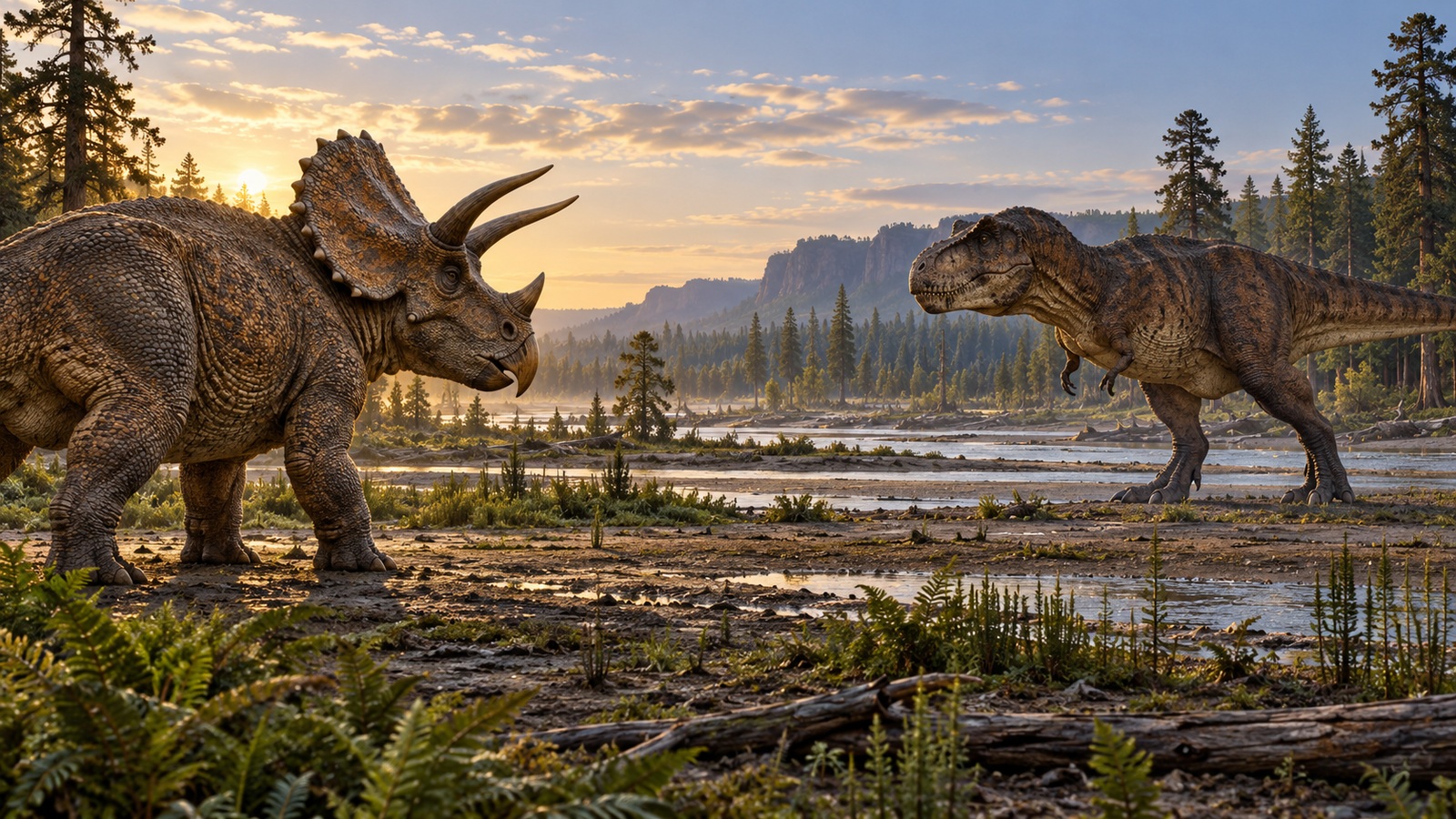
Triceratops belongs on a hunting discussion with a different evidence label. Tooth-marked remains establish feeding, while a skull described by John Happ has been interpreted as preserving a survived tyrannosaur encounter. That reported case includes damage to a brow horn and frill rather than an embedded attacker tooth.
The museum account of this specimen describes deep depressions on the broken horn and denser repaired tissue around frill marks. Attribution relies on the geometry of the damage and comparison with possible teeth. It is informative evidence for assessing live contact, but it is less direct than a tooth still sealed within healing bone.
The difference matters to the proposed hunt. A living adult carried substantial horns at the front, so a frontal approach offered a particular physical hazard. Feeding on a dead Triceratops did not require overcoming those active defenses. Both can leave tooth traces, making the state of the bone and its biological response essential parts of the interpretation.
Armored dinosaurs complicate the idea of an easy menu
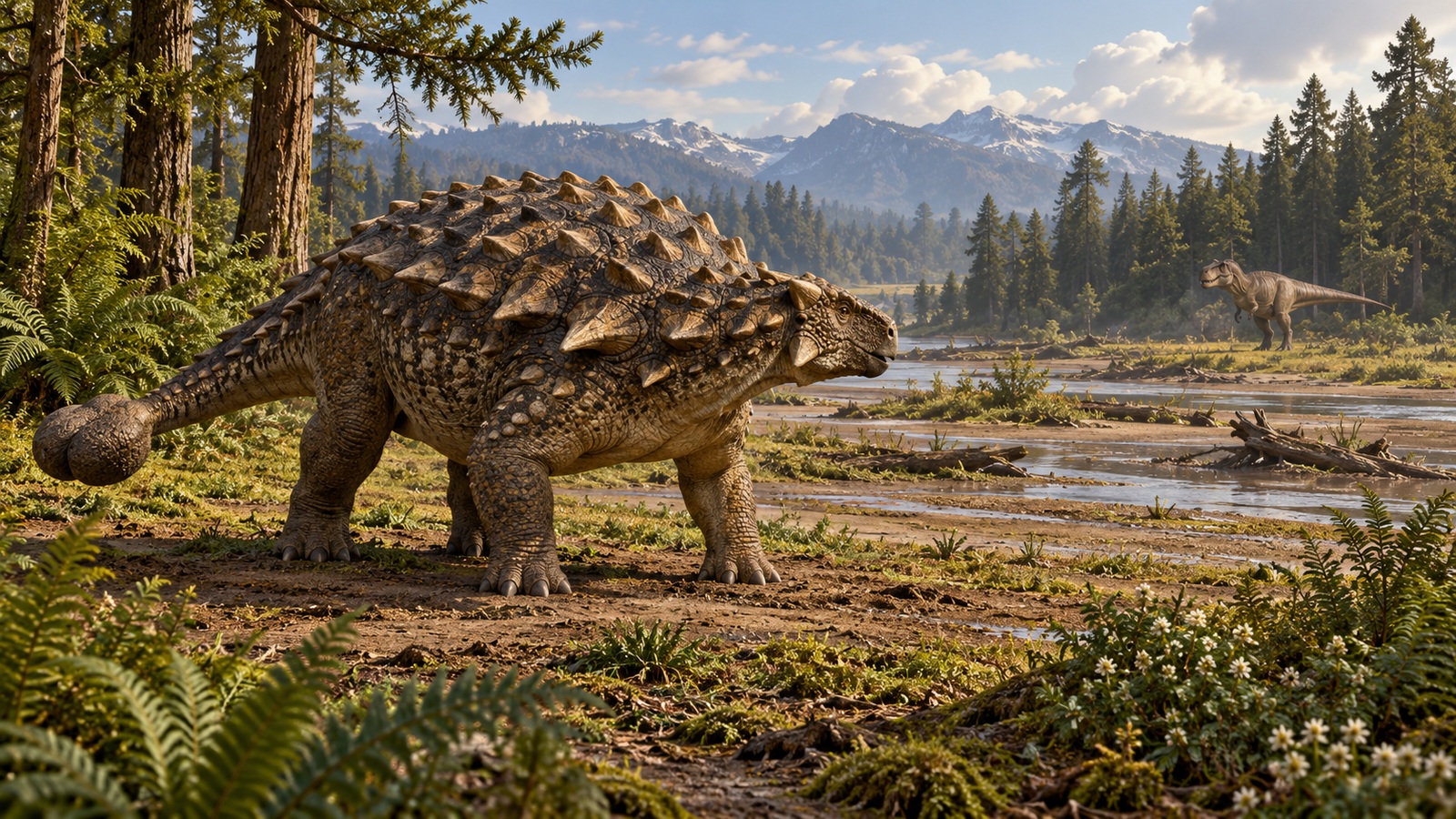
Ankylosaurs add another possible source of food to the community, but their low bodies, bony armor, and, in some forms, tail clubs change the mechanics of an attack. Coexistence alone does not establish how commonly Tyrannosaurus pursued them. A predator might have encountered a vulnerable young animal or a carcass under circumstances very different from confronting a healthy adult. Assertions that it routinely flipped armored prey need direct support rather than repetition from entertainment. The correct ecological category is an animal worth evaluating in context, not a guaranteed meal or an untouchable fortress. Its defenses affected access, and their consequences depended on a real encounter.
A juvenile Tyrannosaurus was not a smaller adult in every respect
The proportions of young tyrannosaurs differed from those of fully mature individuals. Growth changed the skull, teeth, limbs, and overall mass, potentially altering what kinds of targets were practical. A young animal could not be assigned adult performance merely by shrinking the adult’s outline. Its ecological opportunities also depended on its own energetic needs and vulnerability.
Research describing feeding traces attributed to a juvenile Tyrannosaurus illustrates how marks can investigate behavior during growth. Such evidence concerns what the animal did to remains, with limits on whether the prey was killed or found. Small tyrannosaur identifications have also changed, so assigning an isolated feeding event specifically to a juvenile T. rex requires anatomical and taxonomic support. It helps make the growth-stage comparison tangible without supplying a complete juvenile hunting repertoire. More specimens are needed to distinguish occasional behavior from a persistent pattern.
A prey comparison therefore needs ages on both sides. A small tyrannosaur approaching a young hadrosaur presents a different handling problem from an adult confronting a full-grown duck-bill, even though the species labels could look identical in a menu. The difference concerns the amount of resisting body the predator must control and the loads its own jaws can apply. Comparing those relationships is more useful than assigning every age one favorite prey species. It also identifies what additional discoveries would help: feeding traces attributable to a particular growth stage, together with enough of the bitten animal to assess its size.
Detecting a possible meal did not guarantee closing the gap
Tyrannosaurus skull anatomy supports serious consideration of its sensory abilities, including smell and vision. Those abilities could help an animal find food or assess a potential target before committing. They do not produce a reliable universal distance at which it could detect every living herbivore. Wind, cover, light, and the target’s behavior all affected what information was available.
Popular scenes sometimes portray a stationary person or animal as invisible to Tyrannosaurus. There is no sound basis for turning its vision into a movement-only detector. Recognizing form and position would have been useful in ordinary navigation as well as feeding. A hunting reconstruction should not add a cinematic sensory limitation that the fossils do not establish.
Body mechanics limit stories about spectacular pursuits
A massive biped needed to support its weight, manage balance, and load its limbs during movement. These constraints matter when considering whether a long, high-speed chase was plausible, but exact performance estimates depend on reconstructed mass and soft tissues. Different modeling choices can produce different results. Acceleration, turning, ground conditions, and initial separation also affect an encounter. A lower estimated top speed would not demonstrate inability to hunt, because prey capture has many forms. Conversely, a powerful body does not prove that every target could be overtaken. A defensible scenario explains the relevant assumptions instead of converting one speed estimate into an entire behavioral identity.
Opportunity may have mattered more than a favorite species
A target’s position could change the opportunity without changing its species. An animal already moving away offered a different approach from one facing the predator; a narrow passage could restrict the hunter as much as the target. These are mechanical possibilities, not established tyrannosaur tactics. Their value is in explaining why the outcome cannot be read from body length alone.
The healed hadrosaur case shows the practical result of that uncertainty: a formidable predator made contact, yet the other animal survived. It does not tell us whether the attack stopped immediately or continued. Success also required retaining control after the first bite. That missing transition is a more useful hunting problem than assuming that any contact by a powerful jaw guaranteed a kill.
Cannibalism is documented food, not a demonstrated prey choice
Marked Tyrannosaurus remains document another consumer–food relationship, but they should sit outside a list of confirmed live prey. The 2010 cannibalism study concerns feeding traces on conspecific bones. It does not establish a tyrannosaur deliberately hunting a healthy adult of its own species.
That is not a minor distinction in wording. Calling the remains food describes the observable use of a body; calling the individual hunted adds a claim about how it died. Illness, injury, and many other causes could leave a carcass available. The surviving tooth damage does not choose among all of those origins.
Keeping this case separate makes the direct hunting evidence clearer. The healed hadrosaur cannot be explained only as a dead body visited by a consumer. Cannibalized bone can. One sharp contrast between actual specimens communicates the difference more effectively than assigning T. rex a permanent identity as either a hunter or scavenger.
The surviving evidence is filtered by preservation
Many meals leave no recognizable marks on bone, and many marked bones never become fossils. Soft-bodied prey, small carcasses, and tissue removed without tooth contact can be especially hard to identify later. The resulting record is a sample shaped by feeding, burial, geological survival, collection, and scientific recognition. A commonly reported interaction might be genuinely common, particularly preservable, or both. Equally, absence of a confirmed trace does not establish that an encounter was impossible. Scientists improve the picture by adding specimens and testing how traces form, while avoiding the temptation to turn each gap into a confident invented behavior.
A useful prey list carries evidence beside every name
The short answer is evidence-graded. An Edmontosaurus-like hadrosaur provides direct evidence of a live attack survived afterward. Triceratops provides consumption traces and a reported healed skull case that needs its own attribution assessment. Ankylosaurus is a plausible contemporary, with no basis here for treating it as a confirmed routine kill. Tyrannosaurus remains document cannibalistic feeding rather than a demonstrated hunt.
That is a modest list, but it contains more usable information than a longer collection of imagined victims. The hunter’s anatomy made dangerous bites possible; the prey’s size, defenses, and movement shaped what happened next. The clearest known attack ends with survival long enough for bone repair. A realistic hunting account needs room for that outcome alongside the familiar image of a successful kill.