A dinosaur winter could be dark without resembling today’s polar ice caps
At high latitudes, some dinosaurs lived through seasons when daylight became scarce and food production changed dramatically. Elsewhere, animals encountered heat, unreliable water, or drought severe enough to disrupt an entire community. These settings challenge the familiar picture of dinosaurs inhabiting one permanently warm, lush world. They also require careful reconstruction: a Cretaceous polar forest was not simply modern Antarctica with dinosaurs inserted, and a warm annual average did not eliminate cold nights or seasonal stress. Scientists investigate survival by combining climate evidence, fossils of different life stages, anatomy, and comparisons with living animals. The resulting explanations involve several interacting demands—maintaining useful body temperatures, finding resources, and completing a life cycle—rather than one universal cold-weather or desert adaptation shared by every dinosaur.
A: No. Seasonal variation can be substantial even where the yearly average is relatively warm.
A: It changed the conditions supporting plant growth and the resources available through the food web.
A: It reduces heat exchange but does not remove the need for energy and physiological regulation.
A: They constrain reproduction and development without recording every seasonal response.
A: Different occurrences need not represent the journeys of the same individuals.
A: Several biological and environmental processes can interrupt deposition.
A: Evaporation removes heat by losing water, linking the two budgets.
A: Conditions could prevent successful breeding or the survival of younger stages.
A: A predictable recurring stress and a sudden global disruption impose different demands.
A: It connects a specified exposure and life stage with evidence for a feasible thermal and resource strategy.
Extreme depends on the condition and the animal
A climate can be challenging because of cold, heat, water shortage, seasonal darkness, or combinations of these factors. The same air temperature can also have different consequences for a tiny animal and a multi-tonne adult. Their rates of heat exchange, resource needs, and access to shelter differ. Describing an environment as extreme is therefore the beginning of an explanation, not a complete physiological diagnosis.
Duration matters as much as intensity. A short cold episode, a long cool season, and an entire interval of reduced productivity impose different problems. Conditions can be tolerable briefly yet unsustainable over months. A credible survival hypothesis must fit the length and timing of the challenge as well as its peak severity.
Ancient climate is reconstructed from several independent clues
Associated plants, sedimentary structures, soils, and geochemical evidence help characterize the conditions represented by a fossil deposit. Continental reconstructions establish where a locality lay when the animals lived. These observations provide a climate framework that should not be inferred solely from the dinosaur’s appearance. Independent evidence makes proposed links between anatomy and climate testable.
Each indicator has limits. A plant assemblage may reflect a particular habitat or season, while a chemical signal can be altered during burial. A regional average can also conceal local variation. Researchers evaluate agreement among several indicators rather than relying on one apparently convenient number.
The time represented by a rock unit needs attention too. A formation can span changing environments and many generations of animals. Combining all of its fossils into one unchanging climatic scene can create a false picture. Good reconstructions specify the locality and interval for which the evidence is strongest.
Polar geography imposed a distinctive light regime
High-latitude environments experienced strong seasonal changes in daylight because of Earth’s axial geometry. That constraint existed even when the world was warmer than it is today. A forest could therefore grow during favorable months while its animal inhabitants faced a very different winter light regime. Darkness affected more than visibility: it influenced plant productivity and the resources supported by the wider community. The important question is how an animal maintained its life through those seasonal changes, not merely whether it could withstand a cold afternoon. Reconstructing a polar dinosaur scene requires treating light and temperature as related but separate environmental variables.
A Prince Creek nursery points toward staying through winter
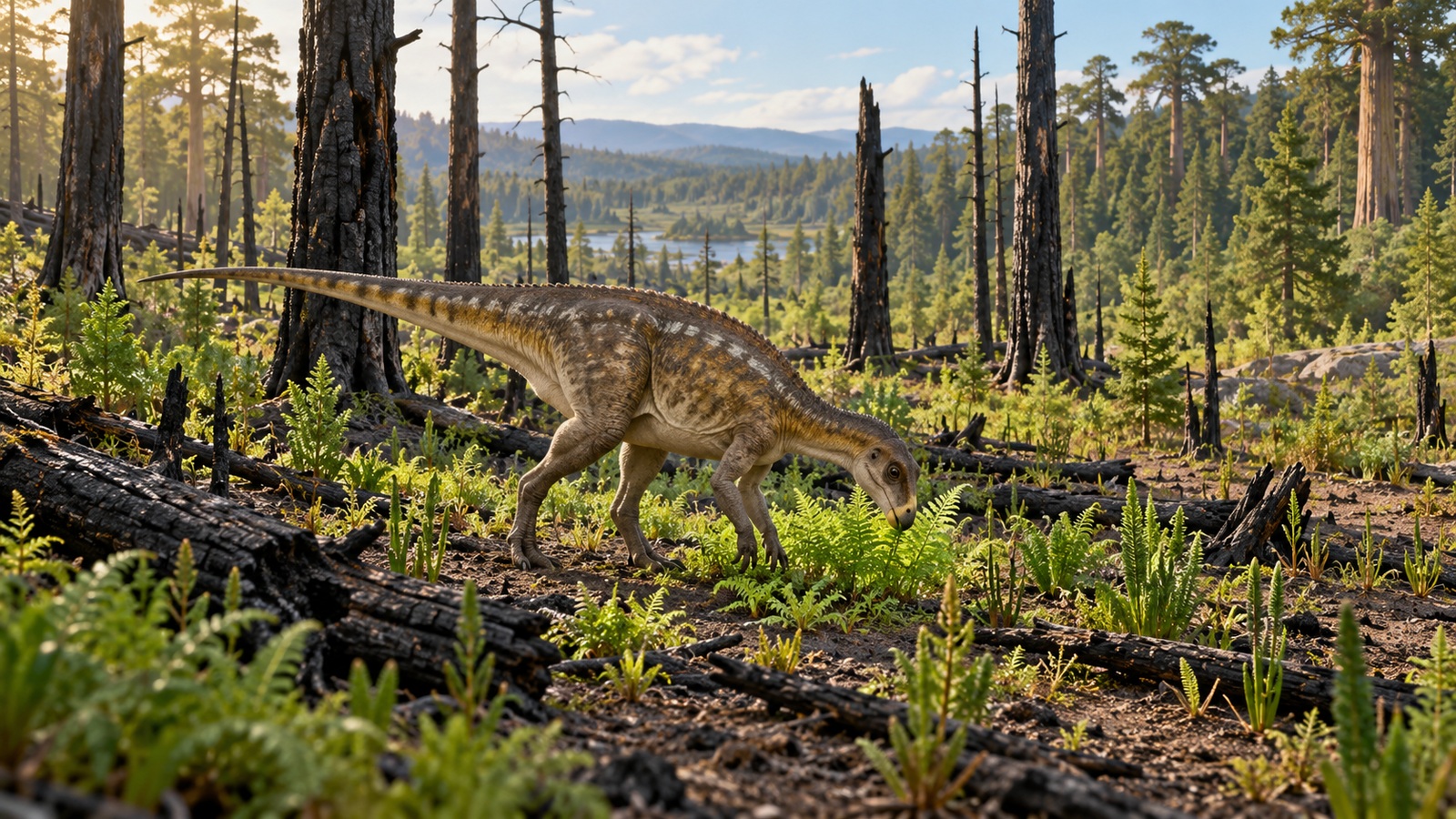
The Prince Creek Formation of northern Alaska preserves a community that lived far inside the Arctic Circle about 70 million years ago. Tiny teeth and bones reported in the 2021 study of perinatal dinosaurs belong to animals near hatching, not simply adults visiting summer feeding grounds. The remains represent several dinosaur groups, including plant eaters and predators. Breeding at high latitude was therefore a feature of a varied community rather than an isolated exception.
The timing makes the discovery especially important. Dinosaur eggs could require months to develop, leaving newly hatched animals little opportunity to grow before the northern winter. The researchers argued that very young dinosaurs were unlikely to complete a long journey to substantially warmer latitudes in the time available. Their evidence supports year-round residence, challenging the idea that migration removed the entire dinosaur community from the Arctic every autumn.
As the University of Alaska Fairbanks account explains, continuous summer light offered a favorable growth season before a much darker winter. Staying locally avoided the travel demands on hatchlings, but required these animals to meet cold-season energy needs where they lived. The fossils establish that important life-history response more securely than they establish a particular winter menu. They do not show that all residents hibernated or that every Arctic dinosaur had the same coat.
Insulation and heat production addressed different parts of the problem
An insulating covering reduces the rate at which heat is exchanged with the surroundings. It does not create an unlimited source of heat. Internal heat production, activity, feeding, and environmental exposure all influence the resulting body temperature. A plausible cold-survival model therefore needs both a thermal balance and a resource balance.
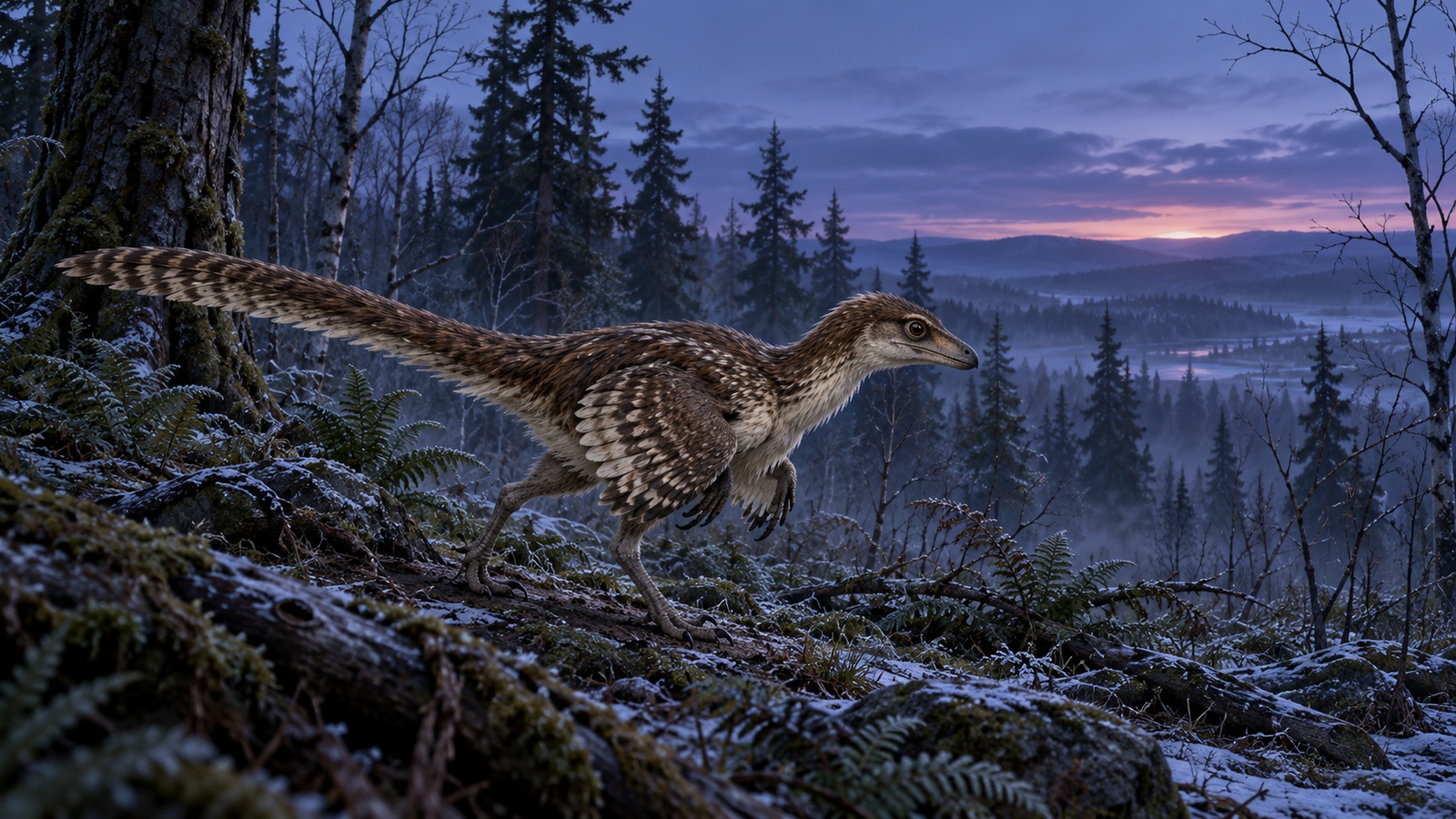
Feathers and other filamentous coverings provide evidence for potential insulation in many dinosaur lineages. Their distribution and structure nevertheless varied, and equivalent preservation is absent for many species. A feathered small dinosaur cannot serve as a direct anatomical model for every large herbivore. Each proposal must fit what is known about the animal’s body.
Body size also changes thermal inertia. A substantial body can change temperature more slowly than a small one under comparable conditions, but that does not eliminate the need for suitable long-term heat exchange. The same inertia that helps buffer a brief cold interval can complicate cooling in another setting. Size is a physical influence rather than a universal solution.
Metabolic reconstruction remains an active research area. Different anatomical, histological, and chemical approaches investigate related but not identical aspects of physiology. Their conclusions should not be collapsed into one simple label for all dinosaurs. The useful ecological task is to evaluate whether a proposed combination of heat production and loss fits the climate and resources under discussion.
Winter food could be as important as winter temperature
An animal capable of maintaining a useful temperature still needed energy and nutrients. Seasonal changes could reduce fresh plant growth, alter food quality, or affect the activity of small prey. A habitat suitable in summer could become much more demanding during a prolonged low-productivity interval. This makes feeding ecology central to climatic survival. Possible responses include using different resources, changing activity, moving within a region, or reducing expenditure, but each specific proposal needs evidence. The physiological ability to stay warm should not be mistaken for proof that a population could obtain enough food throughout a difficult season.
Heat created a different thermal challenge
In warm conditions, an animal must avoid accumulating more heat than it can safely lose. Solar exposure, activity, body size, air movement, and available water affect that balance. The hottest moment is not necessarily the period of greatest food availability. Timing activity and using environmental variation are therefore relevant possibilities when reconstructing heat management.
Evaporative cooling can remove heat but consumes water. Other forms of heat transfer depend on temperature differences and exposed surfaces. Fossils rarely preserve enough physiology to calculate a dinosaur’s exact cooling schedule. A responsible explanation discusses the physical demands without assigning an unsupported panting rate or modern-animal routine to a particular species.
Drought stressed water supply and the food web together
Reduced rainfall can shrink drinking opportunities while also changing vegetation and prey availability. Those effects can reinforce one another. Even where water remains, crowding or poor surrounding forage can create additional difficulties. A large resource-rich landscape in one season need not offer the same opportunities during prolonged drying.
Evidence at Dinosaur National Monument links parts of its Late Jurassic record with drought and subsequent flooding. The National Park Service’s account of the Morrison ecosystem describes the geological observations behind that interpretation. Such deposits document environmental stress as well as the processes that later preserved remains. They should not be read as a normal census of healthy animals living under average conditions.
The distinction matters for survival claims. A drought-associated assemblage can show that some individuals failed to survive an episode, while the wider lineage persisted elsewhere or later. It does not establish universal resistance or universal vulnerability. Ecological reconstruction needs to separate the mortality event from the population history around it.
Migration is a testable proposal rather than a default escape
Seasonal movement can connect resources across a landscape, but the route must be physically and ecologically plausible. Distance, travel time, terrain, breeding, and juvenile capabilities all matter. An attractive map arrow is not independent evidence that a dinosaur completed the journey.
Researchers may investigate movement through isotope records, geographic distribution, or other observations, with each method requiring careful interpretation. Presence at several localities does not automatically show the same individuals moved among them. A proposal for a particular species must fit the relevant time interval. Long-distance migration, regional movement, and remaining within a varied local habitat are distinct possibilities.
Hibernation claims require more than a quiet-looking fossil
A fossil skeleton does not directly record an extended lowered metabolic state. Growth interruptions can have several causes, and a resting posture may be unrelated to a full seasonal strategy. Living animals demonstrate that reduced activity can take many forms, so a vague analogy can hide substantial biological differences. A hibernation hypothesis needs evidence appropriate to the physiology, duration, and environmental context being proposed. Without that support, it is more accurate to describe possible reductions in activity or expenditure than to announce that a dinosaur slept through winter in a specific modern manner.
Survival in one harsh setting did not guarantee resilience to every crisis
A lineage could persist through recurring seasonal difficulty while remaining vulnerable to a sudden disruption of food supplies or breeding conditions. Frequency and predictability influence which responses are useful. An animal coping with a familiar winter had not necessarily evolved a response to an abrupt global catastrophe.
Similarly, an adaptation suited to one kind of stress could create limitations under another. Retaining heat, storing resources, or relying on a seasonal food source could become less useful if the environmental pattern changed. These tradeoffs prevent climatic tolerance from being summarized as simple toughness. Successful survival always depends on the particular conditions and their timing.
Find the vulnerable stage in the complete life cycle
Eggs, hatchlings, juveniles, and adults did not share identical thermal or resource requirements. A population’s distribution could therefore be limited by a stage that was less conspicuous than its largest adults. Reproduction and early growth must be included when evaluating a proposed climate range. Adult anatomy alone cannot establish that a complete population could sustain itself.
This is why small fossils and nesting evidence can matter so much in polar research. They connect climatic interpretation with development rather than simply adding another adult occurrence to a map. Their preservation is uneven, however, so absence needs careful evaluation. The strongest explanation combines direct life-stage evidence with an independently reconstructed environment.
A complete model must also account for the transition between seasons. Recovering from winter, reproducing during a favorable interval, and preparing for the next difficult period can impose their own demands. Survival is not only the ability to endure one isolated extreme. It is the ability to maintain a population across the sequence of conditions that returns year after year.
A range of strategies fits the diversity of dinosaur climates
Dinosaurs survived challenging climates through combinations that probably varied among lineages and places. Body coverings, size, physiology, movement, resource use, and local environmental opportunities all deserve investigation. The evidence for each component is uneven, and some proposed behaviors remain unresolved. That diversity is more realistic than one universal polar dinosaur or desert survivor.
The clearest accounts begin with the actual stress, its duration, and the life stage affected. They then connect anatomical and fossil evidence with a physically plausible response. Polar reproduction, seasonal darkness, drought deposits, and thermal constraints each contribute a different part of the picture. Together they reveal dinosaurs living within environmental limits, rather than escaping those limits through a single extraordinary adaptation.