Living successfully required more than matching a dinosaur to a landscape
A small dinosaur stepping into shelter could change its immediate surroundings without changing its inherited anatomy. The burrow might reduce exposure, while its body already carried the structures needed to move, feed, sense danger, and reproduce. Both behavior and physical traits helped dinosaurs meet environmental demands, but they worked on different timescales. An individual could choose a place to rest; evolutionary changes in a population accumulated across generations. Fossils preserve only parts of those processes, so convincing accounts connect a proposed advantage with anatomy, trace evidence, and the habitat actually present. Dinosaurs occupied a remarkable range of environments because different lineages combined workable feeding systems, body designs, coverings, and behaviors. Their adaptations were varied solutions to particular problems, rather than equipment assembled for an imagined perfect prehistoric world.
A: No. An individual's choice and population-level evolutionary change occur through different processes.
A: Yes. Mechanical, protective, or signaling roles can overlap and require separate tests.
A: Firm ground, narrow passages, and soft banks can favor different movements within one regional climate.
A: Avoiding detection could still provide benefits even when an animal possessed physical protection.
A: It can create a local microenvironment, although construction and access still depend on the animal's capacities.
A: Reproduction may require conditions that the adult itself does not need throughout the year.
A: Related animals can modify behavior and proportions while retaining inherited structural features.
A: History, constraints, and overlapping functions can prevent such a simple explanation.
A: Independent reconstructions make their proposed ecological match a test rather than a circular assumption.
A: Its effects depend on available resources, physical conditions, and the rest of the animal's biology.
An environment presents several problems at once
Food, water, physical space, temperature, competitors, predators, and opportunities to reproduce all contributed to a dinosaur’s surroundings. A feature that helped with one problem could influence several others. Large body size might change access to resources and the risks posed by attackers, while also increasing the amount of food required. No useful trait operated independently of the rest of the animal.
Habitats also varied within a region. A river margin, wooded slope, exposed flat, and sheltered channel could offer different conditions over short distances. An animal did not necessarily experience the average climate represented in a broad regional reconstruction at every moment. Habitat use could therefore change exposure without requiring an evolutionary transformation each time the dinosaur moved.
The best starting point is a specific challenge. Asking how an animal could collect vegetation, protect exposed tissues, or use shelter creates a question that fossils might help test. Describing every conspicuous feature as useful in some unspecified way is less informative. An adaptation claim needs a proposed function and evidence connecting that function with the relevant environment.
Inherited adaptation differs from an immediate response
In evolutionary biology, an adaptation is a trait shaped through selection because it contributed to success under relevant conditions. Individuals within populations varied, and some inherited variants left more descendants than others. This process did not require dinosaurs to anticipate the future or consciously redesign their bodies. It acted through differences already arising across generations.
Behavioral choices belonged to the animal’s lifetime. Moving into shade or changing where to feed could alter conditions quickly, whereas a population’s inherited proportions changed through a different process. Development and physiological adjustment introduced further possibilities. Keeping these categories separate prevents a short-term response from being described as the sudden evolution of a new species.
A feature’s function must be tested against alternatives
A broad structure might assist feeding, display, defense, or several activities. Its appearance alone cannot settle which role was most important during its evolutionary history. Researchers examine mechanical performance, distribution among relatives, growth patterns, and the setting in which the animal lived. Direct traces can be especially valuable when anatomy permits several plausible uses. The question is not merely whether an imagined function could work, but whether the available evidence makes it a convincing explanation compared with alternatives. Some traits may also have acquired additional uses after their initial evolution.
Food acquisition linked the body to local resources
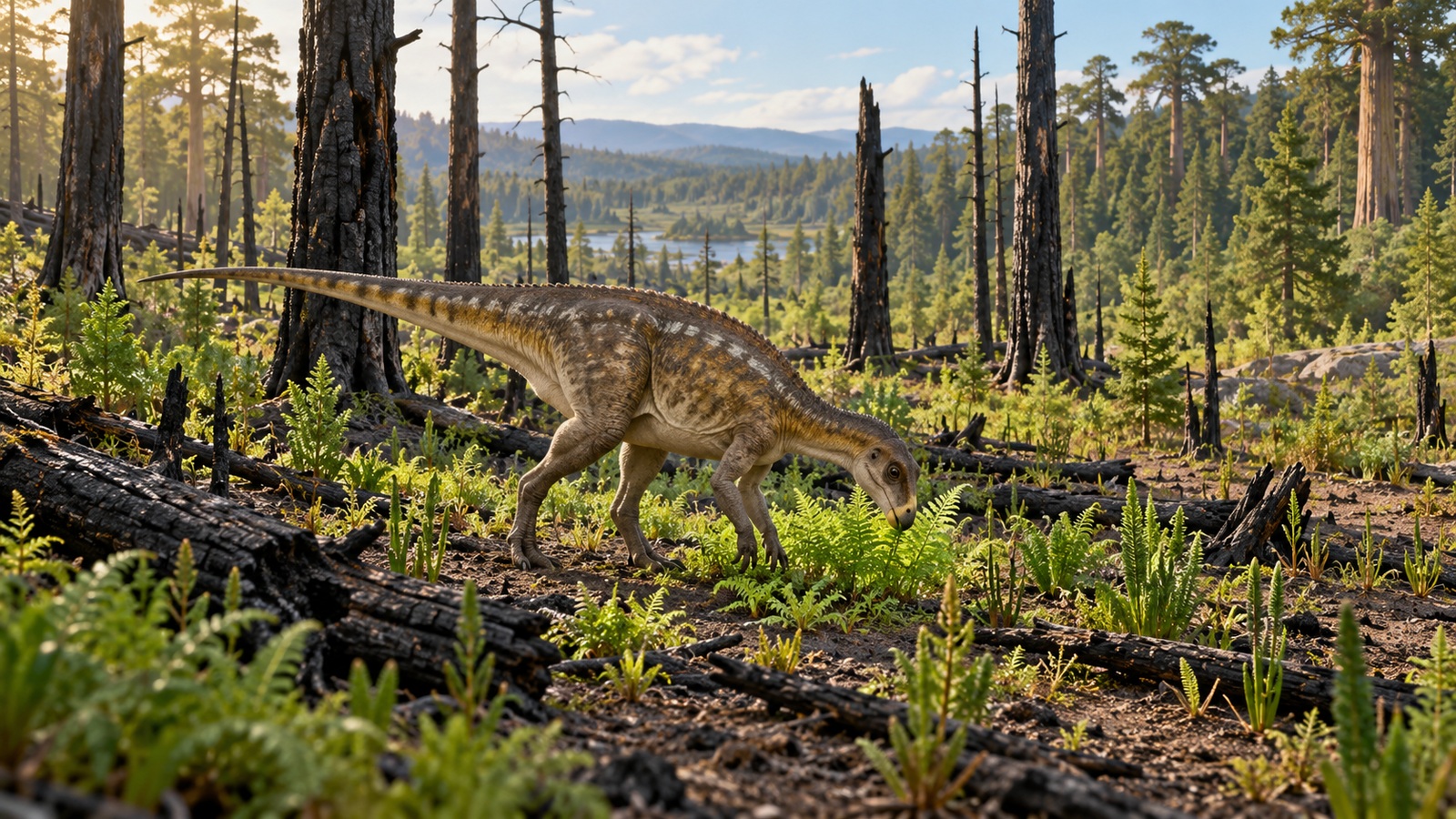
Nigersaurus offers a concrete feeding adaptation: its unusually broad muzzle placed a row of cutting teeth across the front of the jaws. The original detailed anatomical study interpreted this lightweight apparatus as suited to gathering and slicing relatively soft, low vegetation. A wide gathering edge could contact a broad strip of plants, while successive replacement teeth kept the working edge supplied as exposed crowns wore down. Feeding involved both getting food into the mouth and maintaining equipment used repeatedly.
This is a more precise environmental match than assuming every long-necked dinosaur browsed treetops. Nigersaurus could use the reach of a sauropod body in a low feeding zone, with a mouth unlike the heavy processing apparatus of some other herbivores. Its anatomy constrains the kind of handling performed; it does not identify every plant swallowed. Plant fossils and sediments provide the separate evidence needed to reconstruct its available resources.
Flexibility could be useful when resources varied, while specialization could improve performance on a relatively reliable resource. Neither strategy was automatically superior. A specialized structure might become less valuable if conditions changed, but broad flexibility could carry its own compromises. Ecological success depended on the fit between the whole feeding strategy and the circumstances.
Shelter shows how behavior could expand usable habitat
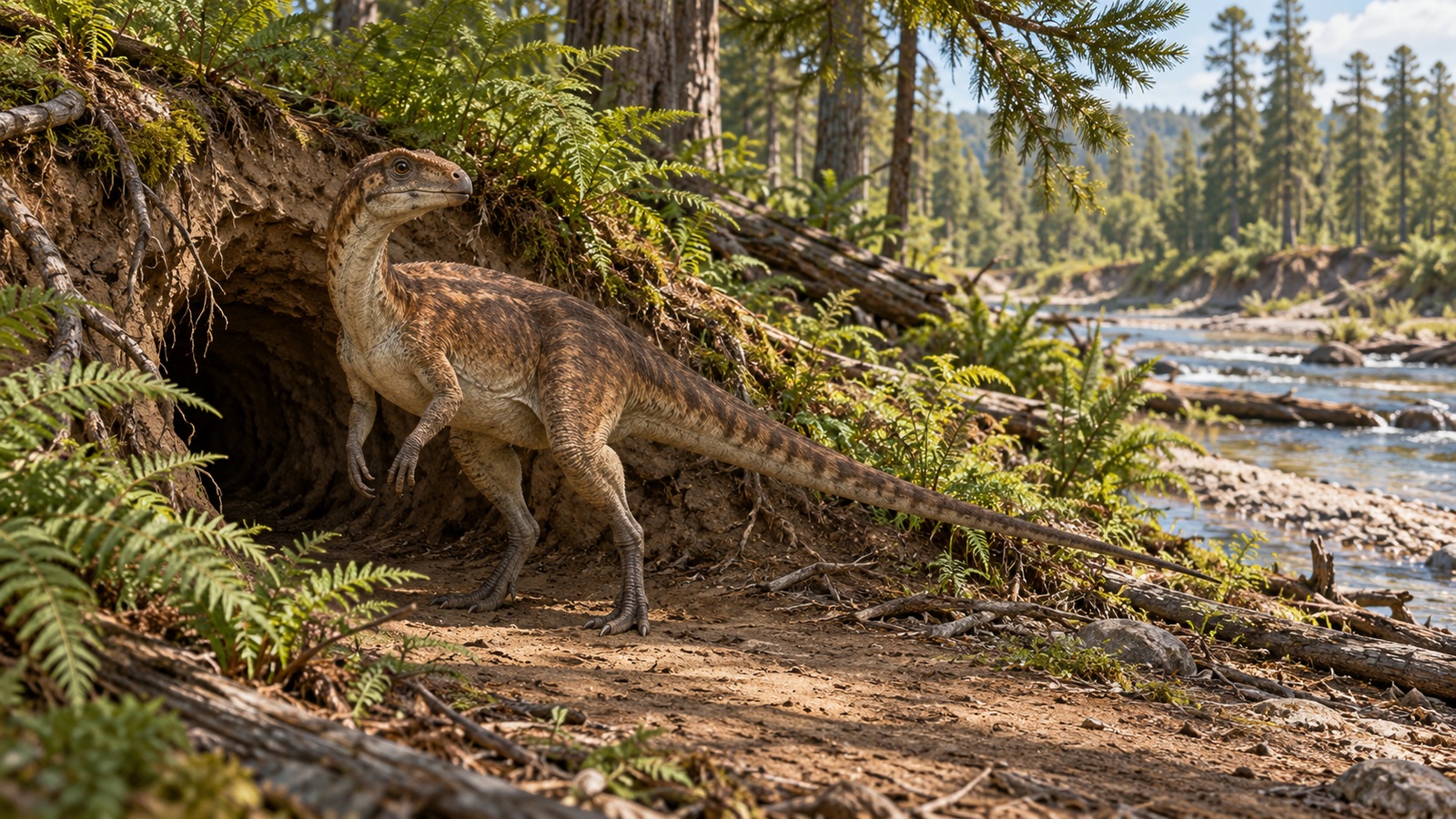
The original Oryctodromeus discovery placed an adult and two juveniles within the expanded end chamber of a sediment-filled burrow in Montana. The tunnel’s dimensions fitted the adult’s body, and skeletal features supported digging rather than simple accidental occupancy. This connected an animal with an actual constructed space. The combination was stronger than either a suspiciously rounded sediment patch or a dinosaur skeleton alone. It showed a small running herbivore using an underground setting that most familiar dinosaur scenes omit.
The significance is specific. A burrow can create conditions different from those on the exposed surface, but one case does not establish that every small dinosaur lived underground. Nor does it prove which threat caused a particular individual to enter. The preserved structure supports the behavior more securely than a complete account of its daily use.
Shelter also illustrates why physical traits and behavior interact. Limbs and the rest of the body must make construction or access possible, while the shelter changes the environment experienced by that body. A useful refuge would still impose costs of construction, maintenance, or restricted access. Those costs belong in an ecological explanation rather than being omitted from a story about a clever solution.
Burrowing is not the only possible way to exploit local variation. Vegetation cover, uneven terrain, or the protected side of an obstacle could also alter exposure. For a particular extinct dinosaur, however, such behaviors require their own evidence before being presented as established routines. Plausibility helps formulate a hypothesis; a trace or repeated association helps test it.
Camouflage connects appearance with a viewing environment
Color can influence how an animal is detected, but reconstructing that relationship requires exceptional evidence. Skin structures, pigment-related remains, and their distribution can constrain aspects of appearance. Lighting and the observer’s viewpoint then affect whether a pattern could reduce visibility. An attractive pattern in artwork is not itself evidence of an adaptation. Scientists must distinguish recovered information from the artist’s choices, particularly when interpreting an incomplete surface or a pattern extrapolated to missing regions.
An armored dinosaur provides a detailed case rather than a universal rule
Research on Borealopelta used exceptional preservation to investigate coloration alongside substantial body armor. The proposed countershading pattern meant a darker upper surface and a lighter underside. Under light coming mainly from above, that arrangement can reduce the contrast between an illuminated back and a naturally shaded belly, making the body’s rounded shape less conspicuous. It connects a particular pigment distribution with a physical lighting problem, rather than simply calling any mottled dinosaur camouflaged. Its importance lies partly in the combination: physical protection did not necessarily eliminate the value of being less conspicuous. Different kinds of protection could contribute to the same animal’s survival.
That interpretation should not be transferred automatically to every armored dinosaur. Other species may have differed in appearance, size, behavior, or habitat, and equivalent pigment evidence may be absent. The case shows how a functional proposal can be linked to a particular fossil. It also highlights why environmental adaptation needs specimen-level observations as well as general ecological reasoning.
Body coverings could serve more than one purpose
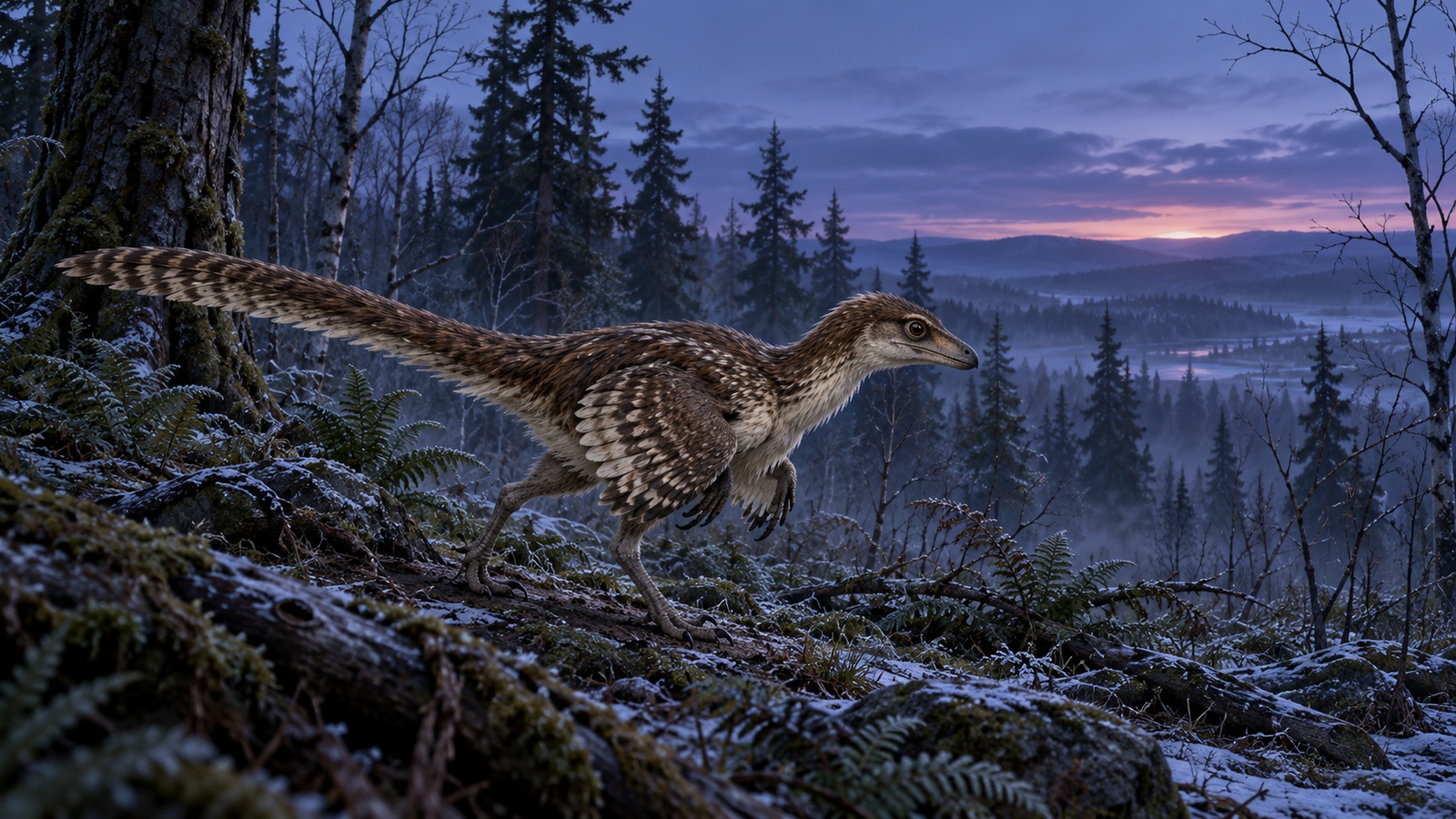
Yutyrannus makes the thermal problem visible on a large predator. Three skeletons described in the 2012 study preserve long filamentous feathers from Early Cretaceous China. Such a covering could retain air beside the body and slow heat loss. The important contrast is with a bare reconstructed skeleton: a living animal’s exterior changed its exchange with the surrounding air, as well as its outline.
Preservation establishes that this large tyrannosauroid bore feathers, while insulation is a functional interpretation of that covering. It does not require the feathers to have had only one use. A visible surface could also contribute to display, and its usefulness depended on distribution and structure. The fossil replaces a generic claim that feathers were solely flying equipment with an actual large-bodied, feathered animal.
Size further changes the relevance of insulation and heat exchange. A large body stores and exchanges heat differently from a small one, so an identical covering could have different consequences. Physiology, activity, and available shelter also matter. These interacting factors make simple claims that all dinosaurs used one thermal strategy unreliable.
Movement determined which parts of a habitat were accessible
The Oryctodromeus burrow also connects body dimensions with access. A refuge was useful only if the animal could enter and move through its tunnel, so the fit between the adult and the preserved passage matters alongside evidence of digging. Above ground, that same small body faced different openings and obstacles from a giant sauropod. Reach, clearance, and the space required to turn determined which food patches or shelters were physically available. Locomotor adaptations therefore affected the portion of a landscape an animal could use, even within one broad climate.
Reproduction created a separate set of environmental demands
An adult might tolerate conditions that were unsuitable for eggs or newly hatched young. Nesting therefore introduced requirements involving substrate, moisture, temperature, and the safety of a breeding site. Reproductive success depended on more than the adult’s ability to feed and travel. A population could be limited by a stage that occupied a relatively small part of the landscape.
The American Museum of Natural History’s Citipati example preserves an adult over its eggs in a brooding posture. This links a particular dinosaur body with an arrangement used during reproduction, rather than leaving the nest as an empty patch of ground. Adult attendance offered a way to interact with the eggs’ immediate surroundings. The posture supports brooding, although it does not by itself measure how much heat passed between adult and clutch.
The different needs of life stages also complicate a simple label such as forest-adapted. Adults and young could encounter different resources and risks within the same broad setting. Their degree of ecological separation requires evidence rather than assumption. Adaptation is best evaluated across the life cycle, not solely through the anatomy of a large adult mount.
Every workable solution involved constraints
Inherited anatomy limited which evolutionary changes were readily available, while physical demands limited which combinations could function. Increasing investment in one structure could affect weight, development, or resource requirements elsewhere. A trait could remain useful without being the best conceivable solution to every problem. Evolution worked with existing organisms rather than designing them from scratch.
This helps explain why related dinosaurs could retain recognizable body plans while occupying different environments. Change often involved modifying proportions or behavior within an inherited framework. The resulting fit was contingent on the lineage and circumstances. Calling an animal adapted should not imply that it was invulnerable to competition, disease, or further environmental change.
Reconstruct the habitat before explaining the match
The modern place where a fossil is found may look nothing like its ancient environment. Rock deposited in a wooded floodplain can now be exposed in dry badlands, and continents have moved since the animal lived. Sedimentary structures, associated fossils, pollen, and geological relationships provide the appropriate evidence for reconstruction. A modern desert landscape cannot be used as the sole reason to describe its fossil dinosaurs as desert specialists. The environmental model and the anatomical model must be developed independently enough that their apparent agreement is meaningful.
Adaptation is strongest as an explanation with a test
A useful account identifies the challenge, the proposed trait or behavior, and observations that could support or weaken the explanation. Direct traces such as a burrow can connect behavior with a physical setting, while exceptional skin preservation can connect appearance with a concealment hypothesis. Other proposals remain less securely constrained. Recognizing those differences helps readers evaluate evidence without dismissing everything that cannot be observed directly.
Dinosaurs adapted to their environments through varied combinations of inherited structure, physiological capacities, and behavior. Their success was local and conditional, spanning different habitats and different life stages. The most informative examples explain why a particular feature could matter in a particular setting. They replace the idea of a universally equipped prehistoric survivor with a more realistic picture of animals making workable lives within real constraints.