T. rex was a sensory specialist, with no established human-style intelligence score
Tyrannosaurus rex had a relatively substantial brain for a giant nonavian dinosaur, enlarged smell-related structures, and an inner-ear system suited to coordinating a large moving head. That combination supports an effective animal gathering information and responding to its surroundings. It does not establish the monkey-like reasoning sometimes claimed in headlines. Brain-size comparisons and disputed neuron estimates address different levels of the problem, while fossils rarely reveal what one individual learned. The most useful answer therefore explains the positive anatomy first: how smell, orientation, and the proportions of brain regions fit this particular predator. Comparisons with earlier relatives such as Timurlengia show that part of the sensory equipment evolved before tyrannosaurs became enormous. Together these findings replace the caricature of a mindless giant without turning the animal into a prehistoric human in a different body.
A: No. The braincase was a particular posterior compartment within a much larger, multi-system head.
A: It could guide an animal toward a previously useful area before a current food signal arrived, although that particular memory is not preserved in a braincase.
A: No. It is an earlier related tyrannosauroid used in evolutionary comparisons.
A: Keeping the visual scene usable as the head and body move helps coordinate travel and contact with objects.
A: Air movement and nervous-system processing are different parts of a sensory pathway.
A: Individuals could encounter different conditions, but the fossil anatomy does not preserve a complete record of what each learned.
A: Timurlengia indicates that important braincase and hearing-related features appeared at a smaller body size before the latest giants.
A: No. An enlarged olfactory system identifies an emphasis, while the animal also received visual, auditory, and bodily information.
A: It informs evolutionary context without demonstrating the same activity in every descendant.
A: Both labels compress varied anatomical evidence and untested learning capacities into a single unsupported judgment.
The braincase was one compartment within a much larger skull
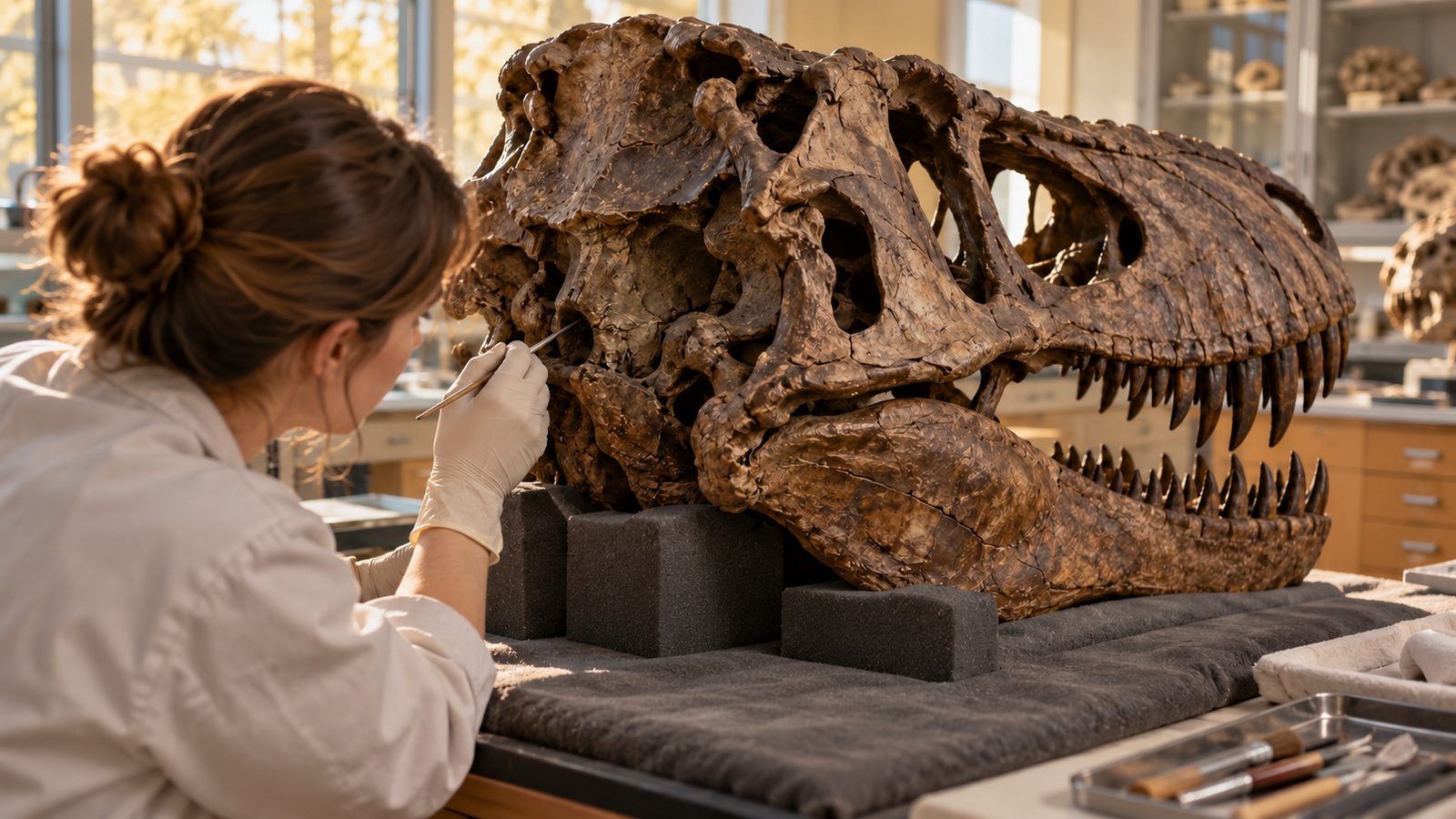
A tyrannosaur head contained far more than a brain. The jaws, tooth roots, muscles, nasal passages, air spaces, eyes, and supporting bones occupied substantial volume. Comparing the nervous system with the outer silhouette of the head can therefore create a misleading impression. The relevant anatomy lies in a particular protected region, not in every space behind the teeth. Identifying that region is the first step toward describing its contents and connections. A study of intelligence built only around the dramatic size of the skull begins with the wrong measurement.
A working brain connected perception with controlled action
A brain coordinates information from the eyes, nose, ears, and body. For T. rex, those demands included keeping a heavy head stable while walking and directing the mouth during feeding. A large skull was therefore only part of the story. The nervous system had to connect perception with controlled movement.
CT scans reveal the cavity and passages surrounding that system. The resulting endocast is a model of the space, not a recovered brain. Nerves, blood vessels, and membranes also occupied the head, making the fit between cavity and living tissue an important part of the reconstruction.
This anatomy gives the intelligence discussion a firmer foundation than a personality imagined from the animal’s appearance. A large smell-related region is positive evidence of sensory investment. A carefully located nerve passage helps explain which structures were connected. Neither observation is a direct test of memory, but both tell us more than the size of the external skull alone.
Smell provides one of the clearest sensory themes
Tyrannosaur research has repeatedly drawn attention to the olfactory apparatus. The combination of neural structures and anatomy associated with the nasal region supports an important role for smell. This is a stronger conclusion than reconstructing a precise maximum detection distance. Odor movement also depends on wind, source strength, terrain, and the animal’s position.
Comparative work on theropod olfactory ratios placed tyrannosaurids among groups with substantial olfactory investment relative to the sampled comparison. That finding helps frame ecological hypotheses about locating resources or navigating surroundings. It does not divide the animal into an exclusive hunter or scavenger category. Either behavior could benefit from useful chemical information.
Information quality depended on the entire sensory pathway
Consider an odor reaching an animal before the source is visible. The nose receives chemical information, and the nervous system must distinguish relevant signals from the surrounding mixture. Finding food is one possible use; responding to another tyrannosaur or orienting within a familiar area offers others. Olfactory investment therefore supports a range of useful activities rather than deciding whether every meal was hunted.
Vision supplies different information about the same source. The broad-backed Tyrannosaurus skull left useful forward sight lines, potentially helping it locate an object more precisely once it came into view. A visually identified branch, carcass, or moving animal presents different motor demands. The head and body then have to respond without losing balance.
This sequence explains why sensory specialization and general intelligence should not be collapsed together. Detecting a weak cue can depend on specialized anatomy, while learning which cue predicts a useful outcome involves experience. A fossil can support the first more directly than the second. That is a distinction between two real biological capacities, not a reason to dismiss either.
It also makes room for errors. Wind can shift an odor, vegetation can conceal an outline, and a moving target can change direction. Even a well-equipped predator needed to update its actions as information changed. The fossils reveal the equipment for that work more securely than its success on every occasion.
The inner ear adds evidence about a moving head
The semicircular canals in the inner-ear region sensed head rotation, contributing to balance and stable gaze. Witmer and Ridgely’s 2009 tyrannosaur study connected the reconstructed braincase and ear with coordinated eye and head movement. This is a useful positive result for an animal carrying a large skull above the ground: maintaining a workable view while the body moved was part of normal feeding and travel. It does not make the canals an intelligence meter. Coordination and learning interact during behavior, but the preserved geometry principally informs the sensory and control system.
Brain size requires a reconstruction before a comparison
Brain size becomes meaningful only in relation to the body and the reference animals. A giant needs neural tissue for a giant body, so a large absolute brain does not automatically imply a greater capacity to learn. Conversely, the old image of T. rex as a huge body controlled by almost no brain is misleading. Its relative brain size was substantial among many nonavian dinosaurs.
Hurlburt, Ridgely, and Witmer’s 2013 comparison placed T. rex above many adult nonavian dinosaurs in relative brain size, while certain smaller bird-related theropods remained higher. Their estimates still fell within the living nonavian reptile range under the method used, rather than the typical bird range. Alligator brain-to-cavity relationships supplied a calibration, not a complete behavioral substitute. The result provides a measured anatomical comparison without crowning T. rex the cleverest dinosaur or declaring its mind identical to an alligator’s.
The neuron debate highlighted several links in the inference chain
Recent arguments about Tyrannosaurus cognition have used estimated forebrain dimensions and comparisons with living animals to propose numbers of neurons. Those calculations require assumptions about how much neural tissue was present and how densely cells were packed. A numerical result can look exceptionally precise while retaining uncertainty at each preceding step. The cells themselves are not being counted in ordinary fossil braincases.
A 2024 reassessment challenged both reconstruction choices and the behavioral conclusions drawn from those estimates. Subsequent discussion, including a 2026 critical outlook, also examined what researchers mean by cognition and how it can be compared. The disagreement is not resolved by replacing one mammal nickname with a different living-animal stereotype. It concerns what the available measurements can establish.
For readers, the central lesson is to separate the stages. A reconstructed cavity, an estimated amount of neural tissue, a proposed cell count, and an inference about learning are not interchangeable observations. Each needs its own support. Collapsing the sequence into a headline about a brainy giant hides the very scientific work that makes the problem interesting.
Learning was a biological possibility rather than a preserved test result
A functioning predator had to respond effectively to changing surroundings, but fossils do not show exactly how much an individual learned during its lifetime. Useful experience could affect movement, encounters, or resource use without resembling human reasoning. Equally, a behavior that looks complex to us might include substantial inherited organization. Anatomy alone rarely separates those contributions. The appropriate research task is to identify specific capacities that can be investigated, rather than infer an entire personality from a skull. This keeps plausible ecological competence distinct from untested claims about elaborate planning.
Relatives show that sensory organization and giant size were not one event
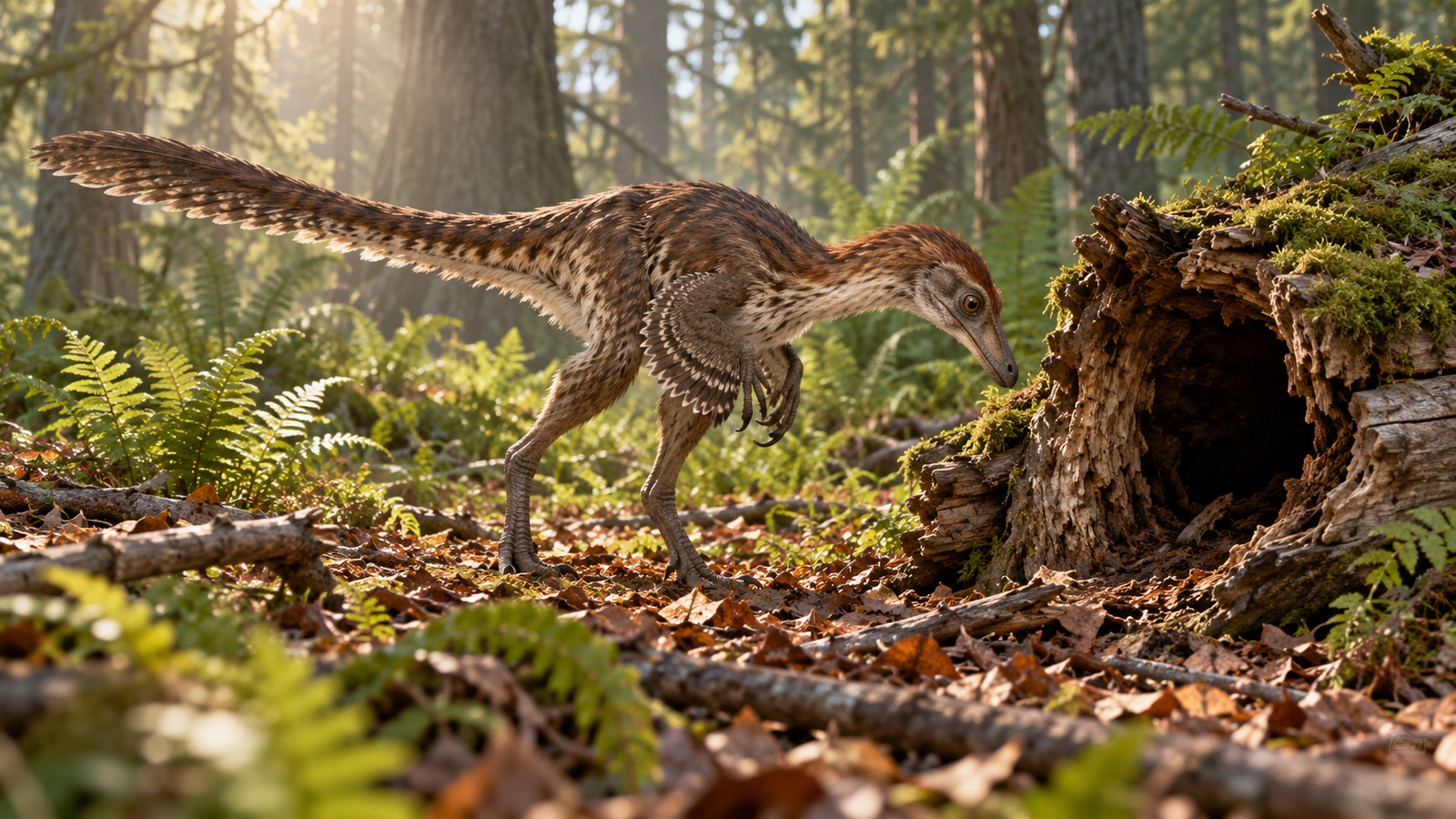
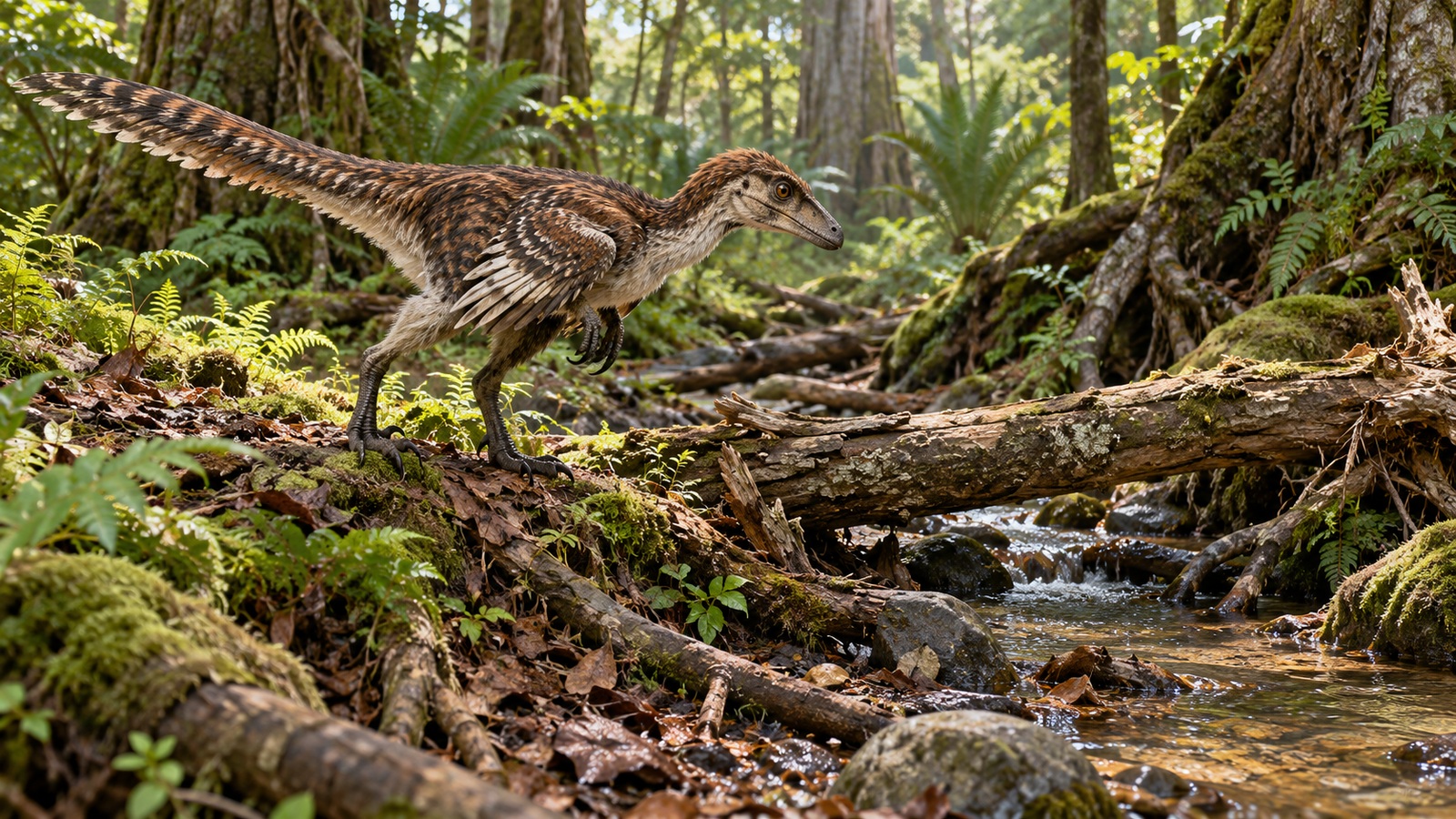
Timurlengia euotica lived in what is now Uzbekistan about ninety to ninety-two million years ago, before the enormous latest Cretaceous tyrannosaurids. It was a much smaller animal than adult T. rex. Its braincase therefore lets researchers ask whether the later giants acquired their sensory organization only as their bodies became huge.
Brusatte and colleagues’ 2016 study found a derived braincase and elongated cochlear duct, interpreted as evidence of advanced hearing capabilities at that earlier, moderate body size. The anatomical combination suggested that important sensory changes preceded the later evolution of gigantism. Timurlengia was not a juvenile T. rex, and the study did not give either animal a learning score. Its contribution is a concrete evolutionary sequence: some of the equipment appeared before the giant body that made Tyrannosaurus famous.
An individual history was more than the species’ brain anatomy
A Tyrannosaurus population contained individuals with different histories, just as living populations do. A healed injury shows that one animal survived a physical event; it does not show exactly what the animal remembered afterward. Repeated use of a feeding area could involve learning, but a single skeleton does not record its route through the landscape.
This makes the distinction between capacity and biography useful. The species’ sensory anatomy supplied possibilities available to an individual. Experience could affect how those possibilities were used, yet fossils rarely separate a practiced response from an inherited tendency. It is reasonable to reconstruct an animal responding effectively without inventing a detailed lesson it had learned.
Growth adds another source of variation. A young tyrannosaur and a mature adult had different proportions, available forces, and ecological opportunities. An adult braincase cannot serve as a complete map of every earlier stage. Understanding the animal’s mind therefore involves a life history as well as the anatomy of one large skull.
Other fossils provide context that a braincase cannot
Feeding damage, healed injuries, footprints, and environmental evidence document aspects of tyrannosaur life outside the skull. They can constrain which behaviors were physically possible or actually occurred. Their contribution is complementary rather than a replacement for neuroanatomy. A feeding trace, for example, can establish contact without describing the consumer’s knowledge.
Combining independent observations is useful when each keeps its proper scope. A plausible sensory reconstruction may help explain how an animal gathered information during an encounter, while a trace fossil documents one part of that encounter. Neither supplies its thoughts. A coherent account can connect the evidence without filling every gap with a story.
Living relatives clarify what a learning claim would mean
Living birds and crocodilians show that archosaur nervous systems support learning and flexible responses, but the exact performance varies with species and task. This makes learning biologically plausible for T. rex without specifying how rapidly it mastered an unfamiliar problem. Testing a living animal distinguishes recognition, memory, and response through observed choices. Fossils cannot supply those choices, so the reliable portrait combines substantial sensory equipment with a carefully bounded account of what experience might add. A useful comparison names the ability rather than assigning the whole animal one modern personality.
A capable tyrannosaur needs neither a monkey nickname nor a low score
How smart was T. rex? Its brain was relatively substantial compared with many nonavian dinosaurs, and its sensory organization supported information gathering and coordinated movement. Those are positive findings, not merely absences. They describe an effective animal with a nervous system adapted to its own body and surroundings.
The more ambitious claims remain unsettled. Braincase volume is not a direct neuron count, and a proposed neuron total is not an observed performance in learning or planning. The debate has improved the questions researchers ask, but it has not established monkey-like cognition. Nor does rejecting that comparison revive the old caricature of a nearly mindless predator.
The clearest portrait combines the enlarged olfactory apparatus, useful visual geometry, and ear-related coordination with the evolutionary evidence from smaller relatives. T. rex’s nervous system did important work long before a writer tried to rank it. Understanding that work provides a more satisfying answer than either a flattering nickname or a dismissive intelligence score.