The landscapes dinosaurs inhabited were temporary arrangements
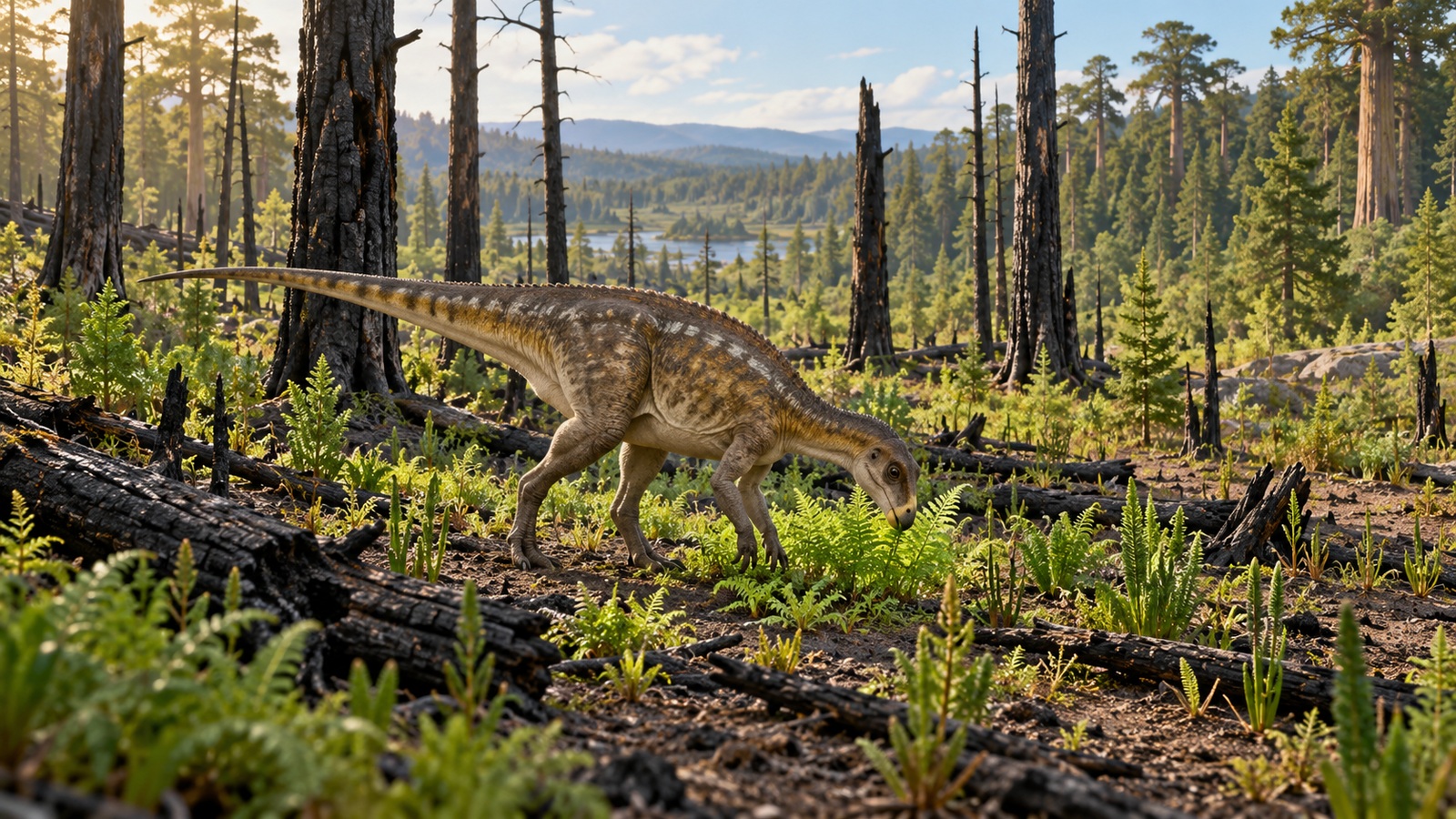
A river changed its course, a forest recovered after disturbance, or a coastline advanced across land that had supported a different community. On longer timescales, continents separated, plant groups diversified, and entire lineages rose or disappeared. Dinosaurs experienced these changes as populations spread across many generations, not as one unchanging collection of animals occupying a permanent Jurassic backdrop. Some responses involved moving into suitable habitat, others involved evolutionary changes, and still others ended in local or complete extinction. Distinguishing those outcomes is essential. Finding a dinosaur in a new setting does not automatically prove that its anatomy transformed there. The fossil record instead allows scientists to investigate how inherited traits, ecological opportunities, geography, and the pace of environmental change combined to shape the history of dinosaur life.
A: They show contrasting solutions: extensive processing in a tooth battery versus gathering food with a relatively light head.
A: It extended the area reachable by the head without requiring the entire heavy body to change position for every mouthful.
A: Its broad muzzle and front-mounted teeth formed a specialized gathering and cutting apparatus.
A: Its fossils showed that extensive filamentous feathering was compatible with a large tyrannosauroid body.
A: Similar food-processing tasks can involve different anatomy; the hadrosaur battery had its own tooth-to-tooth attachments and coordinated development.
A: Dinosaurs already existed; the study links environmental change with a later expansion and diversification.
A: Evolution can modify an existing structure for additional functions rather than inventing it for a distant future use.
A: A change in available resources could reduce the value of the task it performed especially well.
A: It can first change access or isolate populations; divergence, where it occurs, unfolds through their later histories.
A: Each changes how an animal meets a biological demand, while geography and environmental history determine where that benefit can operate.
Hadrosaur teeth kept a working surface through continual wear
Plant eaters faced a recurring mechanical problem: the equipment used to break up food wore down while the animal still needed to eat. Hadrosaurs developed tightly packed dental batteries, with several generations of teeth contributing to a coordinated system. The useful adaptation was not simply having a large tooth count. New teeth entered service while worn material was lost, maintaining a functioning surface over repeated feeding.
Research on the development of hadrosaur dental batteries found tooth-to-tooth attachments and extensive root resorption as the teeth became integrated. Ligaments connected neighboring teeth, allowing the battery to erupt and respond to chewing forces as a unit. This was an unusually elaborate modification of the attachment system seen more generally in dinosaurs. Growth and replacement were part of how the feeding apparatus worked, rather than occasional repairs to an otherwise static jaw.
Such equipment helped herbivores process vegetation, but it should not be described as a direct response to one newly appearing plant. Flowering plants spread unevenly through Cretaceous ecosystems alongside older plant groups. A robust feeding system could be useful across changing mixtures of food. Its value lay in sustained processing, not in proving that every hadrosaur ate the same plants.
Nigersaurus specialized in gathering low vegetation
The Early Cretaceous sauropod Nigersaurus illustrates another solution. Its broad muzzle carried teeth across the front of the jaws, creating a gathering edge very different from a tall, narrow browsing head. The detailed study of its skull and dentition interpreted the combination as suited to collecting and slicing relatively soft plants near ground level. Replacement could be extremely rapid, with an estimated interval as short as about a month. This specialization let a long-necked animal exploit a low feeding zone rather than requiring it to reach the treetops. It also imposed limits: a light skull and specialized cutting apparatus were not interchangeable with a heavy crushing jaw.
A long neck depended on more than extra length
Large sauropods could reach a substantial feeding area without moving their heavy trunks every time they took another mouthful. Their necks also gave different lineages access to vegetation at different heights. These advantages were supported by a combination of features. A relatively small head placed less load at the end of a long lever than a large chewing skull would have done.
Many sauropod vertebrae contained extensive air-filled spaces associated with the respiratory system. Mechanical research on pneumatic neck vertebrae investigates how this architecture reduced weight while retaining support in the loaded parts of the bone. The result was not a neck made from empty, unsupported tubes. Internal spaces and remaining bony structures formed a specialized lightweight framework.
Long-necked feeding therefore involved a linked set of adaptations rather than one miraculous body part. Feeding without extensive chewing helped keep the head small; skeletal lightening reduced the cost of supporting the neck. An animal could gain reach while accepting limits on the kind of food processing performed in its mouth. That combination helps explain why sauropods followed a different anatomical route from large herbivores with elaborate chewing batteries.
Yutyrannus shows insulation in a large-bodied predator
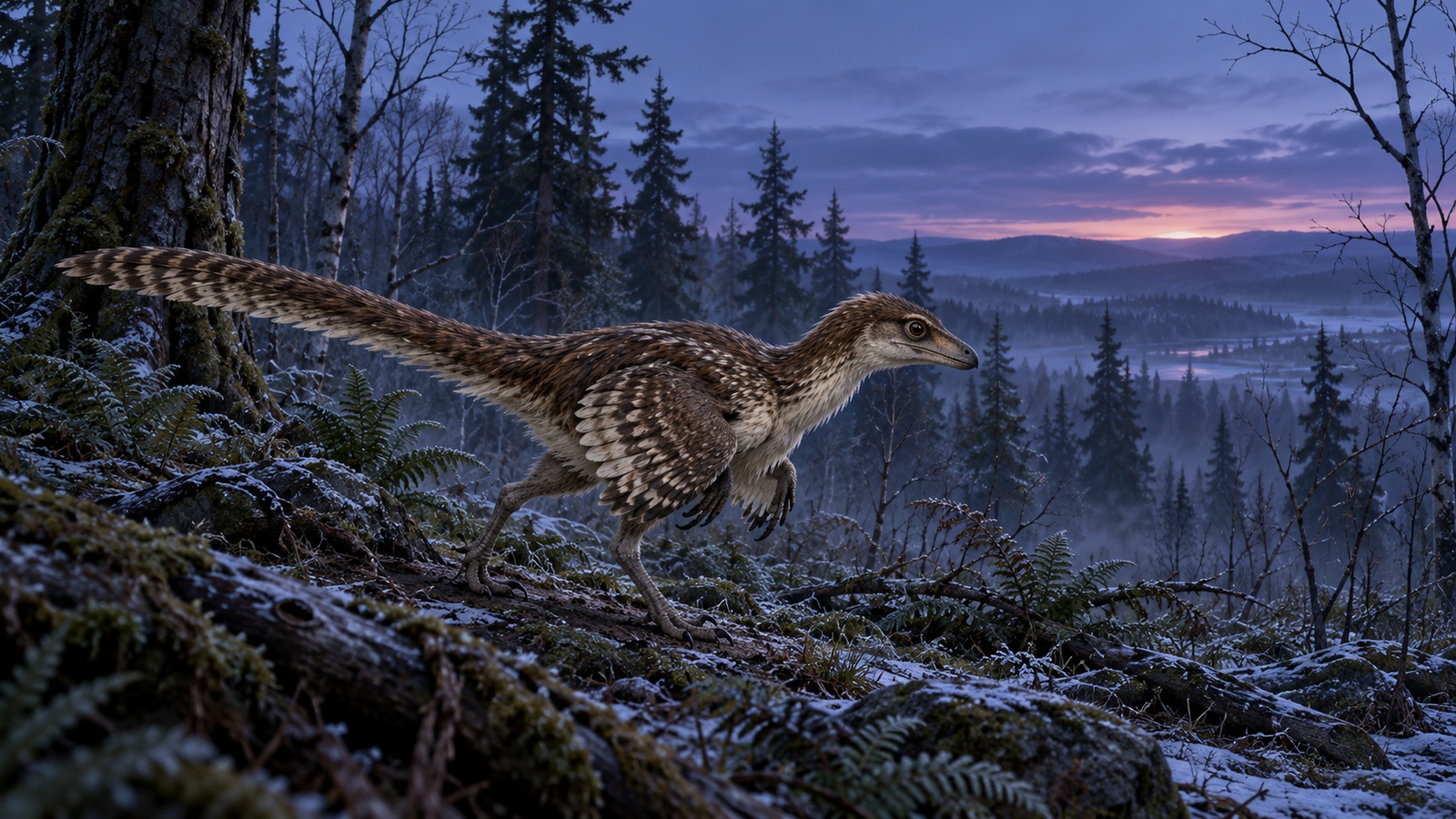
Feathers also provided possibilities beyond powered flight. Three Early Cretaceous skeletons of Yutyrannus from northeastern China preserve long filamentous coverings. Their original description demonstrated extensive feathering in a large tyrannosauroid, rather than only in tiny birdlike dinosaurs. A covering could trap a layer of air near the body and slow heat loss. The fossils make an insulating interpretation plausible, although they do not reveal a complete seasonal coat cycle or measure the animal’s body temperature.
This example is especially useful because size alone did not dictate one dinosaur exterior. A large predator could retain feathering, while other lineages had different coverings and thermal circumstances. A feature useful for temperature control could also change silhouette or visual display. Evolution could modify the distribution and structure of an existing covering without starting again with a wholly new material.
Geography changed where inherited solutions could be used
The breakup of Pangea and later continental rearrangement changed routes between habitats. A lineage could possess useful feeding or thermal features yet remain separated from another suitable area by sea or unfavorable terrain. Conversely, an opened route could let animals enter a setting their existing bodies could already use. This separates the biological equipment illustrated above from the geographic opportunity to deploy it.
A change in fossil distribution can therefore begin with arrival or departure rather than a new anatomical feature. Researchers compare the dates and locations of occurrences with reconstructed land connections, then examine the fossils for actual anatomical change. These records answer complementary questions: the map locates a lineage, while the skeleton reveals its structures. Keeping them distinct avoids attributing every expansion to an innovation that has not been found.
Separation could also redirect later evolution. A barrier might divide populations that had previously exchanged individuals, leaving their descendants in different ecological circumstances. The resulting histories could diverge even if the starting bodies were similar. Modern map distances hide some of those former connections, so ancient geography is part of explaining why related dinosaurs had different opportunities. A route did not need to alter a jaw directly to influence the lineage carrying it.
Environmental change operated on several clocks
A flood could rearrange a local channel in a short interval, while a regional shift in vegetation might unfold across many generations. Continental movement acted on a still larger scale. These processes created different opportunities for response. An individual could leave a damaged patch, but its descendants experienced the cumulative effects of inherited variation and changing population structure. The timescale of the evidence matters too. A rock layer may combine remains accumulated over an interval rather than preserve one instant. A sequence spanning a major transition can contain gaps. Before explaining an adaptive response, researchers need to establish how finely the environmental and biological records can actually be aligned.
Environmental upheaval could open opportunities for existing traits
The Carnian Pluvial Episode brought major climatic and ecological change during the Late Triassic, around 234–232 million years ago. A 2018 study combining skeletons and footprint records linked this interval with a major expansion of dinosaurs. In the Italian Dolomites, the tracked communities changed from dominance by other archosaurs toward much greater dinosaur representation. The authors argued that dinosaur diversification followed changes in climate, vegetation and competing herbivore communities.
This was an ecological opening, not evidence that rainfall immediately invented long necks or dental batteries. Dinosaurs already existed before the episode. Inherited capacities could become more useful when competitors disappeared or resources changed. The study concerns the circumstances of expansion rather than proving that one newly evolved feature caused every part of it.
The footprint component makes the ecological result particularly tangible: a changed walking community is recorded in the ground, independently of the anatomy illustrated by later skeletons. Its proportions can reveal a shift in which animals used a place, while the skeletons supply a separate view of their diversity. Reading those records together connects a climatic episode with an expanding dinosaur presence. It does not require a newly invented body part to appear at every step of that expansion.
Flexible resource use and specialization produced different risks
A lineage able to use several resources might retain options when one declined. A specialist could perform especially well while its preferred conditions persisted. Neither strategy guaranteed survival through every change. Their value depended on the nature of the disruption and the availability of alternatives.
Nor can flexibility be inferred simply because a lineage survived for a long interval. Persistence may reflect stable refuges, a broad distribution, favorable events, or incomplete sampling as well as ecological breadth. Evidence for particular resource use is needed to distinguish those explanations. A successful history should prompt investigation rather than serve as proof of one favored adaptation.
Community replacement differs from transformation within a lineage
A fossil sequence may show one set of animals replaced by another because populations arrived, departed, or disappeared. That pattern is not necessarily a series in which each species gradually changed into the next local form. Identifying ancestry requires anatomical and phylogenetic evidence beyond simple stratigraphic order. Likewise, a stable-looking community can conceal evolutionary change within its members. Separating community composition from lineage transformation prevents environmental history from becoming an unsupported ladder of progressively improved dinosaurs.
Inherited features could acquire additional jobs
A feather covering did not have to originate as a complete modern wing to become useful in the later history of flight. Filaments and more elaborate feathers occurred across different theropod branches. Changes in structure, placement and limb anatomy created new combinations. The history was branching, with different animals possessing different arrangements rather than marching through a single predictable sequence.
This helps explain adaptation without imagining an animal designing for its descendants. A structure useful in one setting could be modified and put to additional uses in another. Natural selection acted on the animals alive at each stage. It did not anticipate a future bird, a colder century or the next geological crisis.
The end-Cretaceous crisis exposed limits rather than a universal design flaw
Nonavian dinosaurs disappeared during the mass extinction around 66 million years ago, while some bird lineages survived. The disruption involved interconnected environmental and ecological effects rather than an examination of which animals were most advanced. A useful trait under ordinary conditions could become irrelevant when a supporting food web collapsed. Conversely, survival could depend on combinations of circumstances not represented by a single conspicuous feature. The Natural History Museum’s extinction overview places the event within this broader history. Its lesson is not that previous adaptations were meaningless, but that their benefits remained conditional on a functioning environment.
Adaptations solved particular problems rather than guaranteeing survival
Dental batteries maintained food-processing surfaces, specialized muzzles gathered different resources, lightweight necks extended reach, and feather coverings changed heat exchange. These were tangible biological solutions with costs and limits. Their benefits depended on the environment in which the animal used them.
Changing geography and ecosystems could favor existing combinations as well as newly evolved traits. The fossil record can sometimes identify a structure directly while leaving its earliest function uncertain. Those limits do not erase the adaptations themselves. They place the long survival of dinosaurs in a world where effective solutions could persist, acquire new roles or cease to be enough.